-
K :
-
an aircraft prefix under the Joint Service Designation System
that represents '(refuel) tanker'.
-
KA :
-
abbreviation for Known Associate; see PROVOCATEUR, DECOY, DANGLE,
CI, THROW-AWAY, LEGEND, LIFTED SKIRT, TRADECRAFT. [cf: the usual
suspects]
-
KABAR / KA-BAR :
-
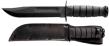
|
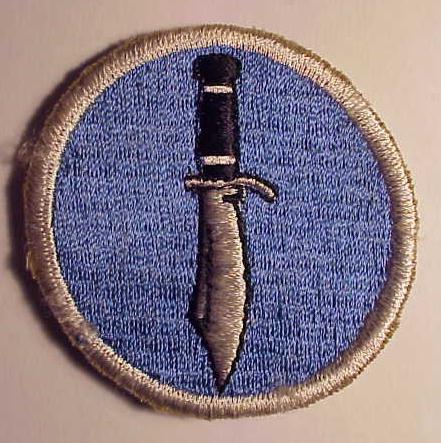
Mk-2 / M-2 fighting/utility knife
|
|
common name for the generic "combat knife", designated as 1219C2
(Mk-2 / M-2) by the US Navy and Marine Corps that was developed
in 1942 as a more practical replacement for the WWI-era Mk-1 /
M-1 trench knife; issued to "frogmen" (UDT/SEAL), Marines, and
shore-party sailors, this multi-purpose knife is a modified bowie
pattern with a single edge and clipped swedge point, featuring a
weight-reducing fuller (v: BLOOD GROOVE), a crossguard, a
butt-plate, and a stacked-leather haft with "sweat grooves" for a
secure grip. The original Navy version featured a plastic handle
and plastic scabbard, with the Marine version featuring a leather
handle and leather sheath. Although made by numerous contractors
[eg: Camillus, Union, Pal, Robeson (ShurEdge), Utica, Conetta,
Ontario, Case, etc], the brand name 'KaBar' (sometimes misspelled
"K-Bar") became synonymous with all versions of this knife,
government issue or private purchase. The KABAR was still the
underwater knife issued to SEAL teams during the VIETNAM WAR,
despite the availability of a non-magnetic Haynes Alloy
(nickel-titanium) demolition knife specifically designed for
underwater use. The basic pattern of this fighting/utility knife
has been updated (ie: "Next Generation") since the GULF WAR with
some high-tech features, such as a stainless alloy blade, Zytel
polymer grip, and Kydex thermoplastic scabbard. See KNIFE.
[nb: the KaBar brand name (KA-BAR Knives Incorporated of Olean,
New York, formerly Union Cutlery Company, a subsidiary of the
Cutco Corporation) is alleged to have been inspired by a
testimonial letter (1923) sent by a fur trapper who used his
knife to "kill a bear" after his rifle jammed]
[v: Knife Terms; The Language of
Swordplay]
-
KACHIN :
-
(Cachin) see JINGPAW RANGERS.
-
KADAI :
-
a family of languages related to the Thai group and spoken by a
small population in southern China and northern Vietnam.
-
KAFCA :
-
Keeping the Able from Contributing to the Action, being an
acronym coined during the Reagan Administration by Arthur Twining
Hadley, a Pentagon consultant, that represents an attempt by the
so-called Defense Establishment to make officers into managers
and soldiers into mediocre functionaries doing the bidding of
their superiors, which, together with interservice rivalry and
out-of-control procurement practices, leaves America woefully
unprepared and national defense bankrupt. [nb: this acronym is
probably an allusion to Franz Kafka, the Austrian writer of
The Castle, The Trial, and other existential works]
-
KAK :
-
abbreviation for Key-Auto-Key, being a form of cryptographic
logic that uses the key from one key set to produce another key
in a different key set; it's a method of automatic substitution
according to a variable schedule that permits rapid and accurate
encoding or decoding of discrete data by the use of a simple
computational device called a 'KAK WHEEL'.
-
KAK WHEEL :
-
a numeric-exchange calculator that was used by the team or
platoon leader to encipher and decipher map coordinates or other
essential information for inclusion in a regular (clear) radio
transmission [eg: "Blackhawk Six, this is One-Six; send log bird
ASAP to my location: I KAK: zulu, tango, alfa, alfa, lima, bravo,
delta, mike; over."]; this simple mechanical device was carried
around the RTO's neck on a thick cord, but was made obsolete
before the end of the VIETNAM WAR by a scrambler radio with
built-in encryption. See CODE, ENCODE, DECODE, SHACKLE, CIPHER,
ENCRYPT, DECRYPT, SCRAMBLE, NULLITY, ALPHABET SOUP, RADIO,
COMICS, GRID COORDINATES.
-
KALASHNIKOV / KALISHNIKOV :
-
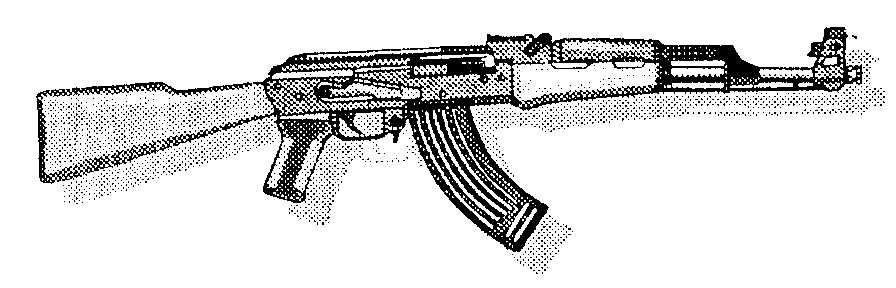
variously the AK-47, Type 56, or AKM (1959) assault rifle, which
are also known as "Kalash" (Kah-lash) and "AK" (AA-Kay, not
"ack") from Avtomat (automatic) Kalashnikov (designer); as
adapted from captured WWII German MP-43 and SPG-44 rifles using
the 7.62X39mm cartridge. After rigorous testing for reliability,
simplicity of operation, and ease of maintenance, this became the
standard rifle for Soviet infantrymen, then it became standard
for communists and revolutionaries around the world. Relatively
lightweight and compact, sturdy and reliable, it simplified and
speeded up training so more firepower could be introduced onto
the combat zone faster. It typically fired in full and
semiautomatic modes from a thirty round magazine, and its high
muzzle velocity contributed to its combat effectiveness, since
bullets were not deflected by foliage. The combination of these
effects plus its rapid-fire capability meant that accuracy was
not a major requirement, thus reducing the training time before a
soldier could be sent into combat. Most armaments analysts judge
the AK-47 to be superior to the U.S. M-16, which became the
standard weapon of American, South Korean, and South Vietnamese
troops. The AK-47 was more durable and less adversely affected by
the climate and conditions of Vietnam. There are numerous
accounts of American troops using captured AK-47 rifles, in
preference to their issue weapons, but the distinctive
Kalashnikov sound SIGNATURE was an invitation to "friendly fire"
incidents during the confusion of combat (THE FOG OF WAR). The
KALASHNIKOV was supplied to the VC and NVA by both the Soviet
Union (USSR) and Red Chinese (PRC / CHICOM). At the end of the
VIETNAM WAR, the AK-74 and AKM were introduced with a smaller
5.45mm caliber cartridge. See 7.62 MINIS, SKS, RIFLE, BAR, CAR,
SMG, ELDEST SON.
-
KALASHNIKOV KIDS :
-
an alternate designation, due to the ubiquity of the AK assault
rifle, for youths participating in a CHILDREN'S BRIGADE or BABY
BRIGADE (qv).
-
KANZUS :
-
(kansas) combined force from Korea, Australia, New Zealand, and
the United States; see SEATO, ASEAN, ANZUS, FWF, ATFV, AATTV, NZV
FORCE, NZATTV, ROK, KATUSA.
-
KARMA :
-
any action that brings inevitable results upon oneself, either in
this life or in a reincarnation; the cosmic principle according
to which each person is rewarded or punished in one incarnation
according to that person's deeds in the previous incarnation;
one's fate or destiny, and any associated emanations. [v: fate,
fortune, destiny, joss, kismet, moira, predestination, weird; che
sarà sarà ("what will be, will be"); que sera, sera
("whatever will be, will be"); cf: appointment in Samarra] [v:
alea jacta est (Latin: the die is cast)] [nb: "You only live
twice -- once when you are born, once when you look death in the
face." by Ian Fleming (1964)]
-
KATN :
-
abbreviation for "Kick Ass Take Names", which is the function and
unofficial motto of the military police; see KICK ASS, AP, MP,
SP, QC, CHIMPS.
-
KATUSA :
-
(kah-too-suh) Korean Augmentation Troops with the U.S. Army,
later changed to Korean Augmentee To the U.S. Army; being a
partnership program initiated during the KOREAN WAR to improve
the performance of ROK troops, which were integrated into
American units. Although still practiced, these assignments are
now reserved for privileged Koreans with superior skills, better
education, and higher social status. Although successful, this
program was not replicated in Vietnam, but used ADVISORs and
companion units instead. See STRIKER, OMLT, BUDDY SYSTEM; compare
DOUBLE FORCE. [v: geminate]
-
KBA :
-
Killed By Air; also cited as Killed By Artillery. See KIA, DOW.
-
KCS :
-
abbreviation for Kit Carson Scout (qv); see HOI CHANH,
ROADRUNNER, EARTH ANGEL.
-
K-DAY :
-
Convoy-Day; the unnamed date for the introduction of a convoy
system on any particular convoy lane. See CONVOY, TIME.
-
KD RANGE :
-
Known Distance Range; not "Knock Down", despite the use
of "pop-up / knock-down" silhouette targets to assist in scoring.
The firing range CADRE informed all trainees that the shooting
principles for practice are identical to those used in combat,
except the targets are the "pop-up / shoot-back" type. See ZERO,
BASS, SIGHT PICTURE, DRY FIRE, RIFLE, SMALL ARMS, RED FLAG, BOLO,
MAGGIE'S DRAWERS, FLYING BRAVO. [v: Firearms Glossary]
-
KEDGE :
-
a small auxiliary ANCHOR of traditional configuration, having
flukes perpendicular to the stock and connected by a shank. Also,
to move a stranded ship into deeper water by advancing it in
stages along the anchor line of a kedge deployed from a
dispatched boat; also called "kedging", being a method of
incrementally warping a load along a waterway by anchor line
hauling from one secure point to another.
-
KEEL :
-
a central fore-and-aft structural member in the bottom of a
ship's HULL extending from the stem to the sternpost; see STRAKE,
FREEBOARD, CAREEN. [nb: in Asia it's known as a "dragon's spine"]
[v: even keel (steady); keel over (capsize)]
-
KEELHAUL :
-
formerly, to drag an offender from stem to stern beneath a ship's
keel, a punishment which often proved fatal, but now meaning to
rebuke severely. See ROCKS 'n' SHOALS, CAPTAIN'S MAST, UCMJ,
BRIG, DRUMHEAD, OVER A BARREL, WALK THE PLANK, GAUNTLET, GARROTE,
DEATH OF A THOUSAND CUTS, TWIST IN THE WIND, PAIN.
[nb: criminals on sailing ships were once lashed to the bowsprit
until they perished, as a form of maritime crucifixion]
Also, the operational CODENAME for the post-WWII forced
deportation and repatriation of eastern European POWs, DPs, and
refugees (including Russians, Cossacks, Slovenians, Croats,
Serbs, and others) into subjugation behind the IRON CURTAIN
during 1944-47 as a result of the Allied agreements at the Tehron
and Yalta conferences, affecting millions of innocents who were
systematically exterminated in labor camps; see CONCENTRATION
CAMP, GULAG.
-
KEEN / KEENING :
-
see ULULATE / ULULATION.
-
KEEP A STIFF UPPER LIP :
-
an admonition against showing trepidationor agitation, as when
resisting the natural tendency to tremble when alarmed or
fearful; to bear difficulties or danger with imperturbability and
fortitude; to act in a determinedly resolute or an unemotionally
stoical manner; a 19th century Americanism for the British idiom:
"Keep your pecker up." See CLEAR AND PRESENT DANGER, DON'T SWEAT
THE SMALL STUFF, PUSH COMES TO SHOVE, BITE THE BULLET, SUCK IT
UP, A MAN'S GOTTA DO WHAT A MAN'S GOTTA DO, WHITE-KNUCKLE,
MAN-UP, DIEHARD, FORTITUDE, FIGHT-OR-FLIGHT, RISKY-SHIFT EFFECT.
-
KEEP THE FAITH :
-
signifier or closure exchanged with fellow servicemembers,
especially combat veterans, expressing loyalty and fidelity; used
in the same manner as Marine use SEMPER FI. Derived from "I have
fought the good fight, I have finished the course, I have kept
the faith." [2 Timothy 4:7]. See UCGC, ESPRIT DE CORPS, MORALE
PATCH, PECKER CHECK, OATH. [nb: "If ye break faith with us who
die / We shall not sleep, though poppies grow / In Flanders
fields." by John McCrae (1915); "If you keep the faith, good
things will eventually come to you." by Elmer Kelton (2002); "We
can no more pick our wars than pick our comrades, and while we
would prefer that some things be different or results be
otherwise, all we can do is our duty, keeping our honor clearly
in mind." anonymous]
-
KEEP YOUR EYES PEELED :
-
an idiomatic admonition to stay alert or to be wary; this
Americanism first appeared (ca1833) as "keep your eyes skinned"
in frontier Kentucky, but was later amended (ca1853) among
pioneers in St. Louis; the reference is to watchfulness made
vigilant by the removal of one's eyelids. See HAIRY EYEBALL,
EYE-BALL / EYE-BALLING, DOUBLE-O, CHECK IT OUT, VR, EYE-CHECK,
STACKING SWIVEL. [v: Bodhidharma]
-
KEEP YOUR FRIENDS CLOSE AND YOUR ENEMIES CLOSER :
-
admonitory quote by Sun-Tzu on the strategy of relationships;
often misattributed to Niccolò Machiavelli. See KNOW YOUR
ENEMY.
-
KEEP YOUR POWDER DRY :
-
an admonition to be prepared for action, to remain resolute and
steadfast; from the fact that early gunpowder was often impure
(containing both calcium nitrate and potassium nitrate [niter],
with the former prone to absorb moisture), which would fail to
ignite if damp or wet. This phrase ostensibly comes from an
address by Oliver Cromwell to his troops before a river crossing
during his campaign in Ireland, concluding: "Put your trust in
God, my boys, and keep your powder dry."; however this apocryphal
attribution was only later made by Valentine Blacker in 'Oliver's
Advice', Ballads of Ireland by E. Hayes (1856). [v: "Keep
your powder dry and your dauber up!" American maxim]
-
KEEP YOUR SHIRT ON :
-
a popular 19th century Americanism for remaining undisturbed or
unperturbed, which derived from the practice of removing one's
coat and shirt when answering a challenge to a fight or DUEL;
this precaution of calm tranquility later led to it being an
admonition against haste or hurry, rashness or recklessness. See
APPEASE, PACIFIST, PEACE; compare FIGHTING WORDS, TRAILING HIS
COAT, BLOODY SHIRT, HAIR-TRIGGER, HALF-COCKED, SABER-RATTLING,
RAMPAGE.
-
KEG :
-
a keg party, or so-called "beer bust"; also known as a "kegger".
Also, a small cask or barrel, usually containing 5-10 gallons
(19-38l) in wet measure or 100 pounds (45kg) in dry measure. See
CANTEEN, LISTER BAG, POD, WATER BUFFALO, BLIVET, BLADDER.
[v: cask, vat, tun, butt, drum, hogshead, barrel, tank, rundlet,
kilderkin, puncheon, keg, carboy, breaker, jug, tub, firkin,
salmanazar, pottle, flask, pony, gill, pot, flagon, bottle,
demijohn]
-
KEK :
-
Key Encryption Key, being a key that encrypts or decrypts another
key for transmission or storage; compare KAK, see KEY.
-
KELLOGG-BRIAND PACT :
-
a bilateral defense pact advanced by the French foreign minister
Aristide Briand and Frank B. Kellogg, the American Secretary of
State, as the culmination of an idea promoted by Professor James
Shotwell that war itself be outlawed; the 1928 alliance (General
Treaty for the Renunciation of War) is known to be unenforceable,
but becomes a sort of multinational goodwill pledge that's
eventually signed by 62 countries. See PEACE, APPEASE, PACIFIST,
REPRISAL, RETALIATION, NEUTRAL.
[nb: after WWI, many of the Lost Generation took the Oxford oath,
which many fascists and communists viewed as implicit
appeasement, if not an explicit warrant, for political hegemony
leading to WWII; this pacifistic pledge declared: "We solemnly
swear that we will never take up arms in defense of our country.
We will never take up arms, even in defense of our country."; a
more extensive pledge was promulgated by 1935: "If war comes, I
will not fight; if war comes, I will not enlist; if war comes, I
will not be conscripted; if war comes, I will do nothing to
support it; if war comes, I will do everything to oppose it, so
help me God."]
-
KELOID / CHELOID :
-
(keeloyd) an abnormal proliferation of scar tissue, as at the
site of an injury, radiation, or surgical intervention; as
derived from "stain" or "spot"; see SCAR. [nb: Negroes are prone
to more pronounced keloidal development than are Caucasians]
-
KENTUCKY WINDAGE :
-
a colloquialism for DEFLECTION; see DEAD-RECKONING, LEEWAY, SIGHT
PICTURE, SNAP-IN, DOPE, COMBAT ZERO, ZERO, GUN CONTROL.
-
KEPI :
-
a military cap with a circular, flat-topped crown and a nearly
horizontal visor, being a style adopted in the mid-19th century
from the French (képi) and Swiss (käppi) FIELD CAP;
see HAVELOCK, HEADGEAR. [nb: while symbols of rank or branch have
often been displayed on the front of these caps above the visor,
their flat top served as the initial site for the display of unit
insignia during the American CIVIL WAR, probably because it could
be most easily read by a commander mounted on horseback, so as to
identify his own unit members]
-
KERCHIEF :
-
a woman's square scarf worn as a covering for the head and/or
sometimes the shoulders; derived as a syncopated variation of
'keverchef / cuevrechef' meaning "head covering". Also, a
handkerchief, as a cloth used for personal grooming. Also, a
neckerchief (NECK SCARF), as a cloth worn around the neck. See
SNOT-RAG, BUSH HANKY, BUSH OYSTER, POCKET LITTER, SNIVEL GEAR,
CREATURE COMFORTS. [v: kerchief, pocket-square, bandana,
fascinator, do-rag, nubia, shawl, scarf, stole, tippet, fraise,
muffler, neckerchief, neck gaiter, neck sock, wiper, sudarium,
napkin, napery, serviette, handkerchief, tissue, Kleenex,
mouchoir, smallclothes, hanky; cf: veronica]
-
KETCHUP :
-
a CONDIMENT consisting of puréed tomatoes, onions,
vinegar, sugar, and spices; trademarked by Heinz in 1876, it's
also spelled catchup or catsup. Also, in a generic sense, any of
various other sauces (eg: mushroom ketchup, walnut ketchup, etc)
that're used for meat, fish, or other foods; as derived from
Malay fish sauce ('kechap') and akin to Chinese eggplant juice.
See COCKTAIL SAUCE, NUOC MAM. [cf: pesto; v: katsap at IVAN]
-
KETTLE-BOTTOM / KETTLE-BOTTOMED :
-
NavSpeak denoting a wide, flat-bottomed hull formerly used for
merchant sailing vessels; see SCOW, LIGHTER, PONTOON, SKIMMER,
TUB, BUCKET, BOAT.
-
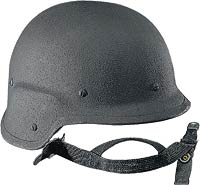
KEVLAR :
-
a synthetic aramid fiber (extruded long-chain polyamide) that was
patented in 1971, and has since been used for body and splinter
armor; see K-POT, GANTLET, HAPPY SUIT, HILLBILLY ARMOR. Also,
MarSpeak for the lightweight K-POT helmet. [nb: it's been well
established that the effectiveness of Kevlar is significantly
degraded when saturated with water]
-
KEW :
-
(cue) Kinetic Energy Weapon; see FAE, DU, STABALLOY.
[cf: potential energy]
-
KEY :
-
an information set, usually a sequence of random or pseudorandom
binary digits, that's used to initially set up and to
periodically change the operations performed in cryptographic
equipment for encrypting or decrypting electronic signals, for
determining electronic counter-countermeasures' patterns (eg:
frequency hopping or spread spectrum), or for producing other
keys. See KAK, KEK, CODE, ENCODE, DECODE, SHACKLE, CIPHER,
ENCRYPT, DECRYPT, SCRAMBLE, NULLITY, HASHING, ALPHABET SOUP,
RADIO, COMICS, GRID COORDINATES. [nb: the term 'key' has replaced
the terms "variable", "key(-ing) variable", and "cryptovariable"]
Also, something that secures or controls access, such as a
mechanical or electronic entry device; see SWIPE CARD, CAC, PIC,
PASSWORD, UNDER LOCK 'n' KEY, WARD, DOUBLE DUTCH. [cf: dongle]
Also, that (nonexistent) device used to access and operate a
military vehicle (eg: JEEP, TRUCK, APC, TANK, BOAT, BIRD, etc); a
nonexistent object that a novice or tyro is required to obtain in
the same manner as any other SNIPE HUNT objective; compare
MERMAID, DRAGON. [nb: despite the fact that military vehicles
must be accessible to anyone in a tactical situation, some
civilian vehicles, painted in military livery and used to convey
senior officers or visiting officials, are activated by an actual
'key', but these are the exception that proves the rule for the
majority]
-
KEY CONTROL :
-
accountability of the physical or electronic devices which
restrict access to select areas or secure government property
belonging to a unit; a responsibility assigned to the unit's
supply (S-4/G-4/J-4) officer, the duty officer (OOD), or the
charge of quarters (CQ).
-
KEYHOLE :
-
by reference to the aperture in a key lock, snooping or intruding
into extremely private information; see KH, SAT.
-
KEYHOLE / KEYHOLING :
-
informal reference to the elliptical or elongated imprint upon a
paper or cardboard target that demonstrates the fact that a
BULLET was not traveling point first, did not fly true along its
trajectory, and so did not impact the target cleanly (which would
leave a perfectly round hole); this defect in ammunition design
or manufacture contributes to inaccuracy, albeit delivering a
more severe wound (due to tumbling) when the bullet does actually
hit an enemy. The M-16 rifle bullet is notorious for this trait,
especially when disturbed by eddies and crosswinds or leaves and
twigs, while the M-1911A1 pistol bullet is famous for its
stability. See YAW.
-
KEYING MATERIAL :
-
key, code, or authentication information for transmission or
storage in physical or magnetic form.
-
KEYMOD :
-
a contraction of KEYhole MODular mounting system, being an
open-source component accessorization system developed by VLTOR
Weapon Systems of Tucson (AZ), and later (July 2012) released to
the public domain for adoption by the entire firearms industry;
KeyMod was designed to be superior to the military's weighty and
non-ergonomic PICATINNY RAIL, because the KeyMod resists recoil
and counter-recoil slippage by the close-tolerance of the
chamfered slot and stepped nut interface.
-
KEYSTONE :
-
the operational CODEWORD for the series of RETROGRADE increments,
spanning the period July 1969 - November 1972, by which the U.S.
Army was withdrawn from Vietnam; further subdivided by stages,
as: Keystone Eagle, Keystone Cardinal, Keystone Bluejay, Keystone
Robin, Keystone Oriole, Keystone Mallard, Keystone Owl, and so
forth. A unit was "keystoned" when it turned in its equipment and
moved to port; or a support element was "keystoning" by effecting
the transfer of another unit's men and materiel. See ACTOV,
CRIMP, CSMO, PROVN, VIETNAMIZATION. Also,
(forthcoming)
joint doctrine includes plans, command and control,
communications, computer systems, intelligence, operations,
logistics, and personnel; see CAPSTONE, USJFCOM.
-
KEY TERRAIN :
-
certain terrain, such as high ground or defiles, that when
occupied or controlled, gives the holder a distinct tactical
advantage; compare STRONGPOINT, ACP, CHOKE POINT.
-
K-50 / K-50M :
-
a revised version of the Red Chinese Type 50 submachinegun (SMG)
that was manufactured by North Vietnam; with a variety of
specimen models as influence, the lighter weight K-50 even
improved on the original Soviet PPSh-41 BURP GUN. The K-50
reduced the length of the barrel on the Type 50 and shortened the
BARREL SLEEVE to only three inches, adding a pistol grip,
introducing a foresight imitative of the French MAT-49, and
replacing the non-collapsing wooden buttstock with a skeletonized
steel-wire type ... all of which reduced its weight by over a
pound. Furthermore, this version restored the SMG's acceptance of
both the box and drum (with wire stock retracted) magazines, as
per the original Russian model.
-
KFS :
-
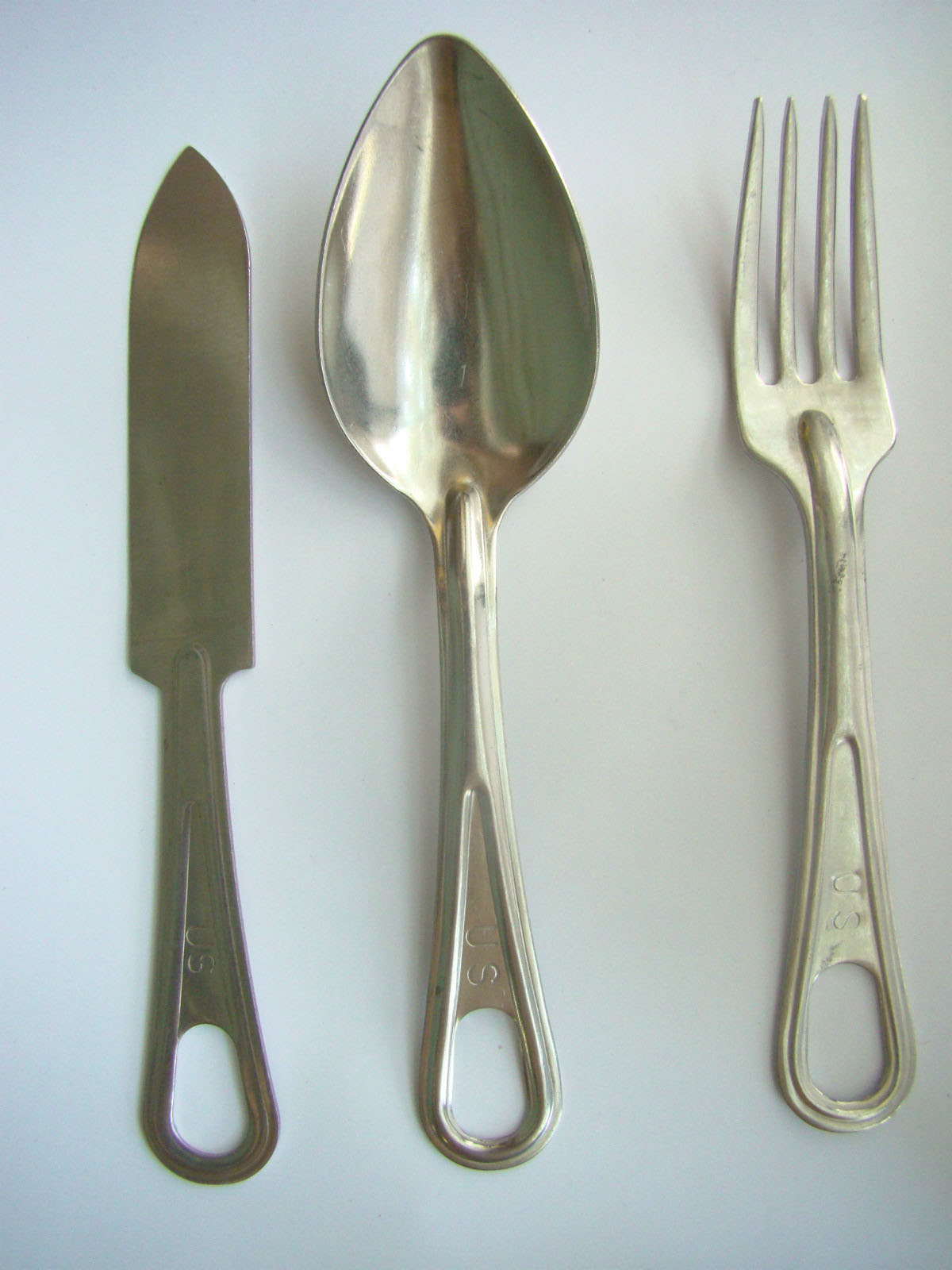
abbreviation for Knife, Fork, Spoon; being the complete set of
eating utensils associated with civilized dining, hence only ever
encountered in a MESS or GALLEY, and during a command (CMMI or
IG) inspection! A soldier in the field reduces weight and
eliminates noise by carrying only a SPOON (also known as the
PARTISAN'S SECRET WEAPON!). See FORK, KNIFE, CHOPSTICK, FRED,
P-38, CHURCH KEY, MESS KIT, CANTEEN CUP, MESS TRAY, COVER,
RATIONS.
[nb: spork is a spoon with tines added; splade / splayd is a
knife, fork, and spoon combined into one device, consisting of a
tined spoon with a sharpened edge; sporf is an all-purpose term
for any hybrid of spoon, fork, and knife; knork is a fork with a
knife-like cutting edge; knifork is a knife and fork combo that's
typically configured as a rocking-knife with tines; knoon is a
combination knife and spoon utensil; spife is a spoon with a
knife on the end; chork is a set of chopsticks that can be
reversed into a fork]
[nb: the small knife ("sgian dubh") that's tucked into the top of
the stocking, below the skirt of the kilt, that's typically
crafted by frugal Scots from broken weapons or scrap metal, is
traditionally used when skinning or eating; it is sometimes
called a "black knife", not for any sinister or devious usage,
but due to its coarse or inferior metal, which contrasts with the
brightly polished finer metal used in weapons] [v: napery,
serviette]
-
KH :
-
abbreviation for KeyHole, the series of surveillance and
intelligence gathering satellites that can produce high quality
photographs; as derived from intrusively revealing, as if spied
through a private keyhole.
-
KHA :
-
Killed in Hostile Action; see KIA, DOW, NOK.
-
KHAKI / KHAKIS :
-
a yellowish brown or tawny summer-weight CLASS-A uniform made of
cotton twill; also called 'suntan' / 'suntans' / 'sun-tan' /
'sun-tans'. The short-sleeved KHAKI shirt had breast pockets and
EPAULETs; KHAKI trousers were usually four pocketed and long, but
KHAKI shorts with knee-socks were experimental during the early
1960's. The Army had no matching beige-colored HEADGEAR, but the
Navy and Air Force did. A privately purchased alternative of the
era was "tropical worsted wool" (TWs) in a slightly darker shade
of light brown; which uniform was both more comfortable and more
attractive than cotton KHAKIS. In 1846, the white British Army
uniform was dyed "dust brown" to match the color of the desert
dirt in India, and is considered to be the first camouflage
uniform. See DRESS, CAMMIES, CAMO, PATCH. [cf: bisque
(pinkish-tan)]
-
KHAKI MAFIA :
-
slang for the "old boys club", for the "movers and shakers", for
henchmen and minions, especially RING-KNOCKERs and other
self-protective MILICRATs; any exclusionary in-group (eg: Bataan
Gang of MacArthur sycophants), but may extend to overtly criminal
rackets engaged in BLACK MARKETeering. As with organized-crime
families [v: FAMILISM], there isn't a single monolithic
structure; so the KHAKI MAFIA (also spelled "maffia" for clique;
also known as "the group", "the outfit", "the organization", or
"the mob") is composed of the "Airborne Mafia", the "Armor
Mafia", the "Aviation Mafia", the "Submarine Mafia", the "Mormon
(Church of Jesus Christ of Latter-day Saints) Mafia", the
"Freemason (Free and Accepted Masons) Mafia", the "Shriner
(Ancient Arabic Order of Nobles of the Mystic Shrine, an
auxiliary of the Masonic order) Mafia", and other subsets which
are dedicated to their own preferment and advancement. See RABBI,
PATRON SAINT, SEA DADDY, BOY'S CLUB, THE ESTABLISHMENT, CASTE,
THE UNHOLY TRINITY, SIX DEGREES OF SEPARATION, RHIP, ROUGHSHOD,
LOYALTY UP - LOYALTY DOWN, HANG HIS STOCKING, CARPETBAGGERS.
[v: pickthank; cf: apparatchik, nomenklatura, eunuch, nabob,
nibs] [v: 'claque' for group or coterie of BROWN NOSERs]
[nb: every MILICRAT knows that the most dangerous people in the
military are not HEROes, but are disgruntled MIL-PERS who are
frustrated by MICKEY MOUSE and CHICKEN SHIT, by SNOW and RED
TAPE, and having been passed over twice for promotion, are
serving their terminal assignment, and because they are honorable
men who have not STACKed ARMS, they know that there is nothing
that the TICKET-PUNCHERs and RING-KNOCKERs of the KHAKI MAFIA can
do to them!]
-
KHAO PIAK SEN :
-
in Laotian cuisine, a beef or chicken broth seasoned with savory
herbs, accented by lime juice, chili oil, and cilantro
(coriander), garnished by bean sprouts, basil, long beans, and
containing flat rice noodles; this Lao noodle soup is the Laotian
version of Vietnamese PHO (qv).
-
KHAO PUN :
-
in Laotian cuisine, a sweet and spicy coconut soup (nam kathi)
containing rice noodles, pounded fish, chicken or pork, garnished
with lime leaves and shallots, seasoned with herbs, fish sauce,
ginger, garlic, perilla (mint), and chilies that's simmered for a
long time; compare TOM KHA KAI, MOHINGA.
-
KHMER REPUBLIC :
-
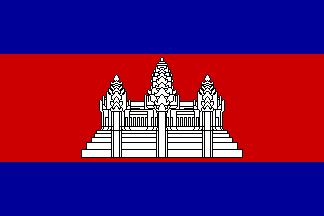
|
Kingdom of Cambodia
People's Republic of Kampuchea
|
|
|
Khmers are traditionally the ethnic majority who inhabit Cambodia
and parts of Thailand and the Mekong delta. [nb: 1847 - Kingdom
of Cambodia (Ang Duong) Angkor Wat emblem on coin; 1863 - Kingdom
of Cambodia (Ang Duong) national flag; 1947 - Kingdom of Cambodia
(Norodom Sihanouk Varman) monarchy promulgated democratic
constitution and universal suffrage; 1948 - Kingdom of Cambodia
(Norodom Sihanouk Varman) new flag; 1954 - Kingdom of Cambodia
(Sihanuks); 1970 - Khmer Republic (Lon Nol); 1975 - Kingdom of
Cambodia (Khmer Rouge); 1976 - Democratic Kampuchea (Pol Pot, et
al); 1979 - People's Republic of Kampuchea [or Kampuchea Popular
Republic] (Heng Samrin, Hun Sen, et al); 1989 - State of Cambodia
(Heng Samrin, Hun Sen, et al); 1991 - State of Cambodia under
provisional UN administration; 1993 - Kingdom of Camdbodia
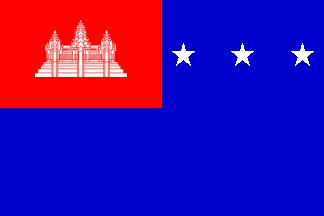
(Norodom Sihanuk). The colors of the national flag represent blue
for royalty, leadership, or contentment; red for the nation,
people, or courage; white for religion (Brahmanism / Buddhism),
faith, or righteousness. The principal emblem has been ANGKOR
WAT. The three stars in the flag of the Khmer Republic variously
represent: people / religion / government, upper / middle / lower
country, triple jewel of Buddhism (Dharma / Prajna / Sandhi),
three branches of government. The present design of horizontal
bands was adopted on 29 October 1948 until 9 October 1970, then
again on 30 June 1993, with the royal coat of arms on 21
September 1993, in preparation for the reestablishment of the
monarchy on 24 September 1993. The royal coat of arms show two
cups, one placed over the other; above them a sacred sword,
placed horizontally, surmounted by a symbol representing "om",
the sound of creation. Beneath the whole, two laurel branches are
united at the bottom by the star of the Royal Order of Cambodia.]
-
KHMER ROUGE :
-
literally "Red Khmers"; the forces of the Cambodian
Communist Party, or of the communist Cambodian Liberation Army.
See CLA.
-
KHMER SEREI :
-
Free Khmer, Cambodian resistance group; see KKK, FARK.
-
KHONG BIET :
-
see KHUNG BIET.
-
KHONG LAU :
-
(kohng laow) colloquial Vietnamese for 'never happen' (pronounced
"Nevah hoppin!", such as a day off from assigned duty, or filling
an inside straight flush, or winning the sweepstakes.
-
KHUNG BIET :
-
(kahm bick / kuhng bee-ech) Vietnamese phrase for "unknown" or
"not understood", as in "Toi khung biet."; sometimes Americanized
as "cam biet" or misspelled "khong biet"; compare BIET. [cf:
'cham mai khao chai' (Thai): "I don't understand.']
-
KIA :
-
(kay-eye-ay) abbreviation for Killed In Action; Vietnamese term:
Tu Tran. See DOW, WALKING GHOST, PH, BODY COUNT, WASTED, ZAPPED,
BUY THE FARM, PUSHING UP DAISIES, BITTER END, SPLASH, KBA, KHA,
BODY BAG, LAID BY THE WALL, ZULU, RINGS OF SORROW, NOK, DUSTOFF,
MEDEVAC; compare WIA, GSW, GSW-TTH, MILLION DOLLAR WOUND,
PROFILE, LINE OF DUTY, SIW.
[nb: allegedly, due to the undeclared status of the VIETNAM WAR,
allied combat deaths were officially classified as "Killed in
Hostile Action" (KHA), and enemy combat deaths were formally
designated as "Killed In Action" (KIA); but such a legalistic
distinction is supposed to regulate the award of "combat only"
decorations. Allied deaths total approximately 300,000
servicemembers, and the enemy is estimated to have lost 1.4 - 2
million military dead during the Second INDOCHINA War (1954-75).]
[ie:
War of Independence (1775-83): 25,000 battle deaths;
Quasi-War with France (1798-1800): 20 battle deaths;
Barbary Wars (1801-15): 35 battle deaths;
War of 1812 (1812-15): 20,000 battle deaths;
First Seminole War (1817-18): 30 battle deaths;
Second Seminole War (1835-42): 1,500 battle deaths;
Mexican-American War (1846-48): 13,283 battle deaths;
Third Seminole War (1855-58): 26 battle deaths;
Civil War (1861-65): 623,026 battle deaths;
Indian Wars (1865-98): 919 battle deaths;
Spanish-American War (1898): 2,446 battle deaths;
Philippine War (1898-1902): 4,196 battle deaths;
Boxer Rebellion (1900-01): 37 battle deaths;
Mexican Revolution (1914-19): 35 battle deaths;
Haiti Occupation (1915-34): 146 battle deaths;
World War I (1917-18): 116,708 battle deaths;
World War II (1941-45): 407,316 battle deaths;
Korean War (1950-53): 36,914 battle deaths;
Vietnam War (1964-73): 58,169 battle deaths;
El Salvador (1980-92): 20 battle deaths;
Beirut (1982-84): 266 battle deaths;
Persian Gulf Support (1987-88): 39 battle deaths;
Invasion of Grenada (1983): 19 battle deaths;
Invasion of Panama (1989): 40 battle deaths;
Persian Gulf War (1991): 269 battle deaths;
Somalia (1992-93): 43 battle deaths;
Bosnia (1995): 12 battle deaths;
Afghanistan (2002-10): 1,084+ battle deaths;
Iraq (2003-10): 4,400+ battle deaths]
-
KICK :
-
informal term used to mean RECOIL, being the distance through
which a weapon moves backward after discharging; the physical
rebound resulting from undergoing a change in momentum ... "every
action has an equal and opposite reaction". See BASS, SPOT WELD,
OFF HAND, BURST, DOUBLE TAP, TRIPLE TAP, HAMMER, FIREPOWER,
SILENCER, PROLONGE. [v: Firearms Glossary]
-
KICK ASS / KICK-ASS :
-
a literal or figurative colloquialism for abuse or coercion,
torment or duress, intimidation or compulsion, inducement or
excoriation; see KATN, CALL ON THE CARPET, BLISTER, FANG, VERBUM
SAP, BROWBEAT, BAYONET SHEET, FLAME, HAWK, ATTITUDE ADJUSTMENT.
[v: comeuppance]
Also, complimentary slang expressive of admiration or
approbation, especially among aviators and other aircrew;
probably derived as a truncation of "That kicks my ass!", and is
used in the same manner as BRAVO ZULU; see GOOD STICK, SHIT-HOT,
ATTABOY, A-1, WARM FUZZY, GLORY PIE, BRAGGING RIGHTS, TROPHY. [v:
fanfaronade]
-
KICKAPOO JOY JUICE :
-
the illicit liquor made by the character Big Barnsmell at the
"Skonk Works" manufactory in Al Capp's comic strip Li'l
Abner; see SKUNK WORKS, HOOCH.
-
KICKBACK :
-
see INVEIGLE / INVEIGLEMENT.
-
KICKER :
-
slang designation for a DROPMASTER or LOADMASTER who performs an
AIRDROP, LOW-LEVEL EVACUATION DROP, or KICK-OUT of the PAYLOAD so
as to effect a tactical resupply by air to ground elements; see
CREW CHIEF, HATCH, RAMP, TAILGATE, LZ, DZ, COMBAT LOADED, BB
STACKER, BAILOUT.
-
KICK-OUT :
-
to deliver essential equipment or necessary resupply to a unit in
the field by quickly throwing packaged goods out of the door or
HATCH of a slow moving airplane, usually a hovering CHOPPER but
any capable BIRD, from SKYMASTER to BRONCO, will suffice during
an emergency. A KICK-OUT is performed as low to the ground as
possible (to spare damage to the delivery), and at the center of
a PERIMETER (which is usually too small for an AIRDROP), and
under adverse conditions (typically receiving SMALL ARMS if not
antiaircraft (AA) fire), since a proper and secure LZ would be
established if time and opportunity permitted. See TAILGATE,
COMBAT LOADED, COOPER VANE, LOW-LEVEL EVACUATION DROP.
-
KICKS :
-
slang for government issue (G.I.) shoes; see LOW-QUARTERS.
-
KICKSTANDED :
-
compulsory, mandatory, or forced retirement of a professional
MIL-PERS, also spelled "kick-standed"; based upon the
powerlessness of a fully functional motorcycle prevented from
operating by elevating the spinning drive-wheel with a kickstand.
This expedient method of disarming a politically embarrassing
situation is supposedly more fair to the individual, since they
are not punished or denied accrued benefits; but it is quite
unjust and cowardly, since the person is presumed guilty and
dishonored by the arrogation. See CYA, DODGE THE BULLET, CHOP,
VULCANIZE, RIF, SHOOT YOURSELF IN THE FOOT.
-
KICK THE CAN DOWN THE ROAD :
-
a catch-phrase for postponement, as when delaying a decision or
putting off some action by holding it in abeyance; to defer a
conclusive solution by procrastination, by engaging in short-term
postponements or delays; a decision or action awaiting a more
appropriate time or circumstance for dealing with it ... the
putative 'can' being displaced is the proverbial "can of worms".
[nb: the verb phrases "kick about" and "kick around" have meant
wander or roam aimlessly since the early 19th century, and the
"kick the can" game is a variant form of "hide-and-seek" (qv)
that allows the captives to escape, thus delaying the end of the
game]
-
KILL BOX :
-
a three-dimensional area that's used to facilitate the
integration of joint fires; being a hypothetical abstraction
that's positioned to encompass the TARGET, whether fixed or
mobile, horizontal or vertical, personnel or vehicles, which is
the most effective target area that can be projected for select
munitions capable of delivery by available assets within the
given time constraints. This theoretical ideal of sufficient
force without the expenditure of excess or inappropriate force
causing unnecessary damage ranges from "one shot, one kill"
SNIPER tactics to minimal implosion absent of COLLATERAL DAMAGE.
With the refinements available from the new technology, such
"surgical strikes" against the designated enemy are now possible,
even in THE FOG OF WAR. Compare PAINT, SHOT, SHOT IN, SHOT OUT,
SPLASH; see FREE FIRE ZONE.
-
KILL CREDIT :
-
a symbolic representation of the death toll, being one of the
ways of "keeping score" in "real" WAR GAMES; see TROPHY, BANDIT,
KILL RING, STREAMER, SOUVENIR, EARS, SCALPING, BRAGGING RIGHTS,
COUNT COUP, TOP DOG, SPLASH, KIA, BODY COUNT, HEADHUNTING,
BUTCHER'S BILL, ZULU, MASSACRE, KILL 'EM ALL, PISSING CONTEST.
[nb: the kill ratio to expended AMMO during the VIETNAM WAR was
about 20,000 rounds per enemy dead]
-
KILL 'EM ALL :
-
popular slogan or sardonic byword, as "Kill 'em all an' let God
sort it out!". Originating as either "Neca eos omnes. Deus suos
agnoscet." or "Neca ecos omnes. Deus suos agnoscet.", which has
been translated as both "Slay them all. God will recognize His
own." and "Kill all! Kill all, for God will know His own."; and
has been variously attributed to Simon de Montfort, Amal Ulric,
Arnald-Amaury, Arnald-Amalric, Arnold Amalric, Caesar von
Heisterbach, and Caesar Heisterbachiensis from the Albigensian
Crusade to extirpate the Catharist heresy, 21 July 1209, in
Beziers France. See MASSACRE, BUTCHER'S BILL, BATTLE CRY, PATCH,
MERCENARY, WINNING HEARTS AND MINDS, VIETNAM IS FOREVER, WAR
PARTY, WARMONGER, TRIGGER-HAPPY, BOUNCE THE RUBBLE, BOMB 'EM BACK
TO THE STONE AGE, BIGGER BANG FOR THE BUCK, DOOMSDAY, OVERKILL,
KNOCK INTO A COCKED HAT, GENOCIDE, ATROCITY, RETALIATION; compare
THEY'LL GIVE A WAR AN' NOBODY'LL COME. [v: vernichtungsgedanken]
[nb: "Attack them everywhere and shake the ground beneath them."
by Abu Muhammad al-Adnani; "Most of the world's ills would be
cured with one three-day open season on people." by Ernest M.
Hemingway]
-
KILLER JUNIOR :
-
the setting of short-FUZEd high-explosive (HE) artillery (ARTY)
rounds for air-burst as a PERIMETER defense technique against
ground attacks. This anti-personnel (AP) procedure for HOWITZERs
was developed by LTC Robert Dean, who was then CO of the 1/8th
Field Artillery in the 25th Infantry Division, as a means to
compensate for the absence of a BEEHIVE or other CASE SHOT round
fitting the 105mm HOWITZER. The 105mm HE projectiles would be set
with two-second timers and fired over open sights on depressed
gun-tubes, resulting in an air-burst approximately 30 feet above
the ground at ranges between 200 - 1000 meters. This technique
was more effective than CANISTER or BEEHIVE because the enemy
could not crawl under the fan of the dispersion pattern. Compare
KILLER SENIOR; see DIME-NICKEL, ONE-OH-DEUCE, ARTY.
-
KILLER KANE :
-
nickname for specialists in night ambush or assassination "behind
enemy lines"; see SHADOW WARRIOR, BODYGUARD, DECAPITATION, TWEP,
STROLLER, SWEEPER, TRAINED KILLER.
-
KILLER SENIOR :
-
the setting of short-FUZEd high-explosive (HE) artillery (ARTY)
rounds for air-burst as a PERIMETER defense technique against
ground attacks. This anti-personnel (AP) procedure for HEAVY
STUFF was developed as a means to compensate for the absence of a
BEEHIVE or other CASE SHOT round fitting the 8" cannon. The 8" HE
projectiles would be set with two-second timers and fired over
open sights on depressed gun-tubes, resulting in an air-burst
approximately 30 feet above the ground at ranges between 200 -
1000 meters. This technique was more effective than CANISTER or
BEEHIVE because the enemy could not crawl under the fan of the
dispersion pattern. Compare KILLER JUNIOR; see BIG STUFF, ARTY.
-
KILL HOUSE :
-
a building used for training military and paramilitary agents in
the tactics and techniques of intervention and rescue, especially
urban combat, by presenting typical, atypical, and specific
scenarios during which MILES, PAINTBALL, SIM-AMMO, live AMMO,
FLASHBANGs, and EXPLOSIVEs are used; some setups include sound
effects, visual distractions, and BOOBY-TRAPs. The KILL HOUSE,
also called "shooting house", may be a MOCK-UP of an aircraft
fuselage, an embassy building, an apartment complex, a business
office, or small factory designed in European, Asian, or Near
Eastern style. These training sessions are normally videotaped
for post-event review. Compare TIRE CITY; see BODYGUARD, DOOR
KICKING, BREACHER, STACK, DOUBLE TAP, MOUT, DELTA FORCE, SPECIAL
OPERATIONS, ANTI-TERRORISM, COUNTER-TERRORISM, AT CLOSE QUARTERS,
RED FLAG.
-
KILLING GROUND :
-
the exposed area of saturated fire where most casualties will
occur; also called "killing field", "beaten zone", "dead zone",
or KILL ZONE.
-
KILLING THE CORPSE :
-
see DOUBLE TAP, TRIPLE TAP, COUP DE GRACE, PLAY DEAD.
-
KILL RING :
-
a painted line or band encircling the MAIN-GUN tube, commencing
from near the MUZZLE, each one of which represents the confirmed
destruction in battle of a similar enemy weapon or vehicle; being
a non-verbal testament of combat prowess, adopted by American
YELLOWLEGs and REDLEGs from WWII German TANKERs. See TROPHY,
BRAGGING RIGHTS, TOP DOG, KILL CREDIT.
-
KILL TV :
-
slang from the GULF WAR-era for the surveillance images that are
transmitted from targeted DRONEs or SATellites to the tactical
operations center (TOC), often as one of several "live-action
shows" displayed on one or another SCREEN amidst a banked array
of similar outputs from ongoing operations, as occurring in
real-time, but subject to post-event review on videotape; such
monitoring is comparable to Video TeleConference (VTC), to CMOS
streaming video via HUNTER, and to TANK PLINKING. See ELECTRONIC
CAMPFIRE, BOOB TUBE, SNOW, DEAD AIR. [v: reality television]
-
KILL ZONE :
-
the exposed area of saturated fire where most casualties will
occur; also called "killing ground", "killing field", "beaten
zone", or "dead zone"; compare ZONE OF FIRE, DEADLINE, POINT OF
IMPACT, IMPACT AREA; see DANGER CLOSE, FPL, AMBUSH, BATTLEFIELD.
Also, the most lethal area, being the preferred AIMPOINT or
target for maximum effectiveness; compare DEFILADE, DEAD SPACE.
-
KILO :
-
meaning 'thousand', as in kilogram or kilometer; see KLICK.
Also, the word assigned to represent the letter "K" in the
international phonetic alphabet; at various times in different
spelling schemes, it has also been acrophonetically represented
as King. See ALPHABET SOUP, PHONETIC ALPHABET. [v: Alphabet Codes &
Signal Flags]
-
KILOTON :
-
an explosive force equivalent to one thousand tons of
trinitrotoluene (TNT); compare MEGATON, GIGATON; see CHARGE,
BURSTING CHARGE, BLAST, BLAST WAVE, SHOCK WAVE, EXPLOSIVE
PRESSURE. [cf: Richter magnitude scale]
-
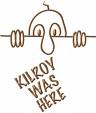
KILROY :
-
,^^^,
(O O)
--oooo--(_)--oooo--
a peering face graffito (cf: SMILEY), often coupled with the
catch-phrase "Kilroy was here!", as made popular during WWII and
after by being indiscriminately emblazoned wherever troops
advanced; this icon ostensibly originated as an inspection mark
made on military equipment by James J. Kilroy. An alternative
attribution credits Francis J. Kilroy Jr., a sergeant in the Army
Air Transport Service, whose friends delighted in recording his
name everywhere they went. [nb: in a similar vein, the SF friends
and associates of Walt Shumate delighted in attributing every
dastardly deed and ignoble feat to him, making his name
impossibly ubiquitous and improbably universal, sometimes
appearing simultaneously at a bar brawl in Okinawa, a whorehouse
in Panama, a caper in Egypt, an escapade in Germany, and a frolic
in Alaska; in the British SAS fraternity, the same has been done
with the Andy McNab persona] [v: pasquinade; cf: kill-joy
(spoilsport)]
-
KIMCHI / KIMCHEE :
-
a spicy Korean dish of pickled or fermented cabbage and onions,
sometimes including fish, that's variously seasoned with garlic,
horseradish, red peppers, and ginger.
-
KIMCHI CAB :
-
any taxicab, hackney, or gypsy cab, from PEDICAB to RICKSHA; also
called CYCLO or RICE-BURNER, TUK-TUK or PUTT-PUTT / PUT-PUT;
compare HACK, RICE ROCKET, JINGLE TRUCK. [v: Japanese takushii
(taxi)]
-
KIMONO :
-
(forthcoming);
a loose robe with wide sleeves that's fastened at the waist with
a sash, as traditionally worn by Japanese men and women; garment,
clothes; literally derived from "thing to wear".
compare CHEONGSAM, AO DAI, HANBOK, PAJAMAS; see GEISHA. [cf:
sarong, lavalava, pareu/pareo]
-
KINESTHESIA / KINESTHESIS :
-
the sensation in one's own body of the movement of muscles,
tendons, and joints, such that a person is aware of sufficient
exertion and relative repetitive motion; also known as "muscle
memory". Compare PROPRIOCEPTION.
-
KINETIC ENERGY :
-
see KEW, DU, STABALLOY, APDS, SLAP, DPICM, SABOT, FAE; compare GO
KINETIC. [cf: potential energy]
-
KINFORMING :
-
a portmanteau word combining 'kin/kinfolk' and 'informing', as
adopted during the GULF WAR; being the notification procedure
required of the unit commander that advises a servicemember's
family of his injury or death, which also initiates the casualty
affairs or survivor assistance process. See NOK, WIA, DOW, KIA,
CACO, HUG SQUAD, SKY PILOT, GHOUL, RINGS OF SORROW, MORTUARY
AFFAIRS, GRAVES REGISTRATION.
-
KINGBEE :
-
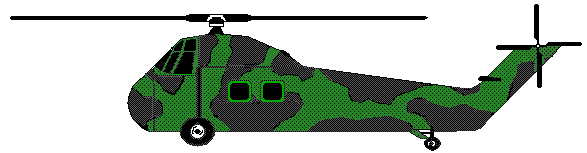
Sikorsky CH-34 cargo and troop-transport (18 MIL-PERS)
helicopter, which had a large loading aperture on its starboard
side, and was used for AIR ASSAULT, MEDEVAC, and resupply
missions; also known as "dog" and "ugly", it was flown by
Vietnamese pilots during airmobility and special operations
missions during the VIETNAM WAR. See CHOPPER. Also, codename of
the 219th Special Operations Squadron in the South Vietnamese Air
Force (VNAF) that flew helicopter support missions for the joint
service organization known as MACV Studies and Observations
Group, together with select US Army and Marine helicopter
support, under the auspices of the RVN president's Liaison
Office; see SOG, SCU, STD, SF, SPECIAL OPERATIONS.
-
KING OF BATTLE :
-
a proverbial motto of the artillery, identifying its prominent,
if not essential, role in combat; see ARTY, KNOCK THEIR SPOTS
OFF, KISS THE MISTRESS, TURN THE JACK, CHESS.
-
KINGFISHER :
-
codename for a constellation of American anti-spacecraft and
ground attack space-based weapons; compare STAR WARS.
-
KING OF THE HILL :
-
preeminent, paramount, predominant, foremost, superior,
unsurpassed, matchless, peerless, incomparable, second to none;
one who has conquered all contenders to achieve dominance. This
activity, also called "king of the mountain", having devolved
into a rough-and-tumble game for children, teaches the value of
a superior position, and the singularity of attainment. KING OF
THE HILL utilizes defensive high ground in the same manner as the
'Base Capture' game, which is a variant of CAPTURE THE FLAG. See
BATTLE ROYAL, UPHILL BATTLE, FIGHTING MAD, CLOSE QUARTERS BATTLE;
compare DUCK ON DRAKE, DUCKS AND DRAKES, HIDE-AND-SEEK, TUG OF
WAR, RED ROVER, PRISONER'S BASE, WAR GAMES.
-
KING PIN :
-
the coupling pin, welded or bolted in the centre of the front
underside of a semi-trailer chassis, which couples to the fifth
wheel (ie: a horizontal ring or segment of a ring, consisting of
two bands that slide on each other, placed above the front axle
of a carriage and designed to support the forepart of the
body while allowing it to turn freely in a horizontal plane) of
the towing tractor or dolly convertor. Compare PINTLE, TRUNNION.
-
KING POST :
-
a strong vertical upright used to support a ship's windlass and
the heel of a ship's bowsprit, as when docking or mooring; also
called a "sampson post". See BOLLARD.
-
KIOWA :
-
Bell OH-1 or OH-58 (JetRanger) observation helicopter; an armed
version is designated "Kiowa Warrior" (OH-58D). See SCOUTSHIP,
LOH, CHOPPER.
-
KIP :
-
to sleep or rest, doze or shuteye; derived from brothel; see PAC
/ PAC TIME, COMBAT NAP, EYELID MAINTENANCE; compare NO REST,
SLUGABED. Also, a unit of weight equal to half a ton, or 1000
pounds avoirdupois. Also, a large heavy bundle or fardel,
especially of hides. Also, the basic monetary unit of currency of
Laos; see LEGAL TENDER.
-
KIR / KIR ROYAL :
-
a Vietnam-era apéritif consisting of chilled white wine or
champagne blended with crème de cassis, a black currant
liqueur; so-called after its inventor, Canon Félix Kir,
the then-mayor of Dijon, France. See HOOCH, GROG, JUICE,
MOONSHINE, THE DRINK, HOIST, GUSTO.
-
KIRSCH / KIRSCHWASSER :
-
a fragrant brandy, colorless and unaged, that's distilled from a
fermented MASH of cherries, which liquor has been primarily
produced in Germany, Switzerland, and Alsace; as literally
derived from 'cherry + water'. See HOOCH, GROG, JUICE,
MOONSHINE, THE DRINK.
-
KISHKE / KISHKA :
-
a beef or fowl intestine that's stuffed with a mixture of flour,
fat, onion, and seasonings, which is then roasted; also called
"stuffed derma" (stuffed skin), as derived from Slavic for
'sausage', then adopted through Yiddish into English; see
SAUSAGE, SCRAPPLE. Also, slang for the innermost parts or guts
(kishkes); see CHITTERLINGS, CASING, CHYME.
-
KISKA TASK FORCE :
-
(forthcoming); 15 August 1943 landing on Kiska in the Aleutian
Islands
-
KISMET / KISMAT :
-
fate or destiny; as derived from divide [qismah] one's lot or
portion. [v: fate, fortune, destiny, joss, karma, moira,
predestination, weird; che sarà sarà ("what will
be, will be"); que sera, sera ("whatever will be, will be"); cf:
appointment in Samarra] [v: alea jacta est (Latin: the die is
cast)] [nb: "You only live twice -- once when you are born, once
when you look death in the face." by Ian Fleming (1964)] [nb: the
dying declaration of Viscount Horatio Nelson when taking leave of
his flag captain, Thomas Masterman Hardy, after the 1805 victory
at the Battle of Trafalgar, is commonly (mis-)represented as
"Kiss me, Hardy.", which interpretation is reinforced by the fact
that Hardy did then bend down and kiss Nelson on the cheek;
however, it should be quoted as "Kismet, Hardy." ... with the
meaning "Such is fate, my old friend Hardy."]
-
KISS :
-
military injunction to "Keep It Short and Simple", or "Keep
It Simple Stupid"; conceived by British MG J.F.C. Fuller, who
formalized the principles of warfare during WWI. [nb: "If you
have an important point to make, don't try to be subtle or
clever. Use a pile driver. Hit the point once. Then come back and
hit it again — a tremendous whack!" by Winston L.S. Churchill;
"Some experience of popular lecturing had convinced me that the
necessity of making things plain to uninstructed people, was one
of the very best means of clearing up the obscure corners in
one's own mind." by Thomas Henry Huxley; "Anything that's
thoroughly understood can be made simple and clearly explained
... confusion is not the result of complexity but of
misunderstanding."; "The ability to simplify means to eliminate
the unnecessary so that the necessary may speak." by Hans
Hofmann; "If the idea for the plan or project cannot be summarily
explained in twenty-five words or less, then it's probably too
complicated to work, and should be redone." paraphrase of Donald
H. Rumsfeld; "Everything should be made as simple as possible,
but not simpler." by Albert Einstein; "The initial resolution to
any vexing problem is usually simple and obvious, and often
wrong." paraphrase of Henry Louis Mencken; "The military has a
knack for making the simple hard, the routine difficult, and the
complex incomprehensible!"]
Also, any slight touch or gentle contact, as a light impact or
soft carom; a delicate strike; to brush or nudge; compare "turn"
at KISS THE MISTRESS.
Also, the touching or pressing together of pursed lips in an
expression of greeting or respect, thought or reverence,
affection or compassion, including a kiss that's blown or thrown
at a distance; a cooperative interpersonal labial conjunction
that's also known as smooch, bus, smack, buzz, neck / necking,
make-out, petting, parking, first base, spoon / spooning, kissy
face, lip lock, swap spit, tonsil mining, uvula speed-bagging,
osculate / osculation; see HUG, PET, WARM FUZZY, PDA, PAX.
Also, a piece of toffee-like confectionery that sometimes
contains nuts, coconut, or the like; see POGY BAIT, GEDUNK, SUGAR
PILL. Also, a small, sometimes conical, bite-sized piece of
chocolate that's usually individually wrapped; see POGY BAIT,
GEDUNK, SUGAR PILL. Also, a baked confection of egg whites and
confectioners' sugar, served as a cookie.
-
KISS OF DEATH :
-
a post-WWII idiom indicating a negative reaction or a destructive
relationship, such as adverse support or hostile endorsement; any
act generating disasterous results or any alliance not conducive
to goal attainment; any destructive relationship or fatal action;
this figure of speech alludes to the kiss bestowed by Judas
Iscariot that betrayed Jesus Christ. See RAIN ON PARADE, TO TAKE
THE GILT OFF THE GINGERBREAD, PANIC BUTTON, CHICKEN LITTLE,
REALPOLITIK. [v: Judas kiss]
-
KISS OF PEACE :
-
see PAX, KISS, HUG, PET.
-
KISS THE MISTRESS :
-
hitting the center of the target; a perfect score. See
SHARPSHOOTER, DEADEYE, KNOCK THEIR SPOTS OFF, MAGGIE'S DRAWERS,
TURN THE JACK, AIMPOINT, BOLO BADGE.
[nb: by playing card analogy since the mid-19th century, the King
is headquarters, the Queen is the principal point on the FRONT
LINE, and the Jack is a secondary position; such that a "kiss" is
a solid hit or strike, and a "turn" is an oblique or glancing
blow of mis- or indirection] [nb: according to classic military
lore, carrying playing cards (also called a "California prayer
book" or the "Devil's calling cards") in combat is bad luck, so
the deck must be left behind in camp or buried upon departure;
cf: DEATH CARDS, WAR GAMES] [nb: some etymologists attribute the
phrase "buck the tiger" to faro gambling, but can not explain its
usage, however the same phrase is widely associated with lusty
gratification, and needs no explanation; v: "They won't drink,
they won't buck the tiger, they won't even fight." Roads of
Destiny; "Nothing stronger than bouillon, not a chance to
buck the tiger even for one moment...." Hagar's Daughter]
-
KIT :
-
materials and supplies for a specific purpose (eg: MESS KIT, MED
BAG, BUG-OUT KIT, BLOW-OUT KIT, DOPP KIT, PRO KIT). Also, the
arrangement of all the materials and supplies that're necessary
for a specific purpose; the proper configuration (kitted-out) of
these items on a combat-ready MIL-PERS. Also, BIVOUAC or
battlefield gear (eg: GO-BAG, WAR BAG); see DUFFEL. Also, the
container for such material (eg: DITTY BAG, KIT BAG, MUSETTE,
FLIGHT BAG, FARADAY CAGE, DIPLOMATIC POUCH); see DUNNAGE. Also,
all the parts necessary to assemble something (eg: radio kit).
[nb: the whole "kit 'n' caboodle" is an early Americanism for the
container with everything that belongs in it, or an entity with
all of its functional elements, such as a COMBAT LOADED or
MISSION READY unit that's GOOD TO GO; another early Americanism
for this entirety, whole or completeness, is "lock, stock, 'n'
barrel", which refers to all the essential parts of a firelock
musket; cf: SHEBANG]
-
KIT BAG :
-
see KIT, MED BAG, MUSETTE, WAR BAG, GO-BAG, FLIGHT BAG, B4 / B-4
BAG, DUFFEL BAG, AWOL BAG, BIVY, DINGLEBERRY.
[nb: "rucksack" = large back-sack; "kraxe" = large rigid-framed
German backpack; "bergen" = large rigid-framed British backpack;
"knapsack" = bite/snap-up/eat, food sack; "kit-bag" = soldier's
small bag/knapsack; "haversack" = single-strapped feed bag worn
over one shoulder; musette = single-strapped small bag worn over
one shoulder] [cf: bundle, bindle/bindlea, swag, bluey, dilly
bag, tucker-bag, bag, pouch, tote, sack, traps, pack, grip,
gripsack, overnighter, weekender, holdall, carpetbag, B-4 bag,
suitcase, one-suiter, single-suiter, two-suiter, three-suiter,
portmanteau, Gladstone bag, traveling case, garment bag,
Val-Pack, luggage; v: "scrip" wayfarer's bag or wallet;
"viaticum" traveler's money and necessities]
-
KIT CARSON SCOUT :
-
named for the renown American frontier Indian Scout, Kit Carson,
abbreviated KCS, this program employed captured or surrendered
enemy soldiers who return to their former operational areas to
serve as guides for Allied troops. See HOI CHANH, ROADRUNNER,
EARTH ANGEL.
[nb: the American frontiersman, hunter and guide, Christopher
Houston "Kit" Carson (1809-68), known as the "Little Big Man",
was made famous by the plaudits of John Charles Frémont
for his employments during the Western expeditions of 1842-5,
then similarly engaged by Stephen Kearny in New Mexico, then
installed in 1853 as Indian agent at Taos, and later militia
leader of the New Mexico Volunteers in campaigns against
southwestern tribes during the CIVIL WAR (including the Texas
battle at Adobe Walls in November 1864), then finally appointed
Brigadier General in July 1866 to command Fort Garland, Colorado]
[nb: a similar program during WWII in the ETO operated by OSS was
called "Sauerkraut" (word play: 'sour' + 'German')]
-
KITCHEN CABINET :
-
an early 19th century Americanism for that unofficial group of
counselors who are relied upon to advise a head of government;
compare CZAR, MANDARIN, WHIZ KID, WISE MEN, BRAIN TRUST, DEFENSE
POLICY BOARD.
-
KITCHEN IN A CARTON :
-
informal name for the 'Unitized Group Ration Express', introduced
to field inventory in 2007, being a no-fuel/no-power self-heating
system that requires no additional equipment. Each self-contained
UGRE system is designed to be airdropped, weighs forty pounds,
and feeds 18 servicemembers with menu items like turkey dinner
with gravy. Compare T-RATIONS; see RATIONS.
-
KITCHEN SINK :
-
an idiomatic expression for complete and entire, with all
essential elements present, as when giving a summary report or
depicting (in condensed form) the layout of a situation; see
BATHTUB, SAND TABLE. [cf: "everything but the kitchen sink",
"kitchen sink drama"]
-
KITD-FOHS :
-
an initialism for Kept In The Dark and Fed On Horse Shit, being a
recipe for creating MUSHROOMs with NEED TO KNOW information or in
a compartmented setting; see COMPARTMENTALIZATION, CHINESE WALL,
TRADECRAFT.
-
KITE :
-
(forthcoming); THROW-AWAY, FIX, DANGLE
[nb: the kite, called a "flying sail", has been used militarily
since the fifth century BC by the Chinese to signal situations,
send commands, scatter leaflets, produce sounds, and lift
observers.] [nb: during WWII, German U-boats used a "gyro-kite"
to lift a temporary observation platform above sea level]
Also, a worthless or fraudulent financial instrument; see BAD
PAPER, COUNTERFEIT.
-
KITTY-CORNER / KITTY-CORNERED :
-
see CATAWAMPUS.
-
KIWI :
-
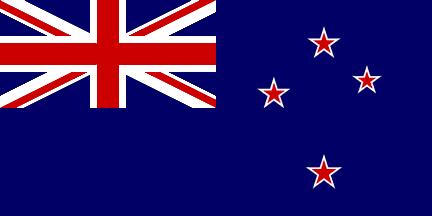
(kee-wee) nickname for New Zealand ADVISORs and servicemen,
also known as "Digger", from "Down Under" (antipodes); as derived
from the flightless bird native to the islands. See NZATTV, NZV
FORCE, RNZAF, NZSAS, TAN TAY LAN, ANZAC, FWF, FANK TRAINING
COMMAND, ANZUS, KANZUS, ASEAN, SEATO, compare AUSSIE, TOMMY, GI
JOE, GI. [v: Down Under Military Glossary] [aka:
Maori 'Aotearoa' meaning "land of the long white cloud"] [cf:
kiwifruit or Chinese gooseberry (Zespri)]
-
KKK :
-
Krum Kmampuchea Khmer, or Khmer Kampuchea Krom, or Khymer
Kampuchea Krom; exile ethnic Cambodian faction working with
Allied elements. See KHMER SEREI, FARK.
-
KLA :
-
Kosovo Liberation Army; see ALLIED FORCE.
-
KLAXON :
-
a loud electric horn, formerly used on motor vehicles; a type of
alarm now used as a warning signal or siren. Compare SQUAWK BOX,
BLOWER, HORN, TANNOY, TOCSIN, ANNUNCIATOR, 1-MC; see WARNING
ORDER, BOATSWAIN'S PIPE, BUGLE CALL, POOP, HEADS-UP, FYI,
STAND-TO, DEFCON, ESP, SACON, FPCON, GQ, ALERT, AHOY, HOISE,
OORAH, HOOAH, HAUL-ASS, STAT.
-
KLICK :
-
slang for kilometer (km), also spelled "click"; being 1,000
meters or 0.621 mile. Compare KNOT, NAUTICAL MILE, MILE; see
RANGER BEADS.
[nb: the kilometer was originally defined as 1/10,000th of the
distance from either of earth's pole to the equator (or the meter
set as one ten-millionth of the distance from a pole to the
equator), or as 1/40,000th of the earth's circumference as
measured through the poles (meridian); which definition would
make the kilometer's length approximately 1,000.197 meters, but
the km has been formally defined as exactly 1,000 meters
(3,280.84 feet) by international agreement] [nb: hectare /
hektare (ha): a unit of surface measure equal to 10,000 square
meters (10 square kilometers), or equal to 100 ares; being
equivalent to 2.471 acres. are (a): a unit of surface measure
equal to 100 square meters (1/100 of a hectare); being equivalent
to 119.6 square yards. acre (ac): a unit of surface measure in
the U.S. and Great Britain equal to 4047 square meters (43,560
square feet, or 1/640 square mile)] [v: the Metric Conversion Act
(23 Dec 1975; amended by the 1988 Omnibus Trade and
Competitiveness Act, the 1996 Savings in Construction Act, and
the 2004 Department of Energy High-End Computing Revitalization
Act) recommended improved efficiency by voluntary accommodation
with the standardized International System of Units (si): meter
(length), kilogram (mass), second (time), ampere (electric
current), kelvin (temperature), mole (amount of substance), and
candela (luminous intensity); including femtometer / fermi (fm),
picometer (pm), angstrom (a), nanometer (nm), millimicron,
micron/micrometer (mu), millimeter (mm), centimeter (cm),
decimeter (dm), meter (m), dekameter (dam), hectometer (hm),
kilometer (km), light year, parsec]
-
KM :
-
kilometer; see KLICK.
-
KMAG :
-
Korea Military Advisory Group, formed from the Provisional
Military Advisory Group (PMAG) that was withdrawn from Far East
Command (FEC) on 1 July 1949, and operated under the control of
the U.S. Mission of the State Department (DoS) until shortly
after the North Korean invasion (25 June 1950), whereupon KMAG
assets reverted to Eighth Army command (redesignated 8668 AU),
and were finally transferred to 8202 Army Unit on 28 December
1950. KMAG has been sardonically re-interpreted as "Kiss My Ass
Good-bye". Compare MAAG, USDAO.
-
KMC :
-
Republic of Korea Marine Corps; compare ROK, USMC.
-
KNACKEBROD / KNÄCKEBRÖD :
-
a flat, thin, brittle unleavened rye bread of Sweden; as derived
from 'break' + 'bread'.
-
KNAPSACK :
-
a bag, made of various materials (from fabrics to leather),
that's worn on the back for carrying supplies and other necessary
items; also called a backpack or RUCKSACK. See KIT BAG, FLIGHT
BAG, WAR BAG, BUG-OUT KIT, DUFFEL, DUNNAGE, WEB GEAR,
DINGLEBERRY.
[nb: "rucksack" = large back-sack; "kraxe" = large rigid-framed
German backpack; "bergen" = large rigid-framed British backpack;
"knapsack" = bite/snap-up/eat, food sack; "kit-bag" = soldier's
small bag/knapsack; "haversack" = single-strapped feed bag worn
over one shoulder; musette = single-strapped small bag worn over
one shoulder] [cf: bundle, bindle/bindlea, swag, bluey, dilly
bag, tucker-bag, bag, pouch, tote, sack, traps, pack, grip,
gripsack, overnighter, weekender, holdall, carpetbag, B-4 bag,
suitcase, one-suiter, single-suiter, two-suiter, three-suiter,
portmanteau, Gladstone bag, traveling case, garment bag,
Val-Pack, luggage; v: "scrip" wayfarer's bag or wallet;
"viaticum" traveler's money and necessities]
-
KNEEBOARD :
-
a PILOT's leg-mounted notebook and/or clipboard containing flight
routines, signal operating instructions (SOI), and mission
specific briefing notes, including strip maps or target photos;
also called "knee chart". See PLASTIC BRAINS, compare HUD.
-
KNEE CAP :
-
see NEACP. [nb: babies are born without kneecaps, which don't
develop until the child lives to be two to six years of age]
-
KNEE-KNOCKER :
-
slang for the protective rim or bulwark surrounding an opening in
a BULKHEAD or DECK, designed to exclude water; this coaming is
also called a "shin-scraper".
-
KNEEL :
-
see SQUAT, TAKE A KNEE, ON ONE'S KNEES.
-
KNELL :
-
any sound or sign proclaiming the death of someone or announcing
the failure of something, as derived from the mournful sound of a
bell rung slowly. Also, to give forth a mournful, ominous, or
warning sound. Also, to summon people for a proclamation by
striking a bell. Compare TAPS, TATTOO, DEAD MARCH; see FUNERAL
PACE, MORTUARY AFFAIRS, GARDEN OF STONES, MEMORIAL.
-
KNIFE :
-

|
Vietnam-era type 3 F-S dagger
|
|
the principal (if not the sole) cooking and eating utensil used
in all cultures throughout human evolution, and only recently
augmented or supplemented; compare FORK, SPOON, PARTISAN'S SECRET
WEAPON; see CHOPSTICK, P-38, CHURCH KEY, MESS KIT, CANTEEN CUP,
MESS TRAY, COVER, RATIONS. [nb: when the knife was the only
eating utensil, the manner of consumption among Occidentals
sharing a meal was for each diner to cut off a morsel from the
whole and lift it to their mouth on the tip of that same knife;
while among Orientals, the practice was to bite into the whole
and cut that mouthful free by slicing between the meal and the
diner's face ... a method persisting among some tribal peoples
until the mid-twentieth century] [nb: King Louis XIV decreed in
1669 that all pointed knives on the street or the dinner table
were illegal in France, henceforth all knife points were ground
down to blunt tips in order to reduce violence ... once the blunt
tip was broadened into a spatula, the blade was bent backwards
and the handle made into a pistol-grip, so the diner would not
have to contort his wrist to eat food from the knife's tip] [nb:
in establishing the metamorphosis of chopsticks, some historians
argue that Confucius (K'ung Fu-tzu), the Chinese scholar, who was
vegetarian, discouraged the use of the knife as an eating utensil
because it would remind the diner of the slaughterhouse]
Also, the primary cutting tool used in all cultures throughout
human evolution, and only recently augmented or supplemented; see
BAYONET, BANANA BOLO, BOLO, MACHETE, ASTRONAUT SURVIVAL KNIFE,
ARKANSAS TOOTHPICK, V-44 MARINE RAIDER KNIFE, BOWIE, MK2, KABAR,
DIVE KNIFE, NEPTUNE, SOG SCUBA-DEMO KNIFE, SOG BOWIE, DIRK,
COMMANDO DAGGER, OSS STILETTO, RAIDER STILETTO, V-42 STILETTO,
MARK II, APPLEGATE-FAIRBAIRN DAGGER, EK COMMANDO KNIFE,
PIGSTICKER, TRENCH KNIFE, KNUCKLE KNIFE, SURVIVAL KNIFE, PILOT'S
SURVIVAL KNIFE, RANDALL MADE KNIVES, BOOT KNIFE, PARATROOPER'S
SWITCHBLADE, POCKETKNIFE, SWISS ARMY KNIFE;
compare ON GUARD, BUTT STROKE, MUZZLE-RING, LUG, CQB, SILENT
PARTNER, LADY'S BEST FRIEND, COLD STEEL, BLOOD GROOVE, PARKERIZE,
BLUING, CLOAK-AND-DAGGER, LONG KNIFE, OLD WRIST BREAKER, MAMELUKE
SWORD, WASTER, WOODEN SWORD, HOT KNIFE, ELECTRIC BUTTERKNIFE,
BAYONET SHEET, SEMPER KNIFE.
[nb: notable American knife manufacturers include Case and
Western, Schrade and Utica, Camillus and Cattaraugus, KaBar and
Union, PAL and Conetta, Imperial and Robeson (ShurEdge), Colonial
and Queen, Kinfolks and Aerial, Buck and Gerber, Cold Steel and
Ontario, Kershaw and Benchmade, Spyderco and MicroTech, making a
wide variety of military, survival, hunting, and folding knives]
[v: Knife Terms; The Language of
Swordplay]
-
KNIFE EDGE CREASE / KNIFE'S EDGE CREASE :
-
see PISSCUTTER, MILITARY PRESS.
-
KNIFE EDGE PASS / KNIFE-EDGED PASS :
-
the attitude of an aircraft flown past a fixed position or past
another aircraft, wherein said aircraft turns edgewise (90°
angle of bank) in level parallel flight, displaying either its
topside or bottom side in profile, without turn or deviation;
compare FLAT PASS, BANANA PASS; see AEROBATICS.
-
KNIFE FIGHT IN A PHONE BOOTH :
-
see FUR BALL, DOGFIGHT.
-
KNIFE'S EDGE CREASE / KNIFE EDGE CREASE :
-
see PISSCUTTER, MILITARY PRESS.
-
KNIFORK :
-
a knife and fork combo that's typically configured as a
rocking-knife with tines; see KFS.
-
KNIGHT :
-
a mounted soldier, typically armored, serving under a feudal
superior in the Middle Ages; as derived from manservant; see PONY
SOLDIER, DRAGOON, DOG SOLDIER, LONG KNIFE, YELLOWLEG, MERRY MEN,
ORDER OF THE SPUR. Also, a man, usually of noble birth, who after
serving a military apprenticeship as page and squire was raised
to honorable medieval rank and bound to chivalrous conduct. Also,
a man upon whom knighthood is conferred (dub / dubbed) by a
sovereign, or any person of similar rank; a member of an exalted
order or association conferring such honors. Also, a game token
(especially a chess piece) imbued with higher rank; see WAR
GAMES.
-
K-9 :
-
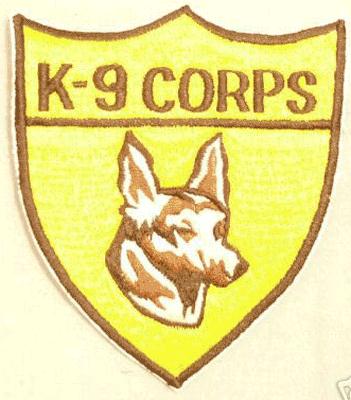
designation being a simulacrum for "canine", denoting the use of
specially trained dogs for military employment in several areas
with their companion handler; of the original five types of
military working dogs ie: guard and sentry, sled and pack,
messenger and courier, explosive and mine detection, scout and
attack), specialization was reduced after wartime exposure by
unreliability or inconsistency and by displacement from advanced
technology, such that only sentry and scout dogs proved to be
practical investments. Dog handling is traditionally conducted
using German-language commands
that're accompanied by unambiguous gestures. First used during
WWI, such loyal but expendable animals have usually been
abandoned or exterminated after each subsequent war, despite
their extensive and expensive training. The bond between dog and
handler is often untransferrable, such that the dog is either
discharged when the handler leaves the military, or is destroyed
if no other kennel is available for retirement. After WWI,
starving signal dogs were rescued by the founders of what later
became The Seeing Eye Foundation for re-training as guide dogs
for blinded veterans, a field of orientation and mobility
(o&m) training that has since burgeoned. These working dogs,
commonly called "police dogs" and "guarddogs", as "four-legged
soldiers" and "fuzzy-faced fighters" [nb: one K-9 during WWII
attacked a machinegun nest and captured all four occupants, being
awarded a Silver Star and Purple Heart for the action!], and were
known during WWII as "war dogs" and "infantry scout dogs", then
during the VIETNAM WAR as a "combat tracker team" (with companion
handler) and as "boonie pups" in camaraderie with the BOONIE RATs
operating in the boondocks, and during the GULF WARs, as military
working dogs (MWD); the dogs' spirit was also represented by the
expression: "Hell on Paws", as a take-off from HELL ON WHEELS.
The Army's Quartermaster Corps (QMC) initially trained all
military working dogs in their several specialties, but after
a period of dispersion, the Department of Defense (DoD) again
consolidated training with the U.S. Air Force. Because all dogs
proved to be "gun shy" under the barrage conditions of WWII,
their military assignments were later restricted to sentry and
scout duties, where their superior senses of smell and hearing
would be unambiguously beneficial; although their detection of
explosives and mines was initially inconsistent, improved
training methods since WWII has returned this capability to the
repertoire of patrol dogs. See SCOUT DOG, COMBAT TRACKER TEAM,
MWD, WAR DOGS, IASK9, STILL TRAILER, OPEN TRAILER, LEND-LEASH, A
DOG IN A DOUBLET, SAPPER, HAPPINESS IS A WARM PUPPY; compare
WEASEL, IRON DOG.
[nb: a joint US-Canadian operation during WWI called "K-9"
transported dogsled teams from Alaska and northern Canada to the
Alps and Vosges Mountains for the FRONT LINE delivery of
messages, food, medicine, or AMMO, and evacuation of the wounded,
in France and Italy during winter snows when horses and mules
proved incapable]
[nb: the first modern military use of dogsleds was in the laying
of telegraph lines across Alaska, the delivery of mail and other
resupply items in both World Wars, and for winter search and
rescue operations in the Arctic, until replaced by snowmobiles
and helicopters in the 1950s ... Germans used dogsleds for
resupply on the Russian Front during WWII, and dogsleds are still
used today for border patrol in Norway, Finland, and Greenland]
[nb: during Operation Barbarossa, defending Russians used
anti-tank "mine dogs" against attacking German vehicles; dogs
were Pavlovian conditioned to eat their food on the underside of
moving vehicles, where the trigger on their back would detonate
the saddlebag explosive that they carried]
[nb: sled dog team races began with the 1907-18 All-Alaska
Sweepstakes, the 1925 Great Race of Mercy delivery of diphtheria
serum (re-enacted in 1975), the 1932 Winter Olympics dogsled
race, the annual Alaska Fur Rendezvous dogsled race that became
the Iditarod in 1967, and the 1973 Iditarod race run from
Anchorage to Nome]
[nb: 'mush', the command urging or spurring a dogsled team to
travel, is a corruption of 'march' as spoken by French voyageurs]
[nb: while dogs have only about ten vocal sounds to express
themselves, cats have more than a hundred]
-
KNOB-TURNER :
-
slang for a radio operator who eavesdrops on enemy broadcasts; a
signals intelligence (SIGINT) specialist who searches for and
monitors enemy transmissions. Compare DITTY-DOT, COMM OP, RTO,
EARS, PIANIST, RADIO PUKE; see FLAPS 'n' SEALS, HOPSCOTCH,
HITCHHIKE, SURF.
-
KNOCK :
-
slang meaning to criticize adversely, to belittle, to disparage;
in older colloquial usage, it meant to create a great impression,
to be irresistible, to fill with admiration or astonishment. [cf:
knock about, knock off, knock down, knockout, knocking or
knocked-up]
-
KNOCKING ON THE ROOF :
-
see ROOF KNOCKING; compare BUZZ, FLAT-HATTING, SNAP ROLL, NOE,
CONTOUR FLYING.
-
KNOCK INTO A COCKED HAT :
-
to destroy utterly or defeat completely; with reference to the
18th century fashion of wearing bicorne and tricorne hats. See
WMD, BOMB 'EM BACK TO THE STONE AGE, NOT ONE STONE LEFT UPON
ANOTHER, BOUNCE THE RUBBLE, MAD, BRINKMANSHIP, PREEMPTIVE STRIKE,
PREVENTIVE WAR, OVERKILL, UP-GUN, OUTGUN, SMACK DOWN, ROMAN
HOLIDAY, MASSACRE, HEADHUNTING, TURKEY SHOOT, DOOMSDAY, KILL 'EM
ALL, ATROCITY, GENOCIDE, HOLOCAUST. [cf: facer] [ety: another
origin alludes to clearing the entire triangular setup of
ninepins (resembling a tricorn hat) so as to win by a wide
margin]
-
KNOCK IT OFF :
-
command broadcast to all participants, by any
element or umpire, to interrupt MOCK-COMBAT training for reasons
of safety or completion; to cease and desist, to give quarter.
Given the natural competition of training, enthusiasm frequently
exceeds judgment, such that strikes and developments are
disputed; so KNOCK IT OFF concludes the exercise for later
analysis and assessment. Actual combat does not have a "pause"
button or an "interrupt" switch; and "fair play by the rules" is
a moot point in victory. Compare BREAKAWAY, see DOGFIGHT, BELAY,
WAVE OFF, SCRUB, RING THE BELL, POOP, ALL'S FAIR IN LOVE AND WAR,
EQUALIZER, TS CARD.
-
KNOCK THEIR SPOTS OFF :
-
hitting the center of the target; a perfect score. Originating as
pistol marksmanship competition with the target being the "pips"
on playing cards. This phrase, which enjoins a superior
performance of skill, may be confused with "knock their socks
off", which extols an impressive (even flamboyant) performance.
See SHARPSHOOTER, DEADEYE, KISS THE MISTRESS, MAGGIE'S DRAWERS,
AIMPOINT, BOLO BADGE, DEATH CARDS, WAR GAMES.
-
KNOON :
-
a combination knife and spoon utensil; see KFS.
-
KNORK :
-
a fork with a knife-like cutting edge; see KFS.
-
KNOT :
-
a constrictive interlacement for fastening. Knot tying has
a language of its own, including: bend, BIGHT, loop, hitch,
running-end, standing-end, trailing-end, fast, splice, braid,
twine, etc; see HARD-AND-FAST, FIGURE-8, MONKEY FIST, TURK'S
HEAD, CROWN; compare SHOCK CORD. [v: Climbing Terms]
Also, a unit of speed equal to one NAUTICAL MILE (or about 1.15
statute miles) per hour; probably derived as a contraction of
"[k]naut(ical mile)"; the usage "knots per hour" is a redundancy.
Also, a unit of measure, being either one NAUTICAL MILE, or a
line marked 47'3" (13.79m) long; compare MIL, MILE, KLICK.
[nb: 12 inches = 1 foot, 3 feet = 1 yard, 6 feet / 2 yards = 1
fathom, 16.5 feet = 1 rod (aka: pole or perch), 66 feet / 4 rods
= 1 chain (90 feet / 15 fathoms = 1 anchor chain), 10 chains /
660 feet (1/8 statute mile) = 1 furlong, 120 fathoms / 720 feet =
1 land cable, 101 fathoms / 606 feet (1/10 nautical mile) = 1
cable, 3 statute miles = 1 land league, 3 nautical miles = 1 sea
league / shot] [nb: a "geographic mile" is the length of a minute
of longitude on the equator]
-
KNOTTY :
-
anything intricate or involved, especially something difficult or
complicated (eg: knotty problem); see CUT THE GORDIAN KNOT,
ALEXANDRIAN SOLUTION, BLUNT FORCE, BRUTE FORCE.
-
KNOW THE ROPES :
-
experienced, knowledgeable, masterly; to be familiar with or able
to execute a task. A nautical phrase from the days of sail, when
an understanding of the complexities of ropes, knots, and rigging
was essential for a seaman. This expression first appeared in a
published work as a reference to the ship's captain in "Two Years
Before the Mast" by Richard Henry Dana (1840).
-
KNOW YOUR ENEMY :
-
a catch-phrase that encourages insight and creativity, since it
is not enough to second-guess oneself ("How would I destroy
me?"), but to recognize enemy patterns and methods, strengths and
weaknesses, potential and goals ("How would he destroy me?"),
both tactically and strategically; also expressed as "know the
enemy". See CAPABILITY, COURSE OF ACTION, LEAST RESISTANCE, FIELD
EXPEDIENT. [nb: "To know your enemy, you must become your enemy
... Keep your friends close and your enemies closer." by Sun-Tzu
(ca490BC); "The wise learn many things from their enemies." by
Aristophanes (414BC); "A wise man gets more use from his enemies
than a fool from his friends." by Baltasar Gracian; "Never
underestimate nor overestimate, neither your enemy nor
yourself."; "Observe your enemies, for they first find out your
faults." by Antisthenes; "Let us carefully observe those good
qualities wherein our enemies excel us; and endeavor to excel
them, by avoiding what is faulty, and imitating what is excellent
in them." by Plutarch]
-
KNUCKLE BUMP :
-
a greeting, or gesture of respect, between participants wherein
the closed hand, held either vertically or horizontally, is
extended to nudge another's; unlike a handshake, this light
contact may be made with either hand and with more than one
person at a time. Also called "fist bump", "knuckle tap", "fist
tag", "faux knock", "knock knucks", and "spudding"; this touch
seems to date back to the time when boxers were unable to shake
hands before their bout because their hands were wrapped or
gloved, as mandated by the Marquess of Queensberry rules (1867).
See DAP, HAND-JIVE, HANDSHAKE DANCE, HAND SIGN, V-SIGN; compare
WIGWAG, DITTY-BOP, SALUTE. [v: Sir John Sholto Douglas]
-
KNUCKLE-DRAGGER :
-
according to all the purported BEST AND BRIGHTEST, those
self-proclaimed elitists and every other pseudointellectual, this
appellation is not derogatory slang, but an accurate
characterization of someone who is large, strong, and dimwitted;
a person who's more physical than mental, such as a brute or
beast ... in other words, military personnel in general and
combatants in particular. This specious inference willfully
ignores the fact that MIL-PERS are more disciplined and energetic
than their civilian peers, typically more widely traveled and
more diversely experienced, often better educated and socially
adjusted, in addition to being more physically competent and
adventuresome. While these societal arbiters will reflexively
defend the downtrodden and disadvantaged, frothing over
politically-incorrect slights, they dismissively disdain the
servicemembers who protect and defend their civil rights ... it
is not fashionable to respect someone for doing what you will not
do for yourself, so you must prove your superiority by belittling
those who do. This specious attribution of military brutishness
is further flawed by the fact that the most powerful weapon in
any arsenal is a creative mind, so a smart soldier is a
successful soldier, and America's warriors have been successful
despite all the sabotage of the cowardly FIFTH COLUMNists and
TRAITORous pseudointellectuals. See SOLDIER, AIRMAN, SAILOR,
MARINE, GI, WARM BODY, ATLAS, CONSERVATIVE, ANTI-FEDERALIST,
REACTIONARY, HUMAN ZOO, SHAVED MONKEY, MEAT EATER, WHITE TRASH,
THIRD ESTATE.
[nb: similarly questionable (if not spurious) allegations have
long been leveled against Neanderthals (ie: primitive,
unenlightened, reactionary) by the cladistic descendents of
Cro-Magnons; v: therianthropic (ie: Nakalipithecus,
Ouranopithecus, Graecopithecus, Sahelanthropus, Orrorin,
Ardipithecus, Australopithecus), paleoanthropic (ie: Homo Erectus
(Acheulean), Homo Habilis (Java Man, Peking Man, Homo Antecessor,
Denisovan / Denisova Hominin, Homo Heidelbergensis), Neanderthal
/ Homo Neanderthalensis, Cro-Magnon); cf: neanthropic /
neoanthropic (ie: Homo Sapiens)] [v: savage, barbarian,
outlander, alien, troglodyte, ignoramus, know-nothing, lowbrow,
booboisie (H.L. Mencken), philistine, old Adam, vandal, pillager,
hooligan, vulgarian, yahoo (degraded brute); cf: second-class
citizen, noble savage]
-
KNUCKLE-DUSTER / KNUCKLE DUSTER :
-
a metal brace or strap that spans the knuckles of a closed fist,
which may be studded or spurred, to increase the impact of a
punch; a handheld weapon, also called "brass knuckles" or
"knucks", used to kill ("dust" or "dust-off") an opponent by
beating him to death with one's reinforced or armored hands.
Compare FIST-LOAD; see TRENCH KNIFE. [nb: this loop of heavy
metal, gripped in the hand and fitting over the knuckles, was
used as an offensive weapon in the days of Roman pugilism]
-
KNUCKLE KNIFE :
-
that class of close combat (CQB) knives fitted with fist-bows [v:
armature, archetto] and knuckle-guards (eg: knuckle-duster), such
as the M-1917 or M-1918 knuckle knife (also known as "Mark I");
typically includes a triangular or double-edged blade, a
skull-crusher pommel, and is generally not configured as a
BAYONET. Although redesigned from battlefield reports by AEF
officers, the "Mark I" was criticized for being too heavy,
unbalanced, difficult to carry, limiting in its grip, and prone
to break when prying ... complaints that were repeated when
surplus knives were issued from inventory to Army RANGERs and
Marine RAIDERs at the beginning of WWII. See TRENCH KNIFE, KNIFE.
[v: Knife Terms; The Language of
Swordplay]
-
KNUCKLE SANDWICH :
-
slang for a clenched fist, as used to deliver a punch in the
mouth; the allusion is to delivering a fist like feeding someone
a sandwich; to throw hands or engage in fisticuffs, slugfest or
punch-up, duke it out or knock-down drag-out, plug or mill,
boxing or pugilism. See MARTIAL ART, JAP SLAPPER, BOK-BOK,
TWO-FISTED, ONE-TWO, SMITE, UPPERCUT, HAYMAKER, SUNDAY PUNCH,
RABBIT PUNCH, BEAT HIM TO THE PUNCH, COUNTERPUNCH, GROUP HUG,
BATTLE ROYAL, BATS 'n' HATS, ON GUARD, AT CLOSE QUARTERS,
UP-CLOSE 'n' PERSONAL, CLOSE QUARTERS BATTLE, PULL ONE'S PUNCHES,
THROW IN THE TOWEL. [v: Japanese gijutsu (technique, art)]
-
KNUCKLE UNDER :
-
an act acknowledging defeat, of submission, of giving-in, being
an allusion to the old custom of striking the underside of a
table with the knuckles when bested in an argument. [cf: knock on
wood]
-
KO / KO'd :
-
(kay-oh; kay-owed) KnockOut, as by a punch or blow; to be knocked
out of commission or service; also known as COLD-COCK /
COLD-COCKED. [cf: technical knockout (TKO)]
-
KOMBOLOI / KOMBOLÓI :
-
see PRAYER ROPE.
-
KOOL-AID :
-
proprietary name of instant fruit-flavored powdered mixes that're
added to relatively potable local water so as to mask the taste
of its chemical treatment. Compare TANG; see BUG JUICE, JUICE,
ERGO, THE DRINK, NUOC, WATER PURIFICATION TABLET. [nb: a
non-concentrate called "Fruit Smack" was marketed by Kool-Ade,
the precursor of 'Kool-Aid', in 1927; '-ade' is a suffix meaning
fruit drink (eg: lemonade, limeade)]
-
KOPECK :
-
an aluminum-bronze coin of Russia, the Soviet Union, and its
successor states, being the 100th part of a RUBLE; also spelled
kopek or copeck, as derived from the diminutive for 'spear' or
'lance', so-called from the lance with which the figure on the
coin was armed. See LEGAL TENDER.
-
KOREAN HEMORRHAGIC FEVER :
-
a serious disease, first detected among several thousand United
Nations troops serving near the Hantan River during the KOREAN
WAR, founded by the Hantaan virus (HTNV) but later known as
hantavirus or HFRS after its etiologic agent was isolated [by
Ho-Wang Lee (1977)]; because the virus can be transmitted by
rodent saliva or urine, excretia or bites, the control of rats
and mice, moles and voles in areas frequented by humans is
crucial for disease prevention, including the disposal of nests,
the closing of access, and the employment of poisons or
predators. Compare TULAREMIA / TULARAEMIA; see DISEASE.
-
KOREAN WAR :
-
a war launched 25 June 1950 to unify the Hermit Kingdom, annexed
since 1910 and divided by the Yalta Conference trusteeship, by
INVASION from the Democratic People's Republic of (North) Korea
aided by communist China (PRC) and Russia (USSR) into the
Republic of (South) Korea aided by US and UN forces, resulting in
an armistice signed 27 July 1953 that confirmed the antebellum
1948 separation along the 38th parallel, less approximately
180,000 Allied and an estimated 2,000,000 enemy casualties. The
KOREAN WAR was America's first "limited war", formally designated
a "police action", was the first military intervention by sixteen
(16) members of the United Nations exercising their peacekeeping
authority, and has since been called "the forgotten war".
[v: Korean War Supplement] [nb: Korean
War (1950-53): 5,764,143 served; 33,651-36,914 battle deaths]
[nb: "In the simplest of terms, what we are doing in Korea is
this: We are trying to prevent a third world war." by Harry S.
Truman (16 April 1951)]
[cf: during the KOREAN WAR, many North Korean and Chinese
communist POWs TATTOOed themselves with anti-American or
pro-communist slogans, on their hands, arms, foreheads, or
chests, as an act of defiant solidarity with their homelands, and
with their war against Western ideals; such that even when they
rioted, no NK or CHICOM POWs were punished for having expressed
their political views with signs or TATTOOs, despite the fact
that such dissent was intolerable in their own homelands]
-
KOREAN WAR VETERANS MEMORIAL :
-
a striking tableau and frieze erected on the Capitol Mall
adjacent to the VIETNAM VETERANS MEMORIAL commemorating the
service and sacrifice of combatants more than forty years after
the armistice for the "Forgotten War". See MEMORIAL DAY, MISSING
MAN FORMATION, TAPS.
-
KOREA TOWN :
-
see K-TOWN.
-
KORO :
-
a culture-specific psychiatric syndrome that's characterized by
the unreasonable fear of one's genitals permanently retracting
into the body, such that one not only loses sexual function but
sexual identity; occurring chiefly in China and southeastern
Asia, this anxiety afflicts both men (penis and scrotum) and
women (labia and breasts), wherein their acquired (psychosomatic)
deformity would alienate them from society. This Malay term
derives from 'land turtle' ("kura-kura") by association.
-
KOSOVO :
-
see PROVIDE PROMISE, JOINT ENDEAVOR, JOINT FORGE, JOINT GUARD,
ALLIED FORCE, KLA. [nb: it has been said that Yugoslavia has one
people, two alphabets, three religions, four languages, five
nationalities, and six republics!]
-
KOSOVO CAMPAIGN MEDAL / KCM :
-
a CAMPAIGN MEDAL recognizing the honorable service of MIL-PERS in
support of military operations (ie: Allied Force, Joint Guardian,
Allied Harbor, Sustain Hope / Shining Hope, Noble Anvil, TF Hawk,
TF Saber, TF Falcon, TF Hunter) in and around the former Yugoslav
Republic of Kosovo (including Serbia, Montenegro, Vojvodina,
Albania, Macedonia, Bosnia, Croatia, Hungary, Romania, Greece,
Bulgaria, Italy, Slovenia, the Adriatic and Ionian Seas) from 24
March 1999 through 31 December 2013, with the authorized
campaigns denoted by the addition of one or more bronze service
stars (BATTLE STAR), including the Kosovo Air Campaign (24 Mar -
10 Jun 1999), and the Kosovo Defense Campaign (11 Jun 1999 - 31
Dec 2013). The obverse shows a picturesque landscape with the sun
rising between two mountains, shining on a fertile valley, with
hope and prosperity represented by a wreath of stylized sheaves
of wheat in a new dawn, under the legend "Kosovo Campaign"; the
reverse displays an outline map of the Yugoslavian province of
Kosovo, keynoted by the NATO compass rose showing cardinal
directions, and all surrounded by the legend: "In Defense Of
Humanity". The Kosovo Campaign Medal was transitioned back to the
ARMED FORCES EXPEDITIONARY MEDAL (AFEM) effective 1 January 2014.
[v: Kosovo NATO Medal; Balkans NATO Medal]
-
KOWTOW / KOW-TOW / KOTOW :
-
in Chinese etiquette, to act in an obsequious or an apologetic
manner; to show servile deference, abject reverence, or deep
homage by touching the forehead to the ground while kneeling;
literally derived from "knock head" (k'o t'ou). Compare REI, WAI,
SAMPEAH, CHAO, SALAAM; see "ko-tonk" (knock head) at BUDDHAHEAD,
SALUTE. [nb: saikeirei (literally meaning "most respectful bow")
is a formal Japanese bow of gratitude that's delivered from a
kneeling posture until the head touches the floor; dogeza is a
crouching bow demonstrating absolute submission or extreme regret
that exhibits self contempt]
-
KP :
-
Kitchen Police, with duties to assist food preparation, setup,
clean-up, and waiter/steward or Dining Room Orderly (DRO);
sometimes called "pot-walloper", "pan-wrestler", or "kicking pots
and pans", formerly known as "blackguard". See SCRUB, SWEAT,
ELBOW GREASE, COOKIE, MESSHALL, GALLEY, POLICE; compare GI PARTY,
POLICE CALL, HOUSECLEANING.
-
K-POT :
-
the lightweight ballistic (Kevlar) HELMET that replaced the STEEL
POT after Vietnam; also called "Fritz" for its resemblance to the
German coal-scuttle or "Dutch Boy" HEADGEAR; in the GULF WAR-era,
this helmet is sometimes called a "brain bucket", "skid lid", or
"dome of obedience". The 'Advanced Combat Helmet' uses a
four-point retention strap system, includes closed-cell foam pads
that can be Velcroed in place to adjust its fit, has a mounting
bracket on the front for night vision devices (NVD), and is
issued with a reversible CAMO cloth cover. Unlike the older and
heavier STEEL POT, the new lightweight K-POT cannot serve as a
wash basin, cook pot, makeshift shovel, improvised seat, or
impromptu bludgeon ... and female MIL-PERS, who wear their long
hair up in a bun, find that the closer-fitting K-POT shifts
forward over their eyes and blocks their vision! [nb: Kevlar
patented 1971]
-
KRAIT :
-
a nocturnal venomous snake, in either black and white or black
and yellow bands, with erect upper fangs (elapid), that's
INDIGenous to South Asia; also called "two-step" or "eleven
second" snake for its deadly effect.
-
K-RATIONS :
-
single meal for an individual soldier in the field (consisting of
1 kraftboard-sleeved can of pork luncheon meat with can key, K-1
biscuit, K-2 biscuit, lemon juice powder, 4 sugar cubes, 4oz
D-bar chocolate ration (aka: Logan bar), 1 stick chewing gum,
pack of 4 cigarettes, clip of matches with VD warning, wooden
spoon and toilet paper); eponymously named for its WWII (1942)
creator, Ancel Keys. See RATIONS.
-
KRIEGSPIEL :
-
[kriegsspiel] see WAR GAMES.
-
K-TOWN :
-
(kay-town) short form of Korea town, being an ethnic Asian
enclave situated among other distinctly homogeneous neighborhoods
and shopping districts within a larger metropolitan area; similar
to "Little Saigon" or "Little Tokyo" [aka: "Japtown"], and not
unlike other exclusive districts (eg: "Little Italy" or
"Germantown", "Little Armenia" or "Thai town", ghetto or
darktown). Compare HO CHI MINH TRAIL, CHINATOWN, LITTLE AMERICA,
SIGG, LITTLE TIGER; see DP, BOAT PEOPLE.
-
KULTURKAMPF :
-
see CULTURE WAR / CULTURE WARS.
-
KUM BA YAH :
-
the title and principal refrain of a 19th century spiritual,
meaning "come by here" from Gullah creole, that's popularly sung
in songfests and has become associated with the civil rights and
anti-war movements; it's also spelled "Kumbaya", "Koombaya", "Cum
Ba Ya", and "Come By Yuh". This folk song has been used in the
modern era, with varying degrees of sincerity or sarcasm, to
evoke spiritual unity and interpersonal harmony, bland piety and
naive optimism. Also, someone who's inexperienced or unworldly,
or something that's impractical or unrealistic; beamish,
Pollyannaish, Panglossian, auspicious, propitious, opportune. See
WE SHALL OVERCOME, HIPPIE, ROSE-COLORED GLASSES, LOVE BEADS,
PROTESTOR, BEST AND BRIGHTEST, PACIFIST, THEY'LL GIVE A WAR AN'
NOBODY'LL COME, COUNTERCULTURE, PEACE.
[nb: "They (radical Islamists) want us exterminated. ... That
said, what do we, Christians in particular, do when faced with an
implacable radical enemy? Just sit around, sing 'Kum Ba Yah' and
hope these bad guys will leave us alone?" by Doug Giles; "I'm not
condoning violence, but sometimes to get justice, you can't just
sit around holding hands singing 'Kumbaya'." by Evan Shamar; A
satirical campaign ad by David Zucker shows an actress playing
Madeleine Albright serving milk and cookies to a group of
terrorists, so when gunmen and suicide bombers emerge from the
basement, her guests distract her by singing 'Kumbaya'.; When
Ambassador John Bolton joked that "Nobody sang 'Kumbaya'." at the
White House farewell dinner for outgoing United Nations
Secretary-General Kofi Annan, Annan laughingly asked: "Does he
know how to sing it?"; When President George W. Bush threatened
to bomb terrorist strongholds in Turkey, an Administration
spokesman said: "It's not 'Kumbaya' time any more."; Senator
Barack Obama sought to distinguish himself from his opponent,
frontrunner Senator Hillary Clinton, by stating that the notion
that they were "holding hands and singing 'Kumbaya'" on every
issue was completely false.; Sol Trujillo, CEO of Telstra, mocked
the proposed taxpayer-funded public-private partnership for a new
national broadband network as some sort of "kumbaya, holding
hands" theory.; "You should go back inside. Finish the big group
sing. Get your kumbaya-yas out." by Joss Whedon]
-
KUNAI / KUNAI GRASS :
-
tall sharp-edged grass, growing throughout Asia and the Pacific
region; also called "blady", "blady grass", and "lalang". See
BOONIES, TULE, ELEPHANT GRASS, SAW GRASS, NIPA PALM, PITA.
-
KVASS / QUASS :
-
a Russian beer made from fermenting rye or barley and having a
dark color and sour taste; see BREW, MALT, LOW WINE, POTEEN.
-
KYAT / CYAT / KYAP :
-
the basic monetary unit of currency in Burma (Myanmar), which is
in the form of a cupronickel coin and paper, that's equal to
one-hundred PYAs; see LEGAL TENDER.
|
|