-
IA :
-
abbreviation for Immediate Action, a rehearsed drill of rapid
reactions or optimal responses to anticipated incidents from
"lessons learned" in field experience; routines are practiced
until they're automatic, unconscious, or intuitive; see OJT, POI,
CROSS-TRAINING. Also, Montagnard for river, as in Ia Drang; see
SONG, SUOI. Also, abbreviation during the GULF WAR for Individual
Augmentee, being someone assigned to a unit to fill a shortage or
to contribute special skills; compare AUGMENTEE.
-
IAEA :
-
International Atomic Energy Agency.
-
IAL :
-
Infrared Aiming Light, or Infra-red Aiming Light, being a device
that assists targeting by sending an invisible (to the naked eye)
line-of-sight indication of the point of impact for the coupled
weapon; see PICATINNY RAIL.
-
IASK9 :
-
during the GULF WAR-era, the Interservice Advanced Skills Canine
course, being a pre-deployment training evolution for military
working dogs and their companion handlers that's situated in
Yuma, Arizona; see K-9, MWD, SCOUT DOG, COMBAT TRACKER TEAM, A
DOG IN A DOUBLET, LEND-LEASH, WAR DOGS.
-
IAT :
-
International Atomic Time, being a system of time based on atomic
clocks that measure the second as the international standard unit
(SI) of defined time; see TIME.
-
IBA :
-
Individual Body Armor, being the protective helmet and vest with
drape and plates that's issued to everyone IN-COUNTRY or DOWN
RANGE, visiting or assigned, civilian or military; commonly
called "happy gear" or HAPPY SUIT; see FLAK VEST, FLAK JACKET,
OTV, IOTV, ESAPI, SAPI, STEEL POT, K-POT.
-
IBCT :
-
Infantry Brigade Combat Team; compare BCT, SBCT, HBCT, FIRE
BRIGADE.
-
IBOLC :
-
(eye-bolk) Infantry Basic Officer Leadership Course; see BOC,
OBC, TBS, OFFICER.
-
IBS :
-
Inflatable Boat Small; also known as "rubber duckie" or "rubber
ducky"; see CRRC, RIB, ZODIAC, BOAT.
-
IC :
-
(eye-see) Intelligence Community, being a common referent that
encompasses the sixteen (16) federal intelligence agencies that
collect, collate, analyze, and distribute hostile information in
a timely manner. Also, abbreviation for Incident Commander.
-
ICAP :
-
Intelligence Civic Action Program, INTEL or PROPAGANDA
sponsored by Civil Affairs (CA) in conjunction with DENTCAP or
MEDCAP activities that provided hygiene treatments in many remote
VILLEs; see WINNING HEARTS AND MINDS.
-
ICBM :
-
InterContinental Ballistic Missile, being very long-range with
nuclear WARHEAD that was initially controlled by SAC; see SNARK,
MINUTEMAN, MISSILE.
-
ICC :
-
International Control Commission, established by the Geneva
Accords of 1954, and made up of representatives from Canada,
India, and Poland; see ICCS. Also, the International Criminal
Court, which was established in July 1998 as a permanent tribunal
for war crimes and crimes against humanity; see IMT, IMTFE,
UNWCC, WAR CRIMES TRIAL, HAGUE TRIBUNAL, LAWS OF WAR, ROE;
compare UCMJ. Also, abbreviation for Installation Coordinating
Center.
-
ICCS :
-
the International Commission of Control and Supervision was
setup in 1973 by the Paris Accords as the successor agency to the
ICC, and included representatives from Poland, Indonesia,
Hungary, and Iran. The ICCS had no enforcement powers, and was a
diplomatic travesty. Americans said the abbreviation stood
for: "I Can't Control Shit"; while the Vietnamese cynically
interpreted it: "Im Cho Coi Sao" (wait quietly and see how things
turn out).
-
ICE :
-
Immigration and Customs Enforcement, a federal agency that was
reorganized from the Immigration and Naturalization Service
(INS), and subsumed under the Department of Homeland Security
(DHS) after the 11 September 2001 terrorist attacks. During this
reorganization, most INS functions were transferred to three new
entities: U.S. Citizenship and Immigration Services (USCIS), U.S.
Immigration and Customs Enforcement (ICE), and U.S. Customs and
Border Protection (CBP); ICE also subsumed the Federal Protective
Service and the Federal Air Marshal Service in this
reorganization.
-
ICE-CREAM SUIT :
-
slang for any all white uniform, from Tropical Whites to MESS
DRESS (also called "snow suit" or "blizzard blazer"), especially
the Navy service dress (CLASS-A) uniform worn with white shoes.
See WITH BELLS ON, SPANKERS AND CLANKERS, DRESS. [cf: whitewing]
[nb: when the Navy specifies a sidearm and cape ("boat cloak")
with formal evening wear, officers wear swords and petty officers
wear cutlasses; v: Enlisted Surface Warfare Specialist and
Surface Warfare Officer (aka: WATER WINGS)]
-
ICE STATION :
-
a remote military base situated in an isolated part of the Arctic
or Antarctic that's manned by specialists in electronic
surveillance; such a camp may be colocated with a scientific
installation monitoring the local weather, wildlife, or
geophysical activity. See JAMESWAY HUT, PNEUMONIA HOLE, WINTER
WARRIOR, THULE; compare LITTLE AMERICA, DEEP FREEZE.
-
ICEX :
-
Intelligence Coordination and EXploitation, or Intelligence
Collection and EXploitation, a joint MACV and CIA/CIO project
sponsored by CORDS in 1967, as a combined collaboration with
Vietnamese National Police and Special Branch for military
intelligence and civil surveillance. As COMUSMACV in 1968, GEN
Creighton W. Abrams took control of the ICEX program away from
the CIA, making it the precursor of PHOENIX / PHUNG HOANG.
-
ICHI-BAN :
-
from Japanese for best or prime, excellent or superb, as used
during the KOREAN WAR and VIETNAM WAR; see NUMBER ONE.
-
ICM :
-
Improved Conventional Munition; see MUNITIONS, EXPLOSIVE.
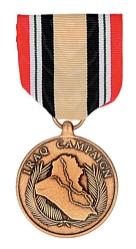
Also, the Iraq Campaign Medal; participants are authorized to
wear a bronze campaign star (BATTLE STAR) on the pendant medal
and ribbon for each of four phases: Liberation of Iraq (19 Mar
2003 - 1 May 2003); Transition of Iraq (2 May 2003 - 28 Jun
2004); Iraqi Governance (29 Jun 2004 - 15 Dec 2005); National
Resolution (from 16 Dec 2005). See CAMPAIGN MEDAL, FRUIT SALAD,
GONG.
-
ICNND :
-
Interdepartmental Committee on Nutrition for National Defense,
formed in 1955 and reorganized in 1967, its research studies
produced the Women Infants and Children (WIC) supplemental
nutrition program (1972), the Food Stamp program (1974), the USDA
School Breakfast program (1975), nutrition programs for the
elderly, military dietary reform, and the establishment of
NIH-funded Nutrition Research Centers.
-
I CORPS / I CTZ :
-
(eye corps, eye C-T-Z) northernmost military region in South
Vietnam. I Corps was one of the four major military and
administrative units of the Vietnamese government in the 1960s
and early 1970s. In particular, I Corps was the Central Vietnam
Lowlands administrative unit and consisted of the five
northernmost provinces: Quang Tri, Thua Thien, Quang Nam, Quang
Tin, and Quang Ngai. The headquarters of I Corps was located in
Da Nang. The major cities in I Corps were Hue, Quang Tri City, Da
Nang, and Chu Lai. I Corps was also known as I Corps Tactical
Zone (I CTZ) and Military Region 1 (MR1). The following U.S.
military units fought in I Corps: 9th Marine Amphibious Brigade,
3rd Marine Division, III Marine Amphibious Force, 1st Marine
Division, 23rd Americal Division, XXIV Corps, 1st Cavalry
Division (Airmobile), 101st Airborne Division (Airmobile), 5th
Infantry Division, and 82nd Airborne Division.
-
ICRC :
-
International Committee of the Red Cross; see RED CROSS.
[nb: mission statement of the worldwide Red Cross organization is
"to improve the lives of vulnerable people by mobilizing the
power of humanity"; the slogan of the International Committee of
the Red Cross is "The Power of Humanity", and its motto is "In
War, Charity" (Inter Arma Caritas), while the slogan of the
International Federation of Red Cross and Red Crescent Societies
is "Protecting Human Dignity", and its motto is "With Humanity,
Towards Peace" (Per Humanitatem ad Pacem)]
-
ID :
-
Infantry Division. Also, identification.
-
IDA :
-
Institute for Defense Analysis.
-
IDAS :
-
Interactive Defense and Attack System, being a SUBMARINE launched
MISSILE system; see SHERWOOD FOREST.
-
ID BRACELET :
-
(eye-dee braycilet) an IDentity or IDentification bracelet is
traditionally a gold or silver linked chain dangle bracelet with
an oval or rectangular plate mounted in-line onto which the
owner's name or initials are engraved; also called a "link
bracelet" or "(love-) slave bracelet", this fashion began with
servicemembers during WWII before the introduction of photo
identification cards. Although some ID BRACELETs engraved the
owner's name and service number, rank and unit on the plate, most
were simple decorations worn with the CLASS-A uniform. Because
most men believed that wearing jewelry as a personal adornment
was effeminate or unmanly, acceptance of the wristwatch during
WWI and adoption of the ID BRACELET during WWII marked a major
stylistic change at the time. In a practice that continued into
the Vietnam-era, soldiers and sailors used these "love-slave
bracelets" as tokens of affection and devotion when forming
"steady" relationships with girlfriends, which was imitative of
"pinning" by college fraternity boys. These link bracelets have
since been dedicated, with the addition of suitable engraving and
a caduceus, as medical alert bracelets, which are often anodized
or plasticized. See BRACELET, PARA-CORD BRACELET, POW-MIA
BRACELET, SHORT SNORTER, CHALLENGE COIN, EARRING, TATTOO, BANGLE,
YELLOW RIBBON; compare DOG TAGS, MEAT MARKER, LUGGAGE TAG. [nb: a
charm bracelet suspends pendant trinkets and dangle ornaments
from the links of a chain bracelet that's worn around the wrist
as decorative signifiers of importance in the wearer's life] [v:
single or double link, rounded or squared connector, twisted
curb, barred marina, elongated figaro, rope cable, and other
chain designs]
-
ID CARD :
-
(eye-dee kard) informal name of the military IDentification CARD,
properly known as the United States Uniformed Services Privilege
and Identification Card, which was formerly called an "AGO card"
and was used (Geneva Conventions Identification Card) to
guarantee servicemembers protection under those treaties, and
known since 1993 as a machine-readable SMART CARD. It originated
during WWII as a tri-fold document with individual photographs
(MUG SHOT) and fingerprints for positive recognition due to the
counterfeiting of DOG TAGS after the attack on Pearl Harbor.
Formerly branch specific [denoted by logo and code (A, AF, N, MC,
CG) until October 1993, thereafter status denoted by color: green
(active duty), blue (retired), tan (dependent or SC-disabled
veteran), red (retired reserve and dependent of reservist)], ID
CARDs are now universal in appearance with military and medical
data barcoded onto the back for servicemembers, with dependent
cards scheduled for renewal every three years. See SERVICE
NUMBER, AGO, DOG TAGS, STERILE, GENEVA CONVENTION, PIC, MWR,
AAFES, NEX, COMMISSARY; compare CAC, SWIPE CARD.
[nb: Vietnamese term: can cuoc] [nb: in 1796, under the auspices
of the Seaman's Protection Act, the United States began issuing
identification certificates to sailors to prevent impressment,
which certificates included the bearer's name, date of birth,
place of birth, height, complexion, and any distinguishing marks,
such as scars, TATTOOs, or deformities; the WWII-era tri-fold
officer ID CARD was AGO WD Form 65-1, the EM ID CARD was AGO WD
Form 65-4, and the Medic ID CARD was AGO WD Form 65-10; active
duty and retiree Common Access Card is DD Form 2, and dependent
Common Access Card is DD Form 1173] [v: Index of
Social Security Numbers (eg: AFSN, ASSN, SSAN)]
-
IDCSS :
-
Initial Defense Communications Satellite System; see DSCS.
-
IDEE FIXE / IDÉE FIXE :
-
(ee-day feeks) literally a "fixed idea", being a persistent idea,
an obsessive preoccupation, or a compulsive fixation that
dominates clear thinking and open practice; in its extreme form,
this mania can be a symptom of psychosis. See PARTY LINE, THE
ARMY WAY, FOR THE HELL OF IT, GOOD ENOUGH FOR GOVERNMENT WORK,
TOE THE LINE, BRASS-COLLAR, HIDEBOUND, BRASSBOUND, BRASS EAR, BOX
HEAD, PRIMROSE PATH, MILITARY MIND, ROUTINE.
-
IDENTIFICATION PANEL :
-
a reversible cloth, sized 2'X2' or 4'X4' with ties and grommeted
eyelets, used for identification of friendly vehicles and
personnel; also called "combat identification panel". These
panels are colored orange on the daytime face, and either tan or
green on the nighttime face, which displays a "cold" square for
thermal imagery. Large panels are mounted on TRUCKs and HUMVEEs,
TANKs and CHOPPERs, while the small panels are mounted on
RUCKSACKs to help regulate COMBAT SPREAD and prevent FRIENDLY
FIRE incidents, especially among SOF personnel. Compare SIGNAL
PANEL, TRON, AIS, BLINKER.
-
IDENTIFICATION THREAD :
-
see ROGUE'S YARN.
-
IDIOT :
-
in its broadest usage, an utterly foolish or incapable person, a
senseless dolt or impetuous boor; but originating as someone of
the lowest order in a former classification system of mental
retardation, which term derives from layman, being a person
lacking in skill or expertise, by analogy with "professional
soldier". Compare USEFUL IDIOTS; see BRUTE, KNUCKLE-DRAGGER,
BUBBA EFFECT, REACTIONARY, WHITE TRASH, ANTI-FEDERALIST,
CONSERVATIVE, CIVILIAN, SILENT MAJORITY, THIRD ESTATE. [v:
imbecile, moron, cretin, amentia]
-
IDIOT BOMB :
-
scornful reference by MIL-PERS to the "exploding cherry blossom"
that was developed by the Imperial Japanese at the end of WWII
from designs for the German V-2 rocket, a supposed successor to
kamikaze and floating chrysanthemum suicide aircraft; it was a
flying bomb, piloted by a volunteer "thunder god", that carried a
2640# payload in the nose of a winged 20ft missile (AGM) that was
launched from a high-altitude bomber to plunge at over 600mph
toward its sea level target.
-
IDIOT BOX :
-
slang for a television (TV) set; also called "boob tube" or
"one-eyed monster"; see CRT, SCREEN, SCOPE DOPE.
-
IDIOT STICK :
-
slang for a rifle, being a disparaging and dismissive referent
for the "primitive club" that's the only weapon a stupid
infantryman is capable of operating; see CROSSED IDIOT STICKS,
GRUNT, CRUNCHY, BOONIE RAT, BLUELEG, INF. Also, by extension, any
of the SMALL ARMS operated by an infantryman in the field; see
SIDEARM, PISTOL, SMG, RIFLE, LMG, MG, MGL, THUMPER, BLOOPER, OVER
'n' UNDER, WEAPON. Also, slang reference to the yoke, balancing
rod, shoulder pole, shoulder bow, or carrying pole used by Asian
laborers to transport heavy loads; see DUMMY STICK, YO-HO POLE;
compare LITTER.
-
IDIOT STICKS :
-
slang for Infantry branch insignia; see CROSSED IDIOT STICKS,
IDIOT STICK. Also, alternative referent for MOX NIX STICKS (qv).
-
IDT :
-
see INACTIVE DUTY TRAINING, RESERVE.
-
IED :
-
(eye-ee-dee) Improvised Explosive Device, being the category for
any low-yield or alternatively detonated devices that incorporate
pyrotechnics or munitions, which are intended to destroy,
incapacitate, harass or distract. An IED consists of five
components: an activating switch, an initiating fuse, a
containment body, the explosive charge, and a power source; the
TRIGGER for such devices include remote-controlled toys,
garage-door openers, and cellphones. IEDs are the primary weapon
used by insurgents because their lethality is effective, being
simple, cheap, abundant, and difficult to detect or disarm; IEDs
are targeted at civil and military capability or authority. See
EFP, MOLOTOV COCKTAIL, SOUP, COCKTAIL, BOOBY-TRAP, TCAP, TATP,
APNC, MOTHER OF SATAN, GAMMON GRENADE, TOE-POPPER, JIEDDO, HME,
VBIED, SVBIED, C-4, EXPLOSIVE, MINE, SYMPHONY, DETONATOR, E-CELL,
DEACTIVATE, EOD, UXO, SABOTAGE.
-
IFAK :
-
(eye-fack) Individual First Aid Kit; also called a "blow-out
kit"; see FIRST AID KIT, FIELD SURGICAL KIT, MED BAG.
-
IFC :
-
Insulated Food Container, being the successor to the MERMITE
container.
-
IFF :
-
Identification Friend or Foe, a confirmation transponder code
broadcast by aircraft flying through various security zones; also
known as "modes and codes" in rhyming slang, which includes the
aircraft's altitude and airspeed as well as its direction and
identification. See SQUAWK, PIPSQUEAK, WEFT, LOCATOR BEACON, IR
MARKERS, VISUAL. [nb: IFF code 7700 is reserved for emergency
SQUAWK]
-
IFFV :
-
(eye-eff-eff-vee) First Field Force Vietnam, originating as Task
Force Alpha to provide corps level support to the South
Vietnamese in the Central Highlands from 1 August 1965 to 30
April 1971; headquartered in NhaTrang, it was redesignated IFFV
in March 1966.
-
IF IT AIN'T BROKE - DON'T FIX IT :
-
an idiomatic expression made famous in Nation's Business
by Bert Lance, the director of the Office of Management and
Budget for the Carter Administration who was compelled to resign
in 1977 over financial irregularities; this folk adage refers to
a HARD-AND-FAST event horizon.
[nb: "Bert Lance believes he can save Uncle Sam billions if he
can get the government to adopt a single motto: 'If it ain't
broke, don't fix it.' He explains: 'That's the trouble with
government: fixing things that aren't broken and not fixing
things that are broken.'" by Bert Lance, Nation's Business
(1977); "The worst rule of management is: 'If it ain't broke,
don't fix it.' In today's economy, if it ain't broke, you might
as well break it yourself, because it soon will be." by Wayne
Calloway, CEO PepsiCo (11 March 1991); "We do not get all the
government we pay for -- thank God." by Milton Friedman on ABC-TV
David Brinkley Show (4 Oct 1992); "If it is not necessary
to change, it is necessary not to change." by Lucius Cary, House
of Commons speech (22 Nov 1641)]
-
IF IT WEREN'T FOR THE HONOR OF THE THING :
-
a humble disclaimer that sardonically excuses the inescapable
fact of the matter, as expressed: "If it weren't for the honor of
the thing, I'd just as well forgo it."; this expression most
often refers to those acts (and their consequences) over which
the MIL-PERS believes that he had no choice (that is, was morally
obliged to act), as when risking his life to complete the mission
(ie: an "ordinary person doing an extraordinary thing") or when
doing one's duty by extending one's best efforts in the
completion of some course or assignment. See GUTS, MOXIE, ONIONS,
DIEHARD, SUMMUM BONUM, MORE HONORED IN THE BREACH THAN THE
OBSERVANCE, CUSTOMS AND COURTESIES OF THE SERVICE, TRADITION,
VETERAN, WINTER SOLDIER, QUIET PROFESSIONAL, BADGE OF HONOR. [cf:
"wight" is a human being, who is defined as such by his ability
to fight, hence is someone who's strong and brave in war] [nb:
"if it wasn't for the honor (of being tarred and feathered and
ridden out of town on a rail), I'd rather walk."]
-
IFR :
-
Instrument Flight Rules; compare VFR, IMC, IIMC, POPEYE, VOR.
-
IFRC :
-
(originally the League of Red Cross Societies) International
Federation of Red Cross and Red Crescent Societies; see RED
CROSS.
[nb: mission statement of the worldwide Red Cross organization is
"to improve the lives of vulnerable people by mobilizing the
power of humanity"; the slogan of the International Committee of
the Red Cross is "The Power of Humanity", and its motto is "In
War, Charity" (Inter Arma Caritas), while the slogan of the
International Federation of Red Cross and Red Crescent Societies
is "Protecting Human Dignity", and its motto is "With Humanity,
Towards Peace" (Per Humanitatem ad Pacem)]
-
IFSAR :
-
InterFerometric Synthetic Aperture Radar; see SRTM, ISAR, SAR.
-
IF THERE'S ONE :
-
a catch-phrase ("If there's one, there's a multitude!") that's
been said of insects and Orientals (YELLOW PERIL) and implies a
plethora from scant evidence; any portent, prophesy, or
prediction made from the only known or knowable part of the
subject or situation. This inferential expression has also been
represented as "If you see one, there's more!", and as a
precursor, harbinger, or forerunner, it has been alluded to in
similes such as "the smoke from many campfires", "the tip of the
iceberg", "the ears of the hippopotamus", "the nose of the
crocodile", and so forth ... these manifest allusions, seemingly
small and superficial, each incorporating a threat, imply that
there is more to follow and worse to come from what is hidden.
Such beginnings must be contrasted with "false leads", which
attempt deductions with insufficient proof, such as "One bugle
does not announce an army.", "One bloom does not make a spring.",
"One robin does not make a spring.", "One swallow doesn't make a
summer.", and the like. Compare CAMEL'S NOSE, RIPPLE EFFECT, LAW
OF UNINTENDED CONSEQUENCES; see MOSQUITO WING, HORDE, THUNDERING
HERD. [v: paradox]
-
IF YOU SEE ONE :
-
see IF THERE'S ONE.
-
IG :
-
(eye-gee) Inspector General; also called The Inspector
General (TIG) by USAF. See VFR DIRECT.
-
IGNITE THREE ON A MATCH :
-
see THREE ON A MATCH.
-
I'VE GOT YOUR BACK :
-
an ungrammatical SLOGAN intended to convey faithfulness; this
well-intentioned sentiment that ostensibly promotes the virtues
of loyalty and solidarity is actually a romantic cliché of
boundless honor, because military servicemembers are subject to
orders, hence this pronouncement underscores the vulnerability of
MIL-PERS, and is a testament to their wishful thinking. Compare
DEATH BEFORE DISHONOR, LOYALTY UP - LOYALTY DOWN, TRUE BLUE; see
DUTY, CODE OF CONDUCT, OATH, PLEDGE OF ALLEGIANCE, HONOR CODE,
PROMISE, CREED, CORE VALUES, MORALITY, SUMMUM BONUM, LOYALTY
CODE, TRADITION, TOE THE LINE.
-
I HAVE NOT YET BEGUN TO FIGHT :
-
a famous BATTLE CRY issued on 23 September 1779 by John Paul
Jones, captain of the "Bonhomme Richard" (Poor Richard), named in
honor of Benjamin Franklin, when invited to surrender by the
larger and better gunned "Serapis" after beginning a naval battle
off the east coast of England. After engaging, Jones lashed the
two ships together, and had to transfer his survivors to the
British frigate once they'd struck their colors ... this is the
only known instance wherein the victor has lost his own ship and
returned in a captured vessel. Although this quote has been
disputed, it represents America's willingness to endure great
hardship to achieve its goals. Jones' exploits as a Scottish-born
naval adventurer have been celebrated by Philip Freneau, James
Fenimore Cooper, Herman Melville, Sarah Orne Jewett, Winston L.S.
Churchill, and James Boyd; his 1792 gravesite was forgotten in
France until rediscovered in 1905, then interred at Annapolis.
[nb: "I wish to have no connection with any ship that does not
sail fast; for I intend to go in harm's way." by John Paul Jones
(16 Nov 1778)]
-
II :
-
morse code shorthand abbreviation for "I'm ready" or transmit;
compare EOT, GA, R; see CW.
-
I&I :
-
Intelligence and Interdiction, or I & I / I-and-I FIRE, being
planned night artillery fire aimed at suspected enemy locations,
disturbing their sleep, curtailing their movement and lowering
their morale through threat of losses. See H&I, HARASSMENT
FIRE, DUFFEL BAG. Also, intoxication and intercourse, as an
ironic abbreviation used in lieu of R&R; see STEEL BEACH.
-
II CORPS / II CTZ :
-
(two corps, two C-T-Z) Central Highlands military region in South
Vietnam. II Corps was also known as II Corps Tactical Zone (II
CTZ) and Military Region 2 (MR2).
-
IID :
-
abbreviation for Improvised Incendiary Device, being a
combustible container of napalm, thermite, white phosphorous or
the like, that burns with an intense heat; compare IED, HME; see
SOUP, COCKTAIL, MOLOTOV COCKTAIL, FLAMMABLE.
-
IIFFV :
-
(eye-eye-eff-eff-vee) Second Field Force Vietnam, providing corps
level support for the South Vietnamese in the Mekong delta
region; established at Bien Hoa and Long Binh in March 1966, it
was disbanded in May 1971.
-
IIFS :
-
Individual Integrated Fighting System, being a transitional
equipment carrying system (including pouches, belt, harness, and
pack) that experimented with prototypical ILBE and MOLLE gear
arrangements.
-
III CORPS / III CTZ :
-
(three corps, three C-T-Z) military region between Saigon and the
Highlands, including WAR ZONEs C and D. Major cities included Da
Lat, Cam Ranh, Cu Chi, Nha Trang. III Corps was also known as III
Corps Tactical Zone (III CTZ) and Military Region 3 (MR3).
-
III MAF :
-
(three maff) Third Marine Amphibious Force, the senior
corps-level command for USMC units in VN; including 1st Mar Div,
3rd Mar Div, RLTms, CAG, and Spt BDEs. Created 6 May 1965 as III
Marine Expeditionary Force, then renamed on 7 May 1965 due to
connotations with French "expeditions" by the Vietnamese. See
MAB, MEB, CAP; compare LONELY HEARTS.
-
IIMC :
-
Inadvertent Instrument Meteorological Conditions, being an
alternative description of Instrument Meteorological Conditions
(IMC), due to unavoidable flight into clouds, dust, or other
obscurity; commonly called POPEYE. See WHITEOUT, BROWN-OUT,
ZERO-ZERO, GOO, FLAT LIGHT; compare IFR, VFR, VOR, VECTOR.
-
IIR :
-
Imaging InfraRed, being a heat sensor with enough resolution to
form images; see IR.
-
IISR :
-
Integrated Intra-Squad Radio, being a compact two-way transciever
used by conventional field elements during the GULF WAR; see
WALKIE-TALKIE, SINCGARS, RADIO.
-
IKE JACKET / EISENHOWER JACKET :
-
see BATTLE JACKET.
-
ILBE :
-
(eye-el-bee-ee) Improved Load-Bearing Equipment, being a system
that uses the PALS grid-work to securely position small items on
a larger backpack (RUCK / RUCKSACK) with a smaller profile for
Marine Corps carry into combat; this Commercial Off-The-Shelf WEB
GEAR system supersedes the ALICE and MOLLE systems.
-
ILLEGAL ENEMY COMBATANT :
-
persons who have conspired or committed acts of international
terrorism, or have as their aim to cause injury to or cause
adverse effects on the United States, its citizens, national
security, foreign policy, or economy, said individuals may be
fought, detained, and tried for such transgressions in the War
Against Terrorism (effective 13 Nov 2001). A person, having
supported or engaged in hostilities against the United States and
its allies, and who has been determined to be an unlawful enemy
combatant by the enactment of the Military Commissions Act (2006)
or a Combatant Status Review Tribunal, such that If civilians
directly engage in hostilities, they are considered 'unlawful
combatants' or 'unprivileged belligerents', and they may be
prosecuted under the domestic law of the detaining state for such
action. See CIVILIAN, BABY BRIGADE, MERCENARY, SPY, GUERRILLA,
INSURGENT, IRREGULARS, MILITIA, MIL-PERS; compare POW. [nb:
because the VIETNAM WAR was not formally declared, North Vietnam
regarded American captives as "criminals" without the civil
rights protection of a prisoner of war (POW)]
-
ILLEGITIMI NON CARBORUNDUM :
-
see ILLEGITIMIS NIL CARBORUNDUM.
-
ILLEGITIMIS NIL CARBORUNDUM :
-
this counterfeit Latin phrase, which has also been concocted as
"illegitimi non carborundum", "noli illegitimi carborundorum",
and "illegitimatum uncarborundum", has been widely used to
express, in a falsely pretentious or fake pontifical manner, the
positive encouragement: "don't let the bastards grind you down".
Aside from the fact that the Latin word for 'bastard' is "nothus"
and that carborundum (trademark for a compound of fused
abrasives) wasn't manufactured until 1891, this phrase seems to
be a misunderstanding of a passage in the Commentarium in
Leviticum of Evagrius Ponticus, which apparent corruption is
traceable in English to a line of John Donne; the original text
should probably be "Ne illegitimi carbunculi tibi in facie sint"
(now idiomatically: "Don't let the bastards grind you down!").
The first attested modern employment of this euphemism was in a 4
April 1920 sermon delivered at Fort Bragg NC; its almost
immediate widespread dissemination was due to it being reported
by H.L. Mencken in an article (p4 Baltimore Sun Monday 5
April 1920) titled "Nursing as a Profession".
[v: mottoes and nicknames of military
units]
-
ILLUM :
-
illumination; primarily being flares dropped by aircraft and
fired from the ground by hand, artillery or mortars, but not to
exclude tower- or vehicle-mounted searchlights; see FLASHLIGHT,
LIGHT STICK, FLARE, MOONBEAM, FIREFLY, MOONLIGHT, LOOM, PINK
TIME.
Also, illuminate; the targeting and guidance of weapons on an
object or objective, as by RADAR, laser, or infrared (IR); which
is distinguished from PAINT, being the designation and tracking
of an object or objective. See LOCK-ON, LASER AIMING DEVICE, GLD,
SALH, PAVEWAY, LANTIRN, LADAR, MILES, SQUAWK, PGM, ECM.
-
I LOVE ME SHRINE :
-
see POWER WALL.
-
ILS :
-
Instrument Landing System, being a radio beam system coupled with
the Global Positioning System (GPS) that can guide aircraft onto
a RUNWAY for a safe landing under severe weather conditions;
compare ALS, see TOUCHDOWN, THRESHOLD, BOUNCE, PANCAKE, AUGER-IN.
-
IL-28 :
-
Soviet jet bomber supplied to North Vietnam but never used in
combat by the NVN Air Force.
-
IM :
-
Instant Messaging; being a wireless form of communication focused
on immediate end-user delivery without the use of typical e-mail
computer architecture or hardware; see SMS, ELECTRONIC PACIFIER,
BURNER, TAC-CHAT, TELEPHONE, EMOJI.
-
IMAGE-CONVERTER TUBE :
-
an electron tube that receives a pattern of radiation, as
infrared, ultraviolet, or x-ray, on a photosensitive surface and
reproduces the pattern on a fluorescent screen; also called
"image tube". See SNOOPERSCOPE, ELECTRONIC CAMPFIRE. [v:
optoelectronics, metascope]
-
IMC :
-
Instrument Meteorological Conditions, also known as "Inadvertent
Instrument Meteorological Conditions" (IIMC), and commonly called
POPEYE; compare IFR, VFR, VOR, VECTOR.
-
IMINT :
-
IMage INTelligence, information developed from various
imaging techniques.
-
IMJIN SCOUT :
-
(forthcoming);
see ACTA; compare RECONDO, Q-COURSE, COC, CHARM SCHOOL.
-
IMMEDIATELY :
-
accomplished at once or instantaneously, done without any delay
or intervening interval; see FORTHWITH, ASAP, PDQ, CHOGI, CHOP
CHOP, RIKI TIK, STAT, TIME. [v: tout de suite (French: at once,
immediately); cf: directly, presently]
-
IMMELMANN :
-
a controlled aerial maneuver in which an airplane makes a half
loop followed by a half roll, which is used to gain altitude
while reversing the direction of flight; eponymously derived from
technique developed by Max Immelmann, a WWI Imperial German
PILOT. A "Double Immelmann" is one looped turn on top of the
other, usually taking the airplane in the same direction when it
started the first Immelmann. Compare SPLIT-S; see AEROBATICS.
-
IMMERSION FOOT :
-
(forthcoming); see TRENCH FOOT, PADDY FOOT
-
IMMERSION HEATER :
-
a portable heater for mounting onto the side of a GI CAN for
heating water to be used in cooking (eg: submerged cans) or
cleaning (eg: sanitizing MESS KITs). Although the military
version of this appliance is gas-powered and vented through a
rudimentary chimney, and has been part of the FIELD KITCHEN since
WWI, the same principle is used on electric water heaters and
cup-sized beverage heaters.
-
THE IMMORTALS :
-
the select BODYGUARD of the kings of ancient Persia; compare THE
NINE WORTHIES, see PALACE GUARD, POLITROOPER.
-
IMMUNE SERUM :
-
a serum containing naturally or artificially produced antibodies
to a given antigen, as obtained from human or animal sources;
compare BLOOD SERUM, see BLOOD.
-
IMPACT AREA :
-
the area bounded by the designated fall limits of the ordnance
employed, whether inert or explosive, on or off target; see POINT
OF IMPACT, DEFLECTION, ZONE OF FIRE, KILL ZONE.
-
IMPACT AWARD :
-
an award presented by a senior officer to an individual for
conspicuous valor or outstanding achievement, as soon after the
action or event as possible, often on the battlefield or in the
hospital; criteria specifically excludes such impromptu awards
for merit and to units. See V-DEVICE, JOCKSTRAP MEDAL, BADGE OF
COURAGE, GONG.
[nb: pagan Norsemen awarded metallic bracelets in recognition of
meritorious or valorous deeds]
-
IMPACT CRATER :
-
see CRATER; compare CAMOUFLET.
-
IMPERIALISM :
-
a policy of extending the rule or the practice of extending the
authority of one state over the peoples and interests of foreign
countries; the act of acquiring and holding colonies or
dependencies. [v: imperial, imperious]
-
IMPERIAL PALACE :
-
slang for the headquarters of U.S. Army Europe (HQUSAREUR) in
Heidelberg (1948-2013), due to its elaborate pomp and extensive
ceremony, which battalion-sized command has also been colocated
with the headquarters elements of 7th Army (including V and VII
Corps, 1st and 4th Inf Divisions, 28th and 43rd Inf Divisions,
2nd Armored Division and Constabulary cavalry regiments), Supreme
Headquarters Allied Expeditionary Forces (SHAEF), U.S. Forces
European Theater (HQUSFET), European Command (HQEUCOM), and the
U.S. Office of Military Government; compare PUZZLE PALACE,
MADHOUSE, PINK PALACE, IVORY TOWER, HQ; see FIVE O'CLOCK FOLLIES,
DOG 'n' PONY SHOW, HEADQUARTERISM.
Also, the royal citadel in the imperial city of Hue (aka: "Purple
City" or "Forbidden City"), being the capital of Vietnam in
Annam, situated beside the Perfume River (Song Huong) on Highway
One (QL 1 or STREET WITHOUT JOY) north of DaNang, which was
heavily contested during the (31 Jan - 2 Mar) 1968 Tet Offensive.
-
IMPERIUM :
-
supreme administrative power; the ultimate command authority; the
imperative right to command the force of the state in order to
enforce the law. Also, a nation having complete control or
exerting supreme power; the dominion of a superpower.
-
IMPORTANT THINGS ARE SIMPLE :
-
the salient portion of a Murphy Law of Combat: "The important
things are always simple; and the simple things are always hard!"
-
IMPOSSIBLE / IMPOSSIBILITY :
-
that which is unable to be performed or effected, such as an
impossible assignment. Also, that which is difficult beyond
reason or is utterly impracticable, such as an impossible plan or
an impossible situation. See BLUNT FORCE, CUT THE GORDIAN KNOT,
ALEXANDRIAN SOLUTION, PING-PONG.
[v: pons asinorum (Latin: insolvable problem (literally: "bridge
of asses")] [nb: "If it is only difficult, it is done; if it is
impossible, we shall see." by Charles-Alexandre de Calonne
(ca1790); "The difficult is done at once; the impossible takes a
little longer," by Anthony Trollope (1873); "'Difficulties' is
the name given to things which it is our business to overcome."
by ADM Ernest J. King (1942); "The difficult we do immediately.
The impossible takes a little longer." U.S. Army Service Forces
motto (1945); "We are the invisible doing the impossible in a
place unknown." soldier sentiment during KOREAN WAR; "Never have
so few been led through such difficulty to do what's right for so
many who thought so little of it!" soldier sentiment during GULF
WAR; "It's kind of fun to do the impossible." attributed to Walt
Disney (1982); "If it exists it must be possible." Boulding's
Law; "It is difficult to say what is impossible, for the dream of
yesterday is the hope of today and the reality of tomorrow." by
Robert Goddard; "So many of our dreams at first seem impossible,
then they seem improbable, and then, when we summon the will,
they soon become inevitable." by Christopher Reeve; "Those who
dream by day are cognizant of many things which escape those who
dream only by night." by Edgar Allen Poe; "All men dream: but not
equally. Those who dream by night in the dusty recesses of their
minds wake in the day to find that it was vanity: but the
dreamers of the day are dangerous men, for they may act their
dream with open eyes, to make it possible." by T.E. Lawrence;
"Some men see things as they are and ask 'Why?' Others dream
things that never were and ask 'Why not?'" by George Bernard
Shaw; "There are many things that are unbelievable, especially
before breakfast, is it not?" by Agatha Christie; "I daresay you
haven't had much practice believing impossible things; when I was
your age, I always did it for half an hour a day ... why,
sometimes I've believed as many as six impossible things before
breakfast." paraphrase of Lewis Carroll (Charles Lutwidge
Dodgson); "Confronted with the impossibility of remaining
faithful to one's beliefs, and the equal impossibility of
becoming free of them, one can be driven to the most inhuman
excesses." by James Baldwin]
-
IMPOUND / IMPOUNDMENT :
-
to seize and confine, as to retain someone or something in the
custody of the law; to legally secure and hold forfeitures;
compare COMMANDEER, see SEQUESTRATION. [cf: appropriation,
expropriation, requisition, purveyance, confiscation, preemption,
eminent domain]
-
IMPRESS / IMPRESSMENT :
-
see COMMANDEER, PRESS-GANG, SHANGHAI, DRAGOON, SLAVE / SLAVERY.
-
IMPRISON / IMPRISONMENT :
-
see PUNISH / PUNISHMENT, CHL, CROSSBAR HOTEL, BRIG, TANK, LBJ,
USDB, THE CASTLE, HOT HOUSE, MONKEY HOUSE, ADULT DAY CARE CENTER,
CLUB FED, GUARDHOUSE, STOCKADE, REEDUCATION, INTERNAL EXILE,
CONCENTRATION CAMP, GULAG, LAOGAI, POW CAMP, DEADLOCK, DEADLINE.
-
IMPROVISE / IMPROVISATION :
-
done without previous preparation, or provided from resources
readily at hand; to makeshift or stopgap; any make-do production
or extemporaneous arrangement, from GAMMON GRENADE and ZIP GUN to
MICKEY MOUSE BATTLESHIP and HILLBILLY ARMOR. See ASYMMETRIC
WARFARE, UW, PROVISIONAL, STRONGPOINT, COMPARTMENTALIZATION,
FIELD EXPEDIENT, JURY-RIG, JERRY-BUILT, WORK-AROUND, PATCH,
PUTAINESQUE, BAND-AID, AD HOC, LEAST RESISTANCE, CROSS-DECKING,
SEAT OF THE PANTS, ADAPT / ADAPTABILITY, PARETO EFFICIENCY
PRINCIPLE, GOOD ENOUGH FOR GOVERNMENT WORK, BOONDOGGLE, OFF THE
RESERVATION, OUTSIDE THE WIRE, PLAN B, RUBE GOLDBERG.
[nb: "Anybody that knows American military history knows that the
American military, actually, in most wars, gets off on the wrong
foot, and we sort of figure it out because, intellectually, we're
very adaptable, and then we become operationally very flexible as
a result of it. And it's true in just about every major war we've
fought, with some exceptions." by GEN Jack Keane; "The misuse or
abuse of something is no argument against its proper use."
variously attributed to Paracelsus, Virgil, and Aquinas]
-
I'M SAFE :
-
a mnemonic acronym for Illness, Medicines, Stress, Alcohol (or
illicit drugs), Fatigue, Emotion, being a checklist of
particulars to determine if a member of the aircraft's flight
crew is mentally and physically capable of performing the
requisite aviation tasks.
-
IMT :
-
International Military Tribunal. The London Agreement between the
Allied representatives of the Soviet Union, Great Britain,
France, and America on 8 August 1945 sponsored Law Ten of the
Allied Control Council, which instruments authorized the Charter
of the International Military Tribunal, and established its
methodology. The Charter of the IMTribunal authorized the trial
of wartime suspects whose acts crossed national boundaries; while
suspects whose acts were localized were to be tried separately by
the Occupation Zone nation having jurisdiction. All four of these
war crimes' courts operated according to its own national
procedures, but each was governed by the IMT Charter. The IMT was
based in Berlin, located in the USSR Occupation Zone, and the IMT
trials were convened in November 1945 at the Palace of Justice in
Nuremberg, situated in the US Occupation Zone. Each Occupation
force appointed a judge, a judicial alternate, a prosecutor, and
a prosecutorial staff, while the defendants chose their own legal
counsel. The charges brought were: conspiracy to wage aggressive
war; waging of aggressive war in violation of treaties; war
crimes; and crimes against humanity. Twenty-two defendants and
eight organizations were charged, resulting in guilty verdicts
for nineteen convicts (12 hanged, 7 incarcerated, 3 acquitted),
and four organizations. The IMT heard appeals after sentencing,
and disbanded on 16 October 1946 as soon as the sentences were
executed. See IMTFE, ICC, UNWCC, ROE, WAR CRIMES TRIAL, HAGUE
TRIBUNAL, LAWS OF WAR; compare UCMJ.
[nb: "That four great nations, flushed with victory and stung
with injury, stay the hand of vengeance and voluntarily submit
their captive enemies to the judgment of the law, is one of the
most significant tributes that power has ever paid to reason." by
Robert D. Jackson in an opening statement at Nuremberg]
[nb: the prosecutors in the 1942 "Pastorius" Nazi saboteurs'
trial respectively became the chief justices of the WWII war
crimes trials of Axis defendants: Attorney General Francis Biddle
was senior US judge at Nuremberg, and Army Judge Advocate General
Myron C. Cramer was the US judge at Tokyo] [v: mittimus]
-
IMTFE :
-
International Military Tribunal for the Far East. The IMTFE was
conducted in Tokyo from 3 May 1946 to 12 November 1948 by judges
and prosecutors from each of the eleven Allied nations:
Australia, Canada, China, France, Great Britain, India, the
Netherlands, New Zealand, the Philippines, the Soviet Union, and
the United States of America. The IMTFE Charter was written by
General Douglas MacArthur, the Supreme Allied Commander, and
Joseph Keenan, the US chief prosecutor. The indictment accused
the defendants of promoting a scheme of conquest that
"contemplated and carried out ... murdering, maiming and
ill-treating prisoners of war [and] civilian internees ...
forcing them to labor under inhumane conditions ... plundering
public and private property, wantonly destroying cities, towns
and villages beyond any justification of military necessity;
[perpetrating] mass murder, rape, pillage, brigandage, TORTURE
and other barbaric cruelties upon the helpless civilian
population of the over-run countries." Of the eighty Class-A war
criminal suspects detained in Sugamo prison after 1945,
twenty-eight were brought to trial before the IMTFE. The accused
included nine civilians and nineteen military professionals.
Unlike the IMT, all the defendants were found guilty; with two
defendants dying of natural causes, seven executed by hanging,
sixteen sentenced to life imprisonment, two to lesser sentences,
and one incarcerated in a mental institution ... all survivors
had been paroled by 1956. In a separate trial, conducted 25-30
December 1949, twelve Japanese from the top-secret TAMA
Detachment, who had been accused of bacteriological experiments
on prisoners in Manchuria, were convicted by the USSR. See ICC,
IMT, UNWCC, WAR CRIMES TRIAL, HAGUE TRIBUNAL, LAWS OF WAR, ROE;
compare UCMJ.
[nb: the prosecutors in the 1942 "Pastorius" Nazi saboteurs'
trial respectively became the chief justices of the WWII war
crimes trials of Axis defendants: Attorney General Francis Biddle
was senior US judge at Nuremberg, and Army Judge Advocate General
Myron C. Cramer was the US judge at Tokyo] [v: mittimus]
-
INACTIVE DUTY TRAINING :
-
authorized training performed by a member of a RESERVE COMPONENT
who's not on active duty or active duty for training, which
consists of regularly scheduled unit training assemblies,
additional training assemblies, periods of appropriate duty or
equivalent training, and any special additional duties authorized
for these reservists by the Secretary concerned, and performed by
them in connection with the prescribed activities of the
organization in which they are assigned, with or without pay; IDT
does not include work or study associated with correspondence
courses. See ACTIVE DUTY FOR TRAINING, AT, RESERVE.
-
INACTIVE NATIONAL GUARD :
-
(forthcoming);
-
INALIENABLE RIGHTS :
-
(forthcoming); [cf: Chinese "mandate of heaven"]
-
IN-BATTERY :
-
ready, ready to work, ready to fire; see UNLIMBER, ARTY; compare
LOCK 'n' LOAD, GOOD TO GO, MISSION READY, COMBAT LOADED, OP
TEMPO, FAT, SADDLE-UP, MOVE OUT, HOOPLA, BATTAILOUS.
-
INBOARD :
-
located at or toward the interior of a craft or vessel (eg:
inboard side of BITTER END); situated nearest to the center,
being opposite of OUTBOARD [ie: as when differentiating inboard
engines (nearest to the fuselage) from outboard engines (farthest
out on the airplane's wing)].
-
INCARCERATE / INCARCERATION :
-
see PUNISH / PUNISHMENT, CHL, CROSSBAR HOTEL, BRIG, TANK, LBJ,
USDB, THE CASTLE, HOT HOUSE, MONKEY HOUSE, ADULT DAY CARE CENTER,
CLUB FED, GUARDHOUSE, STOCKADE, REEDUCATION, INTERNAL EXILE,
CONCENTRATION CAMP, GULAG, LAOGAI, POW CAMP, DEADLOCK, DEADLINE.
-
INCENDIARY :
-
any substance or device that can be ignited so as to burn with an
intense heat, especially when used as a weapon; see NAPALM,
PHOUGAS, MOLOTOV COCKTAIL, FLAMETHROWER, ZIPPO, WP, THERMITE,
ROCK FIRE, GREEK FIRE, COCKTAIL. [v: pyromachy]
-
INCENSE :
-
see JOSS STICK, SPICE, VOODOO, HOODOO, MOJO, ANTHROPOMORPHISM,
MASCOT, INCENSE CLOCK.
-
INCENSE CLOCK :
-
(forthcoming); see JOSS STICK, SPICE, TIME.
-
INCH WORM :
-
a physical training exercise wherein someone, beginning from the
upright standing position, bends forward at the waist so as to
place their hands on the ground immediately before their feet,
then moves by alternating their hands until their body is in a
modified push-up position, whereupon their hands may be walked
back to their feet, or their feet can be walked to their hands,
until the individual is once again in the bent-over posture with
the exercise finishing by recovering the bent-over person to the
fully erect upright starting position; this exercise may be
performed in a PT formation, or singly as a work-out, or as
physical punishment.
-
INCLINOMETER :
-
a form of magnetometer, consisting of a magnetic needle pivoted
through its center of gravity and having its axis through the
vertical plane of the earth's magnetic meridian so as to point in
the direction of maximum magnetic intensity; also known as a DIP
NEEDLE, being an aeronautical instrument used for measuring the
angle that an aircraft makes with the horizontal, or artificial
horizon for orientation or ATTITUDE ADJUSTMENT. [nb: not
'clinometer']
-
INCOC :
-
(in-cock) Infantry Non-Commissioned Officer's Course, being a
division-level training course established to promote leadership
skills among promising junior Non-Coms, especially in combat
theaters; see CHARM SCHOOL, LPC, NCOCC, NCOA, SHAKE 'n' BAKE,
LDR, UP OR OUT.
-
INCOME TAX :
-
a graduated assessment levied on the annual incomes of
individuals and corporations; administered by state and federal
bureaus, the monies from taxes (including property, capital
gains, inheritance, excise, and sales) are collected into a
general fund that's apportioned and disbursed by the
legislatures. The first American income tax (1864-72) was
instituted to pay for the CIVIL WAR; it was then made permanent
by the 16th Amendment (1913) following a constitutional
challenge, whereupon its rate was increased [v: War Revenue Act
(1917)] to fund American involvement in the Great War (WWI) ...
income taxes have yielded as much as 85% of government revenue
since 1919. The income tax is progressive, offering certain
deductions and exemptions, with the corporate rate structured
like the individual schedule. Compare SAVINGS BOND, T-BILL; see
TAXPAYER, LEGAL TENDER, WAR CHEST. [nb: Great Britain levied an
income tax (1799-1816) to fund the Napoleonic Wars]
-
IN-COMING :
-
an alert notice or description of receiving enemy MORTAR or
ROCKET fire; also called "in-coming mail". See HIGH ANGLE
HELL, TURN TURTLE, WHIZ BANG. [cf: bombard as the earliest type
of indirect cannon launching stones, from "noise" (bomb) and
"stone-throwing engine" (bombarda)] [nb: this term should
probably be spelled 'incoming' except for the fact that it's
always pronounced "IN COMING!" ... sorry 'bout that, but combat
is frequently ungrammatical]
-
IN COUNTRY / IN-COUNTRY :
-
the designated hostile area, specifically Vietnam, but not the
geographic limit of the war; compare OUT COUNTRY, UP COUNTRY; see
INDOCHINA. Also, by extension of earlier VIETNAM usage, any
combat zone or hazardous duty assignment overseas; see FEBA, MLR,
FLOT, FRONT LINE, INDIAN COUNTRY, SANDBOX, DOWN RANGE, BOONDOCKS
/ BOONIES, THULE, FIELD ALLOWANCE.
-
INCURSION :
-
the hostile entry of a place, or the military penetration of a
territory, as an expeditionary raid or inroad for defined or
limited objectives; as distinguished from an INVASION for
enduring conquest or perpetual occupation.
[v: anabasis; cf: katabasis, excursion] [nb: Lam Son 719 (8 Feb -
9 Mar 1971) was restricted to interdiction of infiltration routes
through the southern panhandle of Laos] [nb: the Cambodian
INCURSION (30 April - 30 June 1970) was limited to 30km from the
SVN border; as SOG missions were restricted to 20km inside Laos
and Cambodia]
-
INDECISION INDECISIVE :
-
to waver in mind, judgement, or purpose; the inability to decide;
to be irresolute or vacillating in opinion. See RUN IT UP THE
FLAGPOLE, NOSE COUNT, EYE-CHECK, BULLFROG CHORUS, RUNNING DOG,
POPULARITY CONTEST, REASSURANCE. [nb: "If you cannot decide which
is the best between two good options, then you should abandon
them both, and select a better third alternative." military
maxim]
-
INDEPENDENCE DAY :
-
a national holiday, recurring on 4 July each year, commemorating
the adoption of the Declaration of Independence in 1776 by the
Continental Congress on behalf of the American colonies, which
led to the AMERICAN REVOLUTION; American independence was
actually declared on 2 July by the Second Continental Congress,
but the document was not signed until 4 July 1776. Compare
MEMORIAL DAY, VETERANS' DAY, PATRIOT DAY, PATRIOT'S DAY, FLAG
DAY, ARMED FORCES DAY, POW-MIA DAY; see LIBERTY ENLIGHTENING THE
WORLD. [nb: many civilians confuse the meaning of the principal
national holidays, combining each and commemorating all together
at each date; instead of according honors to military
servicemembers on Armed Forces Day, honors to veterans on
Veterans' Day, and honors to the war dead on Memorial Day]
-
INDIA :
-
the word assigned to represent the letter "I" in the
international phonetic alphabet; at various times in different
spelling schemes, it has also been acrophonetically represented
as Item and Inter. This is a "governing flag" in US Navy signals
that also represents "interrogatory". See ALPHABET SOUP, PHONETIC
ALPHABET. [v: Alphabet Codes & Signal Flags]
-
INDIAN COUNTRY :
-
hostile territory, especially in the field or jungle, as any
areas contested by the enemy remote from BASE CAMPs or cities;
also called "Apache country"; see FEBA, MLR, FLOT, FRONT LINE,
IN-COUNTRY, SANDBOX, DOWN RANGE, BOONDOCKS / BOONIES, THULE,
FIELD ALLOWANCE.
[nb: following the Wild West motif prevalent in LBJ's "little
pissant war", numerous allusions to a mythic frontier adventurism
were utilized; including COWBOY, DODGE CITY, and GUNSLINGER.]
-
INDIAN FILE :
-
informal designation for the alignment of a small unit, from
SQUAD to platoon (PLT) size, when operating in a hostile area and
arranged in single FILE (one behind another), with proper
interval, and exclusive of flank security; also called "Ranger
file" or "Conga line". See STACK, COMBAT WALK, COMBAT SPREAD,
ACCORDION, CATERPILLAR, HEADWAY; compare COLUMN.
-
INDIAN ROPE TRICK :
-
a staged performance by a mystic who seemingly levitates a coiled
rope straight into the air, whereupon he climbs this upright rope
and disappears, pulling the rope up into oblivion with him; a
virtuoso act of legerdemain purportedly practiced by fakirs and
swamis since ancient times, and made notorious by the publicity
about this conjuring hoax as reported by Western travelers to
India and China in the 19th century. Several more elaborate
variations of this illusion exist in the lore of magic shows,
some more dramatized than others, some involving assistants and
reappearances, but this deception is essentially an escape gambit
that, as such, has often been used as an "explanation" when a
tracking team loses contact with the enemy, justifying their
failure by claiming that "When we followed them to this point,
they then pulled the ol' Indian rope trick and disappeared!" This
same concept is also expressed, more crudely, as "They crawled up
inside their own assholes and vanished!"
-
INDIAN SIGN :
-
in TRACKing or TRAILing, those clues and cues that are obscure
(if not invisible) to the unskilled; see CASTOFF, PECKER TRACKS,
TRACE, SIGN, BEAT AROUND THE BUSH. [v: pug / pug marks] Also, a
primitive type of magical power or evil eye, not unlike a hex or
enchantment; see JUICE, SPIDER SENSE, MOJO, JUJU, GRIGRI, VOODOO,
HOODOO, ABRACADABRA.
-
INDIAN TELEGRAPH :
-
a relay of runners who pass an important message or concise INTEL
report along by word-of-mouth over variable distances, as from
outpost to outpost or village to village, so as to forewarn of
impending danger or a coming threat or crisis; originating among
Western AmerIndian tribes during encounters with U.S. Army
cavalry patrols during the mid- to late-19th century ... this
COMMO method was used by indigenous peoples in southeast Asia
during the Indochina wars. See BAMBOO TELEGRAPH, NET. [v: smoke
signals, heliography; cf: Pony Express]
-
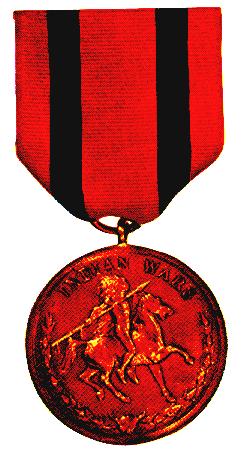
INDIAN WARS :
-
a general term referring to the series of conflicts, under the
tenets of Manifest Destiny, between European immigrants and the
indigenous peoples of North America; ranging from the 1680 Pueblo
Uprising, the 1637 Pequot War, the 1675-7 Wampanoag and
Narragansett Uprising (Metacom's Rebellion or King Philip's War),
the 1711-13 Tuscarora War in Carolina, Pontiac's Rebellion in
1763, Little Turtle's War ending with the Battle of Fallen
Timbers in 1794, defeat of the Shawnee prophecy at Tippecanoe in
1811 (and the demise of the Shawnee Confederacy with the death of
Tecumseh in the 1813 Battle of the Thames, and the defeat of
their British ally in the WAR OF 1812), the 1814 defeat of the
Creek Confederation, the 1832 Black Hawk War (caused by the
forced removal of the Sac and Fox to the Indian Territory west of
the Mississippi River), but most especially the battles fought
after 1860 on the Frontier (Great Plains and Far West) against
the Sioux, Apache, Comanche, Cheyenne, Arapaho, Kiowa, Ute,
Blackfoot, Shoshone, Nez Percé, and Bannock tribes.
Hostilities reached their peak between 1869-78 when more than 200
battles were fought; notable incidents include the Siege of
Tucson, the Massacre at Sand Creek, the Modoc War, the Fetterman
Massacre, the Battle at Little Bighorn, and the Battle of Wounded
Knee. The 1890 Battle of Wounded Knee is usually considered to be
the closing encounter of the INDIAN WARS, although there was an
expedition against the Ojibwa in Minnesota in 1898. At the end of
this era, the AmerIndian was confined on reservations. See
SEMINOLE WAR.
[nb: practiced in Europe and Asia before being introduced to
North American tribes, enemy scalps served as both a trophy and a
talisman of empowerment until they became a token of exchange for
bounties paid during the genocidal INDIAN WARS of extirpation;
although scalping was not always fatal, and not all tribes
engaged in the practice, the term 'redskin' was formerly a
euphemism for an AmerIndian scalp, male or female, adult or
child]
[nb: Indian Wars (1865-98): 919 battle deaths] [v: after the 1886
surrender of the Apaches, the surviving tribesmen, including
women and children, all classified as POWs, endured a 30-year
imprisonment on various remote Army posts (eg: "The Long Walk")]
[nb: in an effort to economize after the CIVIL WAR, Congress
mandated that each Spencer repeater be retrofitted with the
Stabler Cut-off Device, which modification converted the 7-shot
carbine into a single-shot firearm, until combat losses in the
INDIAN WARS forced its abandonment, and later succession of the
Spencer by the trapdoor Springfield having even more firepower]
[nb: during the INDIAN WARS, an Army LT returning from campaign
sent the War Department this message: "Out on patrol 3 months.
Killed 1 hostile. Took 44 casualties. At this rate, war will last
500 years, will cost $100,000,000, and they will win."]
-
INDIAN WRESTLING :
-
see ARM WRESTLING / ARM-WRESTLING. [nb: although frontiersmen
sometimes called it "Indian wrestling" during the 19th century,
this descriptor can apply to several different competitions
involving balance and agility as well as strength, so must be
qualified as "Indian arm wrestling", "Indian leg wrestling", or
"standing Indian wrestling"]
-
INDIA RUBBER :
-
a polymerized elastic substance that's formed into many products,
from tires and electrical insulation to erasers and condoms; a
resilient material (light cream or dark amber in color) made by
chemically treating and toughening the dried and coagulated milky
juice (latex) exuded from rubber trees (especially the Hevea and
Ficus species); also called "natural rubber". See GUTTA-PERCHA,
PARA RUBBER. [cf: synthetic rubber; v: wild rubber]
-
INDICATOR LIGHT :
-
see WIGWAG, ALDIS LAMP, CHRISTMAS TREE, PILOT LAMP, BUD LIGHT,
MARSHALING BATON, FOLLOW ME, BUBBLEGUM MACHINE, BLINKER, MOX NIX
STICKS.
-
INDICATORS / INDICATOR LIGHTS :
-
a Briticism for the turn-signals on motor vehicles; see MOX NIX
STICKS. [nb: an early post-WWII version subdivided the centrally
mounted taillight into a left or right flashing orange
turn-signal flanking a central red brake light, often directly
above the white lighted license plate]
-
INDICTMENT / INDITE :
-
any charge, serious criticism, or cause for blame, especially a
formal accusation by a legal authority that initiates a criminal
case; see ARTICLE 32, YELLOW SHEET.
-
INDIG :
-
(indidge) contracted form of INDIGenous, as a reference to the
native peoples of a region or locale who may be divided in their
loyalties by race, creed, religion, and other criteria; also
represented as 'indigene'. In Southeast Asia during the VIETNAM
WAR, numerous partisan factions and ethnic tribes participated in
Allied operations, including Bahnar, Bru, Cao Dai, Cham, Chinese,
Cua, Halang, Hmong/Miao, Hoa Hao, Hre, Hroi, Jarai, Jeh, Katu,
Kha, Khmer, Koho, Ma, M'nong, Muong, Nung, Raglai, Rengao, Rhade,
Sedang, Stieng. See RF/PF, CIDG, STRIKER, MIKE FORCE, GCMA, BODE,
KKK, ROADRUNNER, EARTH ANGEL, MONKEY PEOPLE, ANNAMITE SASQUATCH,
BUDDHAHEAD, BASKET HEAD, LITTLE BROWN BROTHER, YARD, JINGPAW
RANGERS, RICE BALL, CHINDIT, NUNG, CHINK, RICE CHRISTIAN, LONG
HOUSE, WHITE ELEPHANT, YELLOW PERIL, YELLOW DOG, SLANT-EYE,
SMALL-EYED, FUZZY-WUZZY ANGEL, FUZZY-WUZZY, GUNGA DIN, LULU THE
ZULU, FOREIGN DEVIL, FN, COUNTERPART, GONE NATIVE, LITTLE PEOPLE,
FLIP, BEANER, COON-ASS, REDBONE, FAM, MUJ, RAGHEAD; compare BAD
GUYS. [cf: aborigine, autochthon, native, denizen, inhabitant,
countryman, compatriot, citizen, CIVILIAN, ALLY]
-
INDIRECT FIRE / INDIRECT-FIRE :
-
that firepower which can be brought to bear upon a target that is
not in the line of sight of the shooter, as by an arcing impact;
see MISSILE, MORTAR, ARTY, SHOT OUT, MONEY SHOT, HIGH ANGLE HELL,
DEVIATION, DELIVERY ERROR, CEP, DISPERSION ERROR, HORIZONTAL
ERROR, UP-GUN.
-
INDISCIPLINE / UNDISCIPLINED :
-
that which is disarranged or out of order, confused or
disorganized, unresponsive or uncontrolled, messed-up or muddled;
being ill-trained or misled, as a "flub", "bungle", "blunder",
"pother", "Chinese fire drill", "mare's nest", "dog's breakfast",
"group grope", or "goat fuck". See FLAP, SHIT HIT THE FAN, SEAT
OF THE PANTS, GOAT ROPE, CLUSTER FUCK.
[v: carfuffle / kerfuffle or carwhuffle / kerwhuffle]
-
THE INDISPENSABLE MAN :
-
(forthcoming); irreplaceable; see THE MAN ON HORSEBACK, NECESSARY
/ NECESSITY; compare LOYALTY UP - LOYALTY DOWN, BRASS BLOAT,
CHAIN-OF-COMMAND
-
INDITE / INDICTMENT :
-
see INDICTMENT / INDITE.
-
INDIVIDUAL / INDIVIDUALITY :
-
(forthcoming); see TEAM, STRUCTURALISM; the concept of
self-sufficiency became obsolete with the onset of "the machine
age" wherein people are as fungible as all other interchangeable
components, and "human dignity" becomes a matter of negotiated
privileges, instead of inherent self-worth
[v: "on one's own hook"] [nb: the word 'team' is not spelled with
an "I" in it; "The point of the game is not how well the
individual does but whether the team wins. That is the beautiful
heart of the game, the blending of personalities, the mutual
sacrifices for group success." by Bill Bradley]
-
INDIVIDUAL IDENTITY TAG / INDIVIDUAL IDENTITY DISK :
-
see DOG TAGS.
-
INDIVIDUAL READY RESERVE :
-
a manpower pool consisting of individuals who have had some
training, who have served previously (PS) in the Active Component
or in the Selected Reserve, and have some period of their
military service obligation remaining; these IRR members may
voluntarily participate in training for retirement points and
promotion, with or without pay. See RESERVE.
-
INDOCHINA :
-
the region of Southeast Asia (SEA), between the Bay of
Bengal and the South China Sea, comprising Vietnam, Cambodia,
Laos, Burma (Myanmar), Thailand, western Malaysia, and select
boundary islands (eg: Paracels). Also called "Farther India"
until Scottish poet and Orientalist John Leyden proposed the
referent INDOCHINA during the early 19th century, because the
region lay between India and China, and its history was tied to
both dominant influences. This region and its history was
popularized by Bernard Fall, who is also credited with
designating the native rebellion against British, French, and
American forces as the "Second Indochina War" (qv).
Also, the name of the former (1862-1954) French colonial
federation, French INDOCHINA (Indo-Chine = Extreme Orient) or
"Union Indochinoise", comprising a region in Southeast Asia (SEA)
that included Cochin-China, Annam, Cambodia, Laos, Tonkin, and
the leased territory of Kwangchowan (Guangzhouwan 1898-1945);
Vietnamese term : "Dong Nam A". Compare ANNAM, COCHIN CHINA,
TONKIN.
[nb: During the first through fifth centuries, most of southeast
Asia was dominated by Funan, which included most of present
Thailand, Laos, Cambodia, and the Mekong delta region of Vietnam.
Funan was supplanted around the sixth century by Chenla. Annam
was a small coastal strip in north VN and southern China, and
south of it Champa controlled a coastal strip in central VN.
Pressure from China pushed Annam southwards, and in turn Annam
pushed Champa south to what is now roughly central South Vietnam.
In 1284, Kublai Khan leads a 500,000-man Chinese army into
Vietnam, but guerrillas organized by Tran Hung Dao virtually
destroy the INVASION force. Around the twelfth century the Khmers
emerged as a great empire controlling all the lower Mekong,
leaving Sukhothai as a small version of modern Siam and Laos.
From 1407 to 1428, China seized control of Dai Co Viet, but
resistance forces led by Le Loi drove the Chinese from the
country, and established the kingdom of Dai Viet; so that by
1428, Vietnam regained her independence from China's Ming Empire.
The Khmer Khmer Empire collapsed after Siam seized Ankor in 1431.
Thereafter, Cambodia found itself pinched between its more
powerful neighbours: Siam and Annam. In the late 18th and early
19th centuries, much of Cambodia was partitioned between Siam and
Annam. In 1844, what was left of Cambodia became a protectorate
of Siam. Around the 15th century the Kingdom of Luang Prabang
emerged along the upper and middle Mekong River. Vientiane and
the middle Mekong broke away in 1707. Both Luang Prabang and
Vientiane came under Siamese suzerainty in 1778. During most of
its existence, Laos was disputed over by Siam and Annam. Laos did
not reemerge as a distinct and separate entity until the French
declared this region a protectorate in 1893. Annam expanded
farther southward into Champa in the 16th century, and into the
Mekong Delta in the 18th century. With its capital at Hue, Annam
seized Saigon in 1776. With French advice and assistance, Annam
defeated the Tay Son triumvirate, and united the Tongking and
Cochinchina regions into the Vietnamese Empire in 1802; but the
Cochin, Annam, and Tongking regions were administered separately.
Following religious persecutions, France seized Saigon in 1861,
and annexed Cochin in 1862. Cambodia became a French protectorate
in 1863, and Siam gave up its claims to the area in 1867. The
French then made protectorates of Annam and Tongking in 1884, and
unified the protectorate into the "Union Indochinoise" in 1887,
retaining the capital at Saigon. Laos was added to this union
when it became a French protectorate in 1893. After further
confrontations, Siam ceded more territory, which France added to
Cambodia and Laos in 1907. After the Nationalist Chinese and
British reinstated the French protectorate on 19 Dec 1946, with
Bao Dai as nominal emperor, the Second Indochina War began.]
-
INDUCEMENT :
-
something that helps bring about an action or a desired result;
an advantage or benefit that precipitates a particular action on
the part of an individual; a motive or consideration that leads
one to action, or to additional or to more effective actions; an
act or reward used to persuade someone to accomplish something,
or to refrain from doing something; something, such as the fear
of punishment or the expectation of reward, that inspires action
or motivates effort ... an incentive, inspiration, persuasion, or
encouragement. [nb: Parable of the Chinese Concubine Army: Ho Lu,
the warlord of Wu district, resolved to test Sun-Tzu's guidebook,
so the young officer was charged with transforming the warlord's
harem into a military force. On the morrow, the young officer
lectured his new recruits, and by afternoon he began drilling
them in the fundamentals that they'd just been taught ... the
ranks became confused, and the women giggled and tittered as
their lines broke apart. Sun-Tzu declared that if the orders were
not clear, then it was his fault, however if the orders were
clear but not carried out, then it's the leader's fault. Having
established that the orders were in fact clear, thereupon Sun-Tzu
selected the leader of the harem, the warlord's favorite
concubine, and executed her for indiscipline in the palace's
courtyard before the entire harem, which was witnessed by the
warlord's staff. Now thoroughly motivated, all further commands
were immediately and flawlessly implemented by the inspired
harem. After additional battle practice, Sun-Tzu reported that
the warlord's exceptional harem army was now ready to go to war.]
-
INDUCTION :
-
the process of bringing someone into military service by
introducing him to special knowledge or experience, and
installing him into the ranks; to initiate an 'inductee' or
DRAFTEE as a member of the Armed Forces. Compare ENLIST, RECRUIT,
VOLUNTEER, RETREAD; see DRAFT, MILITIA, MUSTER.
-
INEBRIATED / INEBRIATION :
-
see DUI, DWI, OWI, DRUNK, THIRD DEGREE, LOADED FOR BEAR, DUTCH
COURAGE, STONED, WASTED, ZAP, HOOCH, GROG, BREW, JUICE, THE
DRINK, COLORS, LSD, DOPE, JUNK, GRASS, HAY, SMACK, STICK, IRISH
FLU, FRENCH FIT, HANGOVER.
[nb: "The initial effect of imbibing is to change reality, and
the more one partakes, the deeper reality is revealed, until one
finally has enough to know exactly how stark naked reality
appears, which makes one wish for some distortion to obscure all
of what's been revealed."]
-
INERRANT / INERRANCY :
-
free from error; infallible; as someone who does not stray, who
never wanders off course ... being the anointed state of newly
commissioned officers, especially military academy (TRADE SCHOOL)
graduates.
-
INERTIAL NAVIGATION :
-
an on-board system that determines an aerospace vehicle's course
by means of devices, such as a gyroscope and accelerometer, that
measure the vehicle's movements in flight; also called "inertial
guidance", this expression was coined during the KOREAN WAR.
-
INF :
-
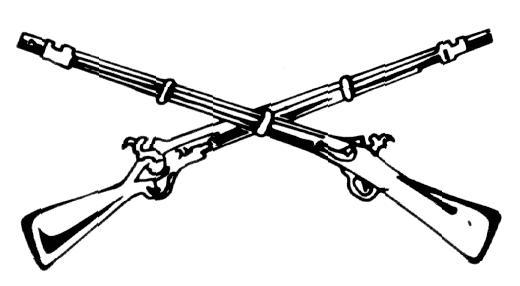
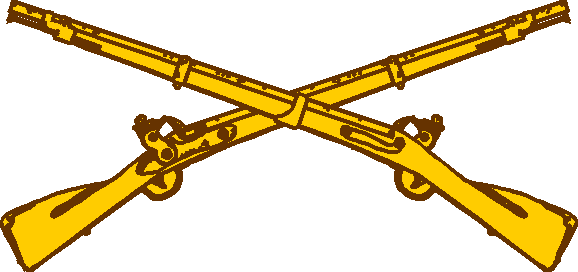
abbreviation for INFantry, being the "Queen of Battle"; derived
from 'infant' or youth. In modern times, the "foot soldier" has
evolved from axman and spearman, through swordsman and
halberdier, into musketeer and rifleman. Branch insignia has been
represented by crossed muskets since 19 November 1875
(standardized in 1924), often called "crossed idiot sticks" for
the arduous nature of the infantry role and those persons idiotic
enough to undertake it. The traditional color of the infantry is
blue, from the uniform of the Continental Army uniform. See
BLUELEG, GRUNT, SNUFFY, GI, 03, GROUND POUNDER, BOONIE RAT,
BUSHMASTER, CRUNCHY, LEG, DOUGHBOY, DOZER INF, FOLLOW ME, CIB,
EIB, HHC, USAIS, USATC, TRUE BLUE; compare ARTY, ARM, CAV. [cf:
infantry (infant= child too young to speak)] [nb: Vietnamese
term: Bo Binh] [nb: the 1795 Springfield Arsenal musket
(smoothbore, flintlock, .69 caliber muzzle-loader) was the first
official shoulder-firearm to use standardized interchangeable
parts] [nb: "dismounted reconnaissance" is MIL-SPEAK for
patrolling on foot]
-
INFIL :
-
INFILtrate or INFILtration; a stealthy entry or an inconspicuous
arrival into any operational area; may involve deceptive FALSE
INSERTIONs. See FLIP-FLOP, SHELL GAME; compare EXFIL.
[nb: unlike sex, getting into an operational area is the easy
part; getting back out with the INTEL after the mission is much
more difficult, and sometimes impossible]
-
INFIRMARY :
-
a place for the care and treatment of the infirm; a clinic for
the sick and injured, which may include a few beds for holdover
patients; see AID STATION, DISPENSARY, BAND-AID, DOC IN A BOX,
FLD HOSP. [v: polyclinic]
-
INFLAMMABLE :
-
compare NON-FLAMMABLE; see FLAMMABLE, INCENDIARY, JUICE, LSU /
LSA, WD-40, POL, PETROL, MOGAS, AVGAS, JP, NAPALM, PHOUGAS, GREEK
FIRE, ROCK FIRE, MOLOTOV COCKTAIL, SQUIB, ZIPPO, WILDFIRE,
FLAMETHROWER, FLARE, FAE, EXPLOSIVE PRESSURE, OVERPRESSURE,
COCKTAIL, SOUP, BLASTING POWDER, GUNCOTTON / NITROCELLULOSE, IED,
EXPLOSIVE, GAMMON GRENADE, GRENADE, WP, THERMITE, TRACER, HOT
SHOT, API, HAZMAT, WIDOW MAKER, RED LABEL, RED FLAG, FLYING
BRAVO. [nb: with the great influx of new recruits during WWII,
the military was obliged to change 'inflammable' to "flammable"
and to coin 'nonflammable' in order to avoid confusion and ensure
safety] [v: phlogiston]
-
INFLUENCE :
-
the capacity to produce an effect upon other people or other
things by indirect means; the power to impel or affect change by
intangible means; see INFLUENCE MINE, INFLUENCE PISTOL.
Also, the ability to obtain advantages as a result of one's
status or position, wealth or knowledge; also known as pull,
sway, persuasion, weight, clout, prerogative, say-so, leverage,
puissance, cachet, charisma, consequential, vitamin B, and so
forth.
-
INFLUENCE MINE :
-
any automatic MINE that is actuated by proximity or peripheral
disturbance, such as magnetic attraction or acoustic prompt, a
trembler switch or some other activating TRIGGER; a mine that
does not require physical contact or direct pressure to detonate.
-
INFLUENCE PISTOL :
-
an acoustic or magnetic EXPLODER that's used to detonate a
torpedo (FISH) or MINE.
-
INFLUENZA :
-
an acute, contagious disease that occurs in several forms, caused
by numerous rapidly mutating viral strains, and characterized by
respiratory symptoms and general prostration; often epidemic, and
commonly called the flu or grippe; see DISEASE.
-
INFORMATION WARFARE :
-
see FALSE FLAG, DECEPTION, MEACONING, MIJI, NETRUSION, CYBERWAR,
DATA MINING, LOGIC BOMB, SLIPSTREAMING, DEADMAN, DISINFORMATION,
RUMOR, BULLSHIT BOMB, BIG LIE, FACTOID, HOOPLA, OSINT,
PROPAGANDA, CONTROLLED INFORMATION, MESH, QUILT, FIREWALL, THE
AMERICAN WALL, INFOSEC, DEEP WEB, DARK WEB, COMSTOCKERY, ICAP,
PSYOPS, AFR, AFRTN, AFRTS, USIS, VIS, PSYWAR, SLIDEWARE, DARPA.
[nb: "The printing press is the greatest weapon in the armory of
the modern commander." by T.E. Lawrence (of Arabia)]
-
INFORMING GUN :
-
a gun fired by a warship to signal its intention to search a
merchant vessel; also called "affirming gun"; compare WARNING
SHOT.
-
INFOSEC :
-
(in-fo-seck) INFOrmation SECurity; compare OPSEC, OSINT; see
CLASSIFIED, DATA MINING, INFORMATION WARFARE.
-
INFRA DIG / INFRA DIGNITATEM :
-
literally 'beneath one's dignity'; see OATH, CREED, CORE VALUES,
CODE OF CONDUCT, ABOVE BOARD, PROMISE, HONOR CODE, SUMMUM BONUM,
MORAL COURAGE, NOBLESSE OBLIGE, LOYALTY UP - LOYALTY DOWN, RHIP,
CASTE, RING-KNOCKER, GENTLEMAN / GENTLEMEN, TRADITION.
-
INFRARED :
-
see IR.
-
INF SCH :
-
informal abbreviation for the U.S. Army Infantry School (USAIS)
which is not only responsible for developing ground warfare
tactics, including weapons expertise and fieldcraft, but also
sponsors PATHFINDER, PARACHUTE, and JUMPMASTER training; see
USATC, ARTY, ARM, CAV. [nb: U.S. Army Armor School has been
colocated with U.S. Army Infantry School for combined arms
doctrine since 2005]
-
INFUSION :
-
a program for transfer of personnel within or between commands to
reduce "rotational hump"; see HUMP.
-
ING :
-
see INACTIVE NATIONAL GUARD, NG, RESERVE.
-
IN GOD WE TRUST :
-
(forthcoming); motto on coinage (1864)
-
INGRATE / UNGRATEFULNESS / INGRATITUDE :
-
a thankless task, being not just unpleasant, undesirable,
objectionable, or distasteful, but unrewarding ... even when done
well, as with so many military assignments; see A FINE AND
PLEASANT MISERY, GUSTO, LIVIN' THE DREAM, WETSU, WATCH MY SMOKE,
DIEHARD, ROOT HOG OR DIE, BITE THE BULLET, SEWAGE MANAGEMENT,
MANLY ARTS, A MAN'S GOTTA DO WHAT A MAN'S GOTTA DO, SWEAT HOG,
GUNG-HO, HARD CHARGER, FIDO, ESPRIT DE CORPS. [nb: "It's a dark
and lonely job but somebody has to do it!" / "It's a dirty and
disgusting job, but somebody's got to do it!"]
Also, not showing due appreciation by not displaying gratitude or
acknowledging indebtedness; not counting one's blessings or
benefactions; see REBELLION, FIFTH COLUMN, GUERRILLA WARFARE,
INSURGENCY, ASYMMETRIC WARFARE, SOFT REVOLUTION, COUNTERCULTURE,
SOFT TYRANNY, UN-AMERICAN, ANTI-AMERICAN, STRANGER IN A STRANGE
LAND, PROTESTOR, SYMPATHIZER, HIPPIE, SILVER-TAIL, NEW AGE
HIPPIE, YIPPIE, BULLSHITVIK.
-
INITIAL POINT :
-
see IP.
-
INITIATION :
-
the ceremonies or rites of formal admission for fraternal
acceptance into a group or organization; see PRECONIZE, RITE OF
PASSAGE, PROP BLAST, PINNING, BLOOD STRIPE, CPO, SHELLBACK, LINE
CROSSING, GOLDEN DRAGON, BLUE NOSE, RED NOSE, DOLPHIN DIVE,
WINGING, WINGDING, SPUR RIDE, SALTING, "wetting down" at CAMPAIGN
HAT, ORDER OF THE SPUR, FORTY AND EIGHT, MILITARY ORDER OF THE
COOTIES, NATIONAL ORDER OF TRENCH RATS, MILITARY ORDER OF THE
DEVIL DOGS, BLOOD BROTHER, BOY'S CLUB, VETERANS' ASSOCIATION,
EARRING, RING-KNOCKER, TATTOO, MEAT MARKER, BLOODING, CHALLENGE
COIN. [v: 'bora' of Australian Aborigines]
-
INITIATOR :
-
that device which activates or launches a sequence or series,
especially of EXPLOSIVEs or firing mechanisms. Also, that element
which actuates a process or begins a proceeding. See TRIGGER,
FUSE, FUZE, DETONATOR, EXPLODER.
-
INK :
-
see MEAT MARKER, TATTOO.
-
IN LIKE FLYNN :
-
after Errol Flynn, the swashbuckling Australian actor, for those
emphatic or dramatic feats of derring-do that were staged for
WWII-era adventure films; compare MISSION IMPOSSIBLE, see
MACHO, MOCK-HEROIC, FICTIONAL CHARACTER.
[nb: the earliest recorded usage is from a 1946 pilot reporting
on a successful landing: "In like Flynn, everything is O.K.";
being equivalent to Flynn's cinematic feats, and devoid of the
sexual connotations that this phrase later acquired] [nb: Our
Man Flint (1966) and In Like Flint (1967) were
Hollywood film take-offs on the original "in like Flynn" phrase,
which have since caused some etymological confusion] [v: emprise
/ emprize]
-
IN MEMORIAM :
-
see TAPS, MEMORIAL DAY, MISSING MAN FORMATION, MEMORIAL,
MONUMENT. [v: tribute, lament, dirge, elegy, threnody, monody,
ode]
-
INQUILINE / INQUILINITY :
-
an animal that lives in the nest or burrow of another animal,
usually without harm to the host; someone who lives on the
hospitality, support, or advantage of others, but without
damaging them; see REFUGEE, DP, BOAT PEOPLE, YELLOW BIRD,
E&E, HIDE, BOLT HOLE, RABBIT HOLE, LUP, RON, NDP, COLD CAMP,
BREAKWEATHER. [cf: parasite / parasitism]
-
INS :
-
Inertial Navigation System, an aircraft coordinate locator
used for plotting position relative to underlying surface; works
from known point of departure through all WAY POINTs plotted
for each air mission. See HOMER, SQUAWK, LOCATOR BEACON; compare
LORAN, AIS, MGRS, GPS, SRTM, UTM. [v: accelerometer]
Also, Immigration and Naturalization Service, being the U.S.
government agency in the Department of Justice that's responsible
for the admission and naturalization of foreigners, and for the
prevention and deportation of illegal aliens through the U.S.
Border Patrol; existing as separate bureaus since 1891, then
consolidated in 1933, this agency was reorganized on 1 March 2003
into Immigration and Customs Enforcement (ICE), and subsumed
under the Department of Homeland Security (DHS) after the 11
September 2001 terrorist attacks. Citizenship may be granted
either to individual petitioners after a minimum of five years
residence without criminal conviction, or to populations made
eligible by legislation [eg: denizens of the Republic of Texas
(1845), the Commonwealth of Puerto Rico (1917), the American
Virgin Islands (1917), all AmerIndian tribesmen (1924), denizens
of Alaska (1959), and of Hawaii (1959)]. See EXILE, LODGE-PHILBIN
ACT. [nb: the uniform naturalization laws require the applicant
to renounce any previous national allegiance, to swear to support
the Constitution of the United States, to read and write the
English language, and to be adjudged of good moral character; v:
Fourteenth Amendment]
-
INSCOM :
-
U.S. Army Intelligence and Security Command.
-
INSECT BAR :
-
(aka: mosquito bar) see BAR, NET. [nb: the word "canopy"
originally meant net, as a gauze mosquito barrier; cf: sparver]
-
INSECT REPELLENT :
-
a liquid preparation, issued in small plastic squeeze bottles,
that's used to disorient or kill insects [v: insecticide,
hirudicide, sanguivoricide]; commonly known as BUG JUICE (qv).
The removal of leeches (averaging 3"-5") by cigarette burn works
well, but regular insect repellent is wonderful, since it
strangles their breathing, makes them vomit all the blood they
sucked, and then suffocates them! ... it's a very gratifying form
of field entertainment for GRUNTS. The manner of carry of the
plastic dispensers of insect repellent, as portrayed in books or
movies, is a reliable TELLTALE for detecting phonies.
-
INSERT / INSERTION :
-
to place or advance a unit or element in any
operational area, often by air-assault; contrasted with
EXTRACTION. See FALSE INSERTION, JACOB'S LADDER, RAPPEL,
DEBARKATION NET, SPY RIGGING.
-
INSIDE THE WIRE / IN THE WIRE :
-
a catch-phrase, used both literally and figuratively, to indicate
that the outer defenses of a COMPOUND or BASE CAMP have been
penetrated, and that secondary defenses must be engaged, or that
the security protection for classified material has been
compromised or breached, and that fallback precautions must be
undertaken; this expression refers to a defensive enclosure or
ambit that implies a safe boundry and entails a secure border
(not an external small unit position or remote station location),
hence the dire consequences subsequent to its pronouncement. See
PERIMETER, BARBED WIRE, RAZOR WIRE, CONCERTINA, TRIPWIRE,
OUTWORK, BARBICAN, GO TO HELL POINT; compare OUTSIDE THE WIRE.
Also, during the GULF WAR-era, designation for an isolated and/or
restricted compound, such as an enemy combatant detention
facility or a tactical operations center (TOC), which requires
visitors and assigned personnel to pass through one or more
security checkpoints during ingress and egress; special
regulations and specific restrictions apply to everyone within
such an enclosure.
-
INSIGNIA :
-
a distinguishing mark, as an emblem of office, a badge of honor,
or a sign of distinction, being a symbolic figure or decoration;
formally a plural of "insigne", but began to be used as a
singular in the 18th century, with "insignias" adopted as the new
plural shortly thereafter, such that INSIGNIA is now standard
usage for both singular and plural forms. See BADGE, CREST, DUI,
DI, BEERCAN, EMBLEM, CHARGE, GREEN TAB, BRASS HAT, BAY, HEADGEAR,
SCRAMBLED-EGGS, SPAGHETTI, PIP, CHOP, RATING, RANK, PINNING,
BRANCH, ENSIGN, WIGWAG, BRACELET, CORD, TRASH, PATCH, SANDWICH,
SCROLL, HERSHEY BAR, FLASH, OVAL, TAB, Q-TAB, TRIPLE CANOPY,
JUNGLE EXPERT, RECONDO, BOLO BADGE, EOD, SAPPER, PATHFINDER,
WINGS, PARACHUTE, MFF, AIR ASSAULT, GLIDER, RIGGER, PILOT,
DOLPHIN, WATER WINGS, DIVER, SCUBA, HARD HAT, UDT, BUDS,
BUDWEISER, CIB, CMB, CAB, GONG, FRUIT SALAD, DEVICE, OLC,
V-DEVICE, BATTLE STAR, IMPACT AWARD, HERO, BATTLE CRY, SIGNATURE,
TOAST.
[v: seal, sign, signet, sigil] [nb: the devices that cover the
mounting prongs that attach the insignia to the uniform, holding
the two parts together, are variously sized, and are called
"fasteners", "clip fastener", "clutch fastener", "clutch back
fastener", "clutch grip fastener", "pinch fastener", "butterfly
fastener", or "dammits"]
-
INSPECTION :
-
an examination to determine the presence, condition, readiness or
compliance of personnel and equipment with procedures or
regulations; see CMMI, FMI, LORI, MCI, MEI, ORI, PI, PMI, QVI,
SAMI, PRE-FLIGHT, POST-FLIGHT, WALK AROUND, WHITE-GLOVE, SPIT 'n'
POLISH, JUNK ON THE BUNK, DRILL, THE BIBLE, MANUAL OF ARMS.
-
INSPECTOR GENERAL :
-
see IG.
-
INSPIRE / INSPIRATION :
-
(forthcoming); [nb: "Inspiration is mostly perspiration, but
sometimes desperation will suffice."; "If a man can be made weak
and brought low, then he can be uplifted and made strong."]
-
INSTANT BREAKFAST :
-
referent for a nutritious food product that's produced in
powdered form and is intended to be mixed with either whole or
powdered milk, with proteins and sugar, vitamins and flavorings
(eg: chocolate, vanilla, strawberry, coffee, etc) added, so as to
be consumed as a concentrated meal substitute by individuals who
are too busy to eat a prepared breakfast; some pre-mixed liquid
formulations are pre-packaged for those persons who are even too
busy to blend a powdered concoction ... introduced (1964) by
Carnation as a quick meal replacement, these single serving food
substitutes were challenged by a variety of dietary supplements
(eg: Ensure, MetreCal, Sego, SlimFast, etc), which ostensibly
offered a more balanced diet. See INSTANT SOUP, INSTANT NOODLES.
[v: protein shake, smoothie]
-
INSTANT NOODLES :
-
as part of the progression in food preservation, coincident with
military affairs and outer-space exploration, the mechanistic
creation of "instant" foods was added to the practices of
dessicating / dehydrating, curing / parching, freeze-drying,
canning, condensing, and concentrating foodstuffs. Momofuku Ando
(Go Pek-Hok), a Formosan entrepreneur who established Nissin
Foods (1958) in Japan when he made the commercial production of
packaged INSTANT NOODLES economically viable by working with
precooked ramen noodles that were dried into a flavored or
seasoned block with a long shelf-life (12mo) so as to be
reconstituted with boiling water ... hence their common nickname
of "two-minute noodles". Dried noodle blocks were shortly (1961)
introduced to Taiwan (ROC) and (1963) to South Korea (ROK), then
Nissin soon (1971) innovated its packaging by offering the
flash-fried dried noodles with flavoring and seasoning already
added inside a sealed polystyrene container, marketed as "Cup
Noodles". Other manufacturers, including Knorr and Lipton
(Unilever), Foodles (Horlicks) and Maruchan (Toyo Suisan), Shin
Ramyun and Nongshim (farmer's heart), Demae Itcho and Sapporo
Ichiban (Sanyo Foods), Hwa-Long (Chinese Dragon) and Master Kong
(Ting Yi or Kang-shi-fu), Sau Tao and Koka, Hwa-Long and
Bai-xiang (White Elephant), Maggi (Nestlé) and Indomie
(Sukses Makmur), Yum Yum and Wai Wai, Trident and Fantastic,
Frontier and Bear Creek, became involved with offerings that
would appeal to different cuisines, and experimented with various
types of noodles (eg: wheat, buckwheat, rice, and egg noodles).
Due to its association with the earliest dried noodle foods, the
term 'ramen' has become synonymous among Americans with all
varieties of pre-seasoned INSTANT NOODLES (including chicken,
pork, beef, mutton, duck, shrimp, fried egg, soy protein,
triturated cheese, and dehydrated vegetable sachets). See RAMEN,
RAMYEON, LAMIAN, LO MEIN, CHOW MEIN, LOP SLOP, ORIENTAL CRUD,
CHOW, BEANS, RATIONS. [nb: according to a nationwide poll
conducted in the year 2000, the best Japanese invention of the
20th century was considered to be 'instant noodles']
-
INSTANT SOUP :
-
compare INSTANT NOODLES; see SOUP, PHO, KHAO PIAK SEN, RAMEN,
LARMEN, RAMYEON, LAMIAN, WON-TON, TOM KHA KAI, KHAO PUN, MOHINGA,
BOAT NOODLES, BULLY SOUP, OH LAM, POOR MAN'S STEW, WASH, STONE
SOUP, BEANS, CHOW, RATIONS. [v: instant chicken noodle soup mix
by Lipton (Unilever)]
-
INSTANT TEA :
-
a drink powder formulated, often with sweeteners and flavorings
added, such that the addition of water will reconstitute it into
a beverage indistinguishable from brewed or steeped tea. A patent
was granted (1885) in the United Kingdom for a paste made of
concentrated black tea extract, sugar, and evaporated milk, which
became prepared tea when hot water was added; this novelty
product wasn't very tasty due to the dehydration process, which
also made it too expensive for popular consumption. Until
spray-drying and freeze-drying enabled the tea to be economically
processed without damaging the flavor of the concentrates, the
"instant tea industry" couldn't develop; then during WWII, using
the same technology developed for "NesCafé" instant
coffee, Nestlé developed "NesTea" powder (1943) by the
addition of aroma and color compounds to the dehydrated flavor
granules and refined sugar, citric acid for tartness, and
anti-caking elements. When Nestlé introduced "NesTea"
instant tea to the United States (1947), Americans immediately
used the mixture to concoct "iced tea" ... something that the
manufacturer hadn't anticipated, but had been commonplace as
"Southern-style sweetened cool tea" since Colonial days. Instant
tea, which can be enhanced by the addition of flavorings (eg:
lemon, raspberry, etc), primarily serves as an alternative to
instant coffee and powdered fruit drinks as a mask for the taste
of chemically treated local waters that're consumed while on
field operations. See BUG JUICE, JUICE, ERGO, THE DRINK, NUOC,
WATER PURIFICATION TABLET. [nb: during the process of making
powdered instant tea, most of the antioxidant catechins in brewed
tea are destroyed; furthermore, instant tea contains additives,
such as artificial sweeteners (eg: aspartame) and butylated
hydroxyanisole (BHA) introduced as a preservative, both of which
are probable carcinogens] [nb: powdered green tea was developed
in 1904 to appeal to Asian tastes] [nb: the Missouri state
reunion of Ex-Confederate Veterans was held at Artesian Park in
Nevada, Missouri (20-21 September 1890), which encampment of over
15,000 veterans, housed in rows of canvas tents, were provided a
lavish barbecue on the first day that included 11,000 pounds of
beef and 880 gallons of Southern sweet tea served cool —
although many attribute the "invention" of iced tea to the 1904
Saint Louis World's Fair, this beverage existed long before that
noteworthy event made iced tea more popular]
-
INSTANT WATER :
-
a Vietnam-era bon mot proposed: "Instant Space Age Water has been
scientifically formulated to replicate Nature's own elemental
distillate, clean and clear and odorless, fortified and purified
with a neutral pH, at only a fraction of the weight of the
original regular substance; a man-made improvement developed for
ready consumption, alone or as an additive, especially for
persons subsisting without amenities under field conditions,
having been designed for better living through chemistry! ... to
reconstitute this marvelous new product, just add water."
-
INSTIGATOR :
-
see PROVOCATEUR.
-
THE INSTITUTE OF HERALDRY / TIOH :
-
The U.S. Army Institute of Heraldry is the repository responsible
for developing and preserving the military insignia and coats of
arms for all branches of service; see INSIGNIA, BADGE, TRASH,
PATCH, SCROLL, CORD, CREST, DUI, DI, EMBLEM, GONG, FRUIT SALAD,
DEVICE, OLC, V-DEVICE, BATTLE STAR, RANK, PIP, RATING, ENSIGN,
FLAG, BRANCH.
-
INSTITUTIONAL MEMORY :
-
see POI, OJT, COA, CHECKING THE DICTIONARY, CHAPTER AND VERSE, BY
THE BOOK, TRADITION, MORE HONORED IN THE BREACH THAN THE
OBSERVANCE, CUSTOMS AND COURTESIES OF THE SERVICE; compare
LESSONS LEARNED.
-
INSTRUMENTALITY OF WAR :
-
a mechanism or device, vehicle or vessel that's designed
primarily for military use or service; or anything similar
employed in a comparably risky or hazardous capacity.
-
INSUBORDINATE / INSUBORDINATION :
-
not submissive to proper authority; disobedient or refractory,
defiant or insolent; see DUTY, CODE OF CONDUCT, CORE VALUES,
SUMMUM BONUM, MORALITY, CREDIBILITY GAP, FIGHTING WORDS, RIOT
ACT, SEDITION, MUTINY, TREASON, SILENT INSOLENCE. [re: punitive
articles 89 and 91 in the UCMJ; v: UCMJ Punitive Articles]
-
INSULT :
-
to affront, offend, slight, or demean by word or deed; to treat
insolently, or to address with contemptuous rudeness; see CAT
AMONG THE PIGEONS, FIGHTING WORDS, TRIGGER TERM, SABER-RATTLING,
TRAILING HIS COAT, HAIR-TRIGGER, HALF-COCKED, GUNPOINT, FIGHTING
MAD, RAMPAGE, BLOODY SHIRT, MANO A MANO, CROSS SWORDS, DUEL.
Also, an agent or vector that inflicts a bodily injury or medical
trauma. Also, an archaism for behaving in an insolently
triumphant manner; to exult contemptuously; as derived from "jump
onto", as in an assault or attack. [nb: "A little injustice in
the heart can be drowned by wine, but a great injustice in the
world can only be drowned by the sword." by Chang Ch'ao]
-
INSURGENCY :
-
domestic REBELLION within a group or state without achieving the
condition of REVOLUTION or CIVIL WAR; rebellion against an
existing government by a group not recognized as a belligerent.
Also, the military employment of sociopolitical methods to
destabilize and overthrow a government; the application of
asymmetric means to achieve political ends. See GUERRILLA
WARFARE, LOW-INTENSITY CONFLICT, UW, ASYMMETRIC WARFARE, SOFT
REVOLUTION, STRUGGLE, CONFLICT; compare COUNTERINSURGENCY.
-
INSURGENT :
-
a person who participates in forcible opposition or armed
resistance to an established authority or a duly constituted
government; a rebel or revolutionary, as derived from "to rise
up" or "ascend". See COUNTERINSURGENCY, UW.
-
INTEL :
-
intelligence; the proverbial "2 shop", being S-2/G-2/J-2 (v:
J-CODES, STAFF). See COMINT, ELINT, HUMINT, IMINT, SIGINT,
SATINT, TECHINT, OSINT, 2DD, PIR, DECEPTION, CHATTER, SWEAT,
SQUEEZE, GATOR, SLURPER, CONFESSION BOX, MISTA, CONTROLLED
INFORMATION, NEED TO KNOW, ONE-TIME PAD, FLASH PAPER, FLAPS 'n'
SEALS, CHICKEN FEED, ROCKING HORSE APPLES, DESK MAPPING, CLOWN
COLLEGE, TRADECRAFT, PSYOPS, RUSE DE GUERRE, PSYWAR, ASA, CIC,
MI, ICAP, CCIR, PIR, IR, JIC, NIC, NIE, SNIE, DOC EX, DIA, CIA,
SDI; compare RUMOR.
[v: the Culper Ring, composed of trusted civilians, both men and
women, was a spy ring that was organized by Benjamin Tallmadge in
the summer of 1778 under the direction of George Washington
during the Revolutionary War, because military intelligence had
proven itself to be insecure and unreliable; cf: Joseph Hooker's
Bureau of Military Information]
[nb: "Thus, what enables the wise sovereign and the good general
to strike and conquer, and achieve things beyond the reach of
ordinary men, is foreknowledge [of the enemy's disposition and
intentions]. Now this foreknowledge cannot be elicited from
spirits; it cannot be [predicted] obtained inductively from
experience, nor by any deductive calculation. Knowledge of the
enemy's dispositions can only be obtained from other men." by
Sun-Tzu (ca490BC); "Intelligence is pseudoscience, like
astrology; sometimes the outcome seems to prove that your methods
and techniques are infallible ... other times, it proves the
exact opposite." by Olen Steinhauer (2014); "To know that we know
what we know, and that we do not know what we do not know, that
is true knowledge." attributed to Confucius / K'ung Fu-tzu;
"There are known knowns, known unknowns, and unknown unknowns."
by Donald H. Rumsfeld]
-
INTELLECTUAL :
-
see PROFESSOR, WIZARD, BRAINIAC, REASON, RATIONALE,
INTELLIGENCER, BEAN-COUNTER, CHIEF, WONK, GUNNER, WALLAH, PUKE,
POGUE. [nb: "'Rabbit's clever,' said Pooh thoughtfully. 'Yes,'
said Piglet, 'Rabbit's clever.' 'And he has brains.' 'Yes,' said
Piglet, 'Rabbit has brains.' There was a long silence. 'I
suppose,' said Pooh, 'that that's why he never understands
anything.'" by A.A. Milne, Winnie-the-Pooh (1926)]
-
INTELLIGENCER :
-
a person working with codes and ciphers; a cryptographer,
cryptanalyst, cryptologist, or crypter; Vietnamese term: Mat
Ma Vien. See ENCRYPT, DECRYPT, CRYPER.
-
INTERCEPTOR / INTERCEPTER :
-
a fighter airplane that's capable of speedily pursuing and
intercepting hostile aircraft; also called "hunter/killer"; see
BIRD. [v: hunter squadron (jagdstaffel)]
-
INTERCO :
-
the acronym for the International Code of Signals, being a
standardized system for sending clear and concise messages,
without resorting to translation of foreign languages; many of
which do not involve an exchange or require a response. INTERCO
messages are signaled by sight (ie: lights, flags, smoke) or by
sound (ie: whistle, bell, siren, foghorn, MORSE CODE). Specific
phrases are represented by letter codes from 1 to 3 characters in
length (eg: MAA = I need medical advice; AN = I need a physician;
AC = I am abandoning my vessel). See CIPHER, CODE, PROWORD,
BREVITY CODE, CODENAME, CODEWORD, NICKNAME, 10-CODES, ACRONYM,
ABBREVIATION, FREQ, GUARD, MAYDAY, PAN, SECURITE.
-
INTERDICTION FIRE :
-
direct and/or indirect fire placed at a point or brought to bear
on an area so as to deny enemy access, use, or occupation; see
ZONE OF FIRE, FPL, RANGE CARD.
-
INTERMITTENT FEVER :
-
see MALARIA.
-
INTERNAL EXILE :
-
the banishment of a person, such as a political dissident or
other despised minority, to a remote place within the same
country; see PNG, DP, FLUTTERING SPARROW, GULAG, LAOGAI,
CONCENTRATION CAMP, STRUGGLE, BOMBING, REEDUCATION. [v: outcast,
castaway, pariah, deportee, expatriate, displaced person, man
without a country, nonperson, untouchable]
-
INTERNATIONAL ORANGE :
-
a shade of bright orange, highly visible at a great distance and
in murky weather, that's been used since 1955 to color rescue or
emergency gear, safety devices and appliances, survey equipment
and vehicles, including boats and aircraft, hangars and control
towers; also known as "safety orange" or "blaze orange". Compare
DAZZLE, COUNTERSHADING, GRAYBACK, CAMO.
-
INTERNATIONAL RADIO SILENCE :
-
a convention establishing two periods (for three-minutes each) of
monitored silence every hour in order to permit distress signals
to be heard; see GUARD, SOS, MAYDAY, PAN, SECURITE, BLIND
TRANSMISSION, listening watch, RTP, RADIO, COMMO, NET.
-
INTERNECINE :
-
pertaining to conflict or struggle within a group (ie: CIVIL
WAR), especially when characterized by great slaughter; mutually
deadly or destructive; as derived from murderous, kill or
exterminate.
-
INTERNET :
-
a network of networks; a group of networks interconnected via
routers. This worldwide information superhighway comprises
thousands of interconnected computer networks, and reaches
millions of people in many different countries. The Internet was
originally developed for the United States military, as a result
of a RAND study on post-war decentralization that was implemented
by DARPA until 1989; and its use was then extended to government,
academic and commercial communications and research. The Internet
is made up of large backbone networks (such as MILNET, NSFNET,
and CREN), and smaller networks that link to them. The U.S.
National Science Foundation maintains a major part of the
backbone (NSFNET). The Internet functions as a gateway for
electronic mail between various networks and online services. The
World Wide Web facility on the Internet makes possible almost
instantaneous exchange of information by linking documents around
the world. Internet computers use the Transmission Control
Protocol / Internet Protocol (TCP/IP). There are over six million
hosts on the Internet: mainframes, minicomputers, or workstations
that support the Internet Protocol. An autonomous internet is a
group of gateways that are under the same administrative
authority and use a common Interior Gateway Protocol (IGP). The
Internet is connected to computer networks worldwide that use
various message formats and protocols; gateways convert these
formats between networks so that the Internet functions as one
big network. UNIX utilities such as FTP, Archie, TELNET, Gopher
and Veronica have been widely used to access the Internet. The
Internet sometimes appears to be amorphous and unregulated, but
there are several administrative bodies: the Internet
Architecture Board, which oversees technology and standards; the
Internet Assigned Numbers Authority, which assigns numbers for
ports and sockets, etc.; InterNIC, which assigns Internet
addresses; the Internet Engineering and Planning Group, Internet
Engineering Steering Group, and the Internet Society. Compare
MESH; see COMPUTER. [cf: intranet]
-
INTERPOL :
-
INTERnational (Criminal) POLice (Organization) has coordinated
the various police activities among participating nations since
before 1923; its management, tasking, and funding was subsumed by
the United Nations (UN) in 2020; see POLICE. [nb: formerly the
International Criminal Police Commission] [cf: EuroPol]
-
INTERROGATE / INTERROGATION :
-
to question carefully or closely, to examine minutely or
exhaustively, especially a formal or official survey that's
intended to check or discredit a previous statement; also known
as "cross-examine" or "cross-question", "pump" or "grill", as
derived from 'ask' or 'query'. See THIRD DEGREE, SQUEEZE, FIELD
EXPEDIENT FACIAL, SONG AND DANCE, BASHING, BLISTER, ENHANCED
INTERROGATION, BRAINWASHING, REEDUCATION, SNATCH, BODY-SNATCHER,
PACKAGE, TONGUE, TRUE BELIEVER, BY ASSOCIATION, SWEAT, GATOR,
SLURPER, SCREEN, LIE DETECTOR, FLUTTER, TRUTH SERUM, POISON PILL,
FISHBOWL, PING, SERE, DEBRIEF, ARTICLE 31, ARTICLE 32.
-
INTERVAL :
-
the lateral space between elements of the same line; with normal
interval measured as one arm's length from shoulder to shoulder
(approx 30") for DRILL, with extended interval measured as both
arms at full length (approx 70") for EXERCISE, and with close
interval measured as a bent elbow's length (approx 6") for GUARD;
see DRESS RIGHT, CLOSE ORDER, THE BIBLE, MANUAL OF ARMS, SCHOOL
OF THE SOLDIER, SCHOOL OF THE SQUAD. [nb: the distance between
RANKs is equivalent to the distance between FILEs, an interval
established by DRESSing RIGHT in one FORMATION and then pivoting
the FORMATION with a 'facing' command so as to DRESS RIGHT in the
other direction ... THE BIBLE reports this distance as 40" from
back to front and 30" from side to side]
Also, that necessary and appropriate spacing that balances
tactics and safety while accomplishing the assigned mission; see
COMBAT SPREAD, INDIAN FILE, CONVOY, HEADWAY, STAND-OFF; compare
ACCORDION, CATERPILLAR, LEEWAY. Also, the use of signals (eg:
LASER) or beacons (eg: PIPSQUEAK) to fix an object or measure an
objective. Also, any period of inactivity or recuperation,
generally as a respite preliminary to resumption; see INTERWAR,
PEACETIME, PEACETIMER; compare IMMEDIATELY, FORTHWITH.
-
INTERVALOMETER :
-
cockpit equipment used for selecting weapon system or rate of
fire / bombing; see PICKLE.
-
INTERVENTIONISM :
-
the policy or practice of government interference in the
political or economic affairs of another state, ostensibly for
its benefit; see BANANA WARS, GOOD NEIGHBOR POLICY, CLIENT STATE,
CONTAINMENT, DIVIDE AND CONQUER, PRESIDENTIAL DOCTRINE, PROXY
WAR, REALPOLITIK; compare ISOLATIONISM. [nb: "Whenever you see a
turtle or a starfish poised atop a fence post then you know it
arrived there by intervention." anonymous]
-
INTERWAR :
-
occurring during a period of PEACE between two WARs, especially
the interval between World War I (WWI) and World War II (WWII);
compare ANTEBELLUM.
-
INTESTINAL FORTITUDE :
-
resolute determination or endurance; courage, bravery, or valor;
see V-DEVICE, IMPACT AWARD, GUTS, MOXIE, ONIONS, DIEHARD,
VETERAN, WINTER SOLDIER, NOBLE SAVAGE, COUNT COUP, BRAGGING
RIGHTS, QUIET PROFESSIONAL, HERO, MACHO.
-
IN THE AIR :
-
the extreme ends in any broad front of advance or defense, or any
discontinuity therein, where the line of troops and arms is
exposed or suspended, subject to being out-flanked, as an
unattached FLANK (eg: Stoneman's Raid) or an unsecured FRONT LINE
(eg: Chickamauga); compare REFUSE, TIED-IN. Also, the
simultaneous suspension of an entire SALVO, VOLLEY or FUSILLADE,
by the skillful loading and firing of a MORTAR rapidly enough
that all of the rounds launched remain in flight before the first
round impacts on the TARGET; sometimes expressed as "hang (in the
air)", not HANG FIRE. Also, the condition of air superiority that
permits land or sea operations to proceed without interference;
see CAP, COVER, UMBRELLA, ABNCP. Also, an EXPLOSIVE detonation
above the ground of a BOMB, SHELL, or other ORDNANCE, together
with its EXPLOSIVE PRESSURE or OVERPRESSURE blast wave; an
AIRBURST.
-
IN THE DOGHOUSE :
-
see (IN THE) DOGHOUSE.
-
IN THE FIELD :
-
any forward combat area, or any area outside of a built-up town
or BASE CAMP; see BOONDOCKS / BOONIES.
-
IN THE MOUTH OF THE CAT :
-
a common metaphor among southeast Asian peoples for violent
death, that's also represented as "in the jaws of the cat"; the
predation of the cat is not just an allusion to men being as weak
as mice who are victimized by house cats, but to those brave
defenders of their villages who are slaughtered (like any other
prey) by the more aggressive tigers and more capable panthers. In
the case of warriors who have survived battle, the imagery is of
having escaped the ready mouth of the lethal cat, of having
eluded the yawning pit of Hell. This expression is also used to
symbolize an act that needlessly confronts death, such that
success or survival is uncertain; it's used in the same way as
"to tempt fate" or "to tempt providence" by taking a needless
risk, especially after a lucky escape. Compare HEAD IN THE LION'S
MOUTH; see TIGER CAGE, PITFALL, TROU-DE-LOUP.
-
IN THE SADDLE :
-
(forthcoming);
see COMMAND, C&C, LDR, COMMANDER, COMMAND ELEMENT,
CHAIN-OF-COMMAND, COMMAND PRESENCE.
-
IN THE SHIT :
-
taking fire or being ambushed; see SHIT.
-
IN THE ZONE / THE ZONE :
-
see HEAD IN THE GAME, BUBBLE, COLD ZERO.
-
INTIMIDATE / INTIMIDATION :
-
to overawe, as by displaying a person's personality, or to cow,
as by displaying a person's status; to force into some action, or
to deter from taking some action, as by inducing fear; derived
from made timid or afraid.
-
INTO THE RABBIT HOLE :
-
see RABBIT HOLE.
-
INTO THE WILD BLUE YONDER :
-
see WILD BLUE YONDER.
-
INTOXICATED / INTOXICATION :
-
see DUI, DWI, OWI, DRUNK, THIRD DEGREE, LOADED FOR BEAR, DUTCH
COURAGE, STONED, WASTED, ZAP, HOOCH, GROG, BREW, JUICE, THE
DRINK, COLORS, LSD, DOPE, JUNK, GRASS, HAY, SMACK, STICK, IRISH
FLU, FRENCH FIT, HANGOVER.
-
INTRUDER :
-
Grumman A-6 twin-engined subsonic fighter-bomber aircraft,
operated by PILOT and weapons officer (WSO), with flight
characteristics sufficiently sluggish and awkward to have earned
it the nickname of "cement truck"; this all-weather low-level MUD
MOVER carried up to 22 500# bombs and was night flight capable.
Compare KA-6 at TANKER; see GIB, BIRD.
-
INURE / INUREMENT :
-
to accustom someone to a particular environment or to habituate
someone to specific conditions, especially "seasoning" of work,
so as to improve their effectiveness or enhance their
functionality. Also, to bring something into use, or to enable
something to take effect, or to permit something to have an
influence, so as it will become beneficial or advantageous.
Inurement is differentiated from desensitization in that the
toughening or hardening process doesn't reduce awareness, doesn't
induce a lack of sympathy or compassion, doesn't impel
indifference or callousness; whereas desensitization makes a
person less alert and less reactive ... a soldier who has been
DESENSITIZEd by an overexposure to combat is both mentally and
emotionally withdrawn, physically delinquent, and short of
endurance, making him "a dead man walking" (GHOST WALKER or
WALKING GHOST). [v: enure / enurement]
-
INVADER :
-
Douglas A-26, B-26/RB-26 light bomber aircraft with a crew of
three. Used during USAF FARMGATE project, the vintage B-26
carries eight nose-mounted .50-caliber machineguns (350 rounds
each), delivers a 4,000 pound bombload, plus 2000# extra ordnance
hung on external racks under its WINGS, and is powered by two
reciprocating engines. Designated A-26 until 1948.
-
INVASION :
-
the entrance or advent of something, especially by force or
hostile intent, as to injuriously or destructively take
possession or overrun; as distinguished from an INCURSION for
defined or limited objectives. [v: anabasis; cf: katabasis] [nb:
"Nothing should be left to an invaded people but their eyes for
weeping." attributed to Otto von Bismarck]
-
INVEIGLE / INVEIGLEMENT :
-
[ety: without eyes, blinded] see GREASE, GREEN GREASE, FRAGRANT
GREASE, JUICE, SOFT SOAP, MOJO, JAWBONE, PRIME THE PUMP,
LOGROLLING, PAY TO PLAY, HANG HIS STOCKING. [v: bribe, squeeze,
payoff, kickback, mordida]
-
INVERT :
-
designation given to Nakhon Phanom Control and Reporting Post
(CRP); see NKP, NAKED FANNY. Also, slang for a homosexual, being
a truncation of 'inversion', which is the psychiatric term for
assuming the sexual role of the opposite sex; see FAG, PREEVERT,
AC/DC, DON'T ASK - DON'T TELL, CAMP, GLORY HOLE, FIRING LINE,
CANDY-ASS, POGUE, POGY BAIT, SPUNK, PECKER TRACKS; compare
STRAIGHT ARROW. [v: gender dysphoria]
-
INVISIBLE :
-
an enemy operative or espionage agent (eg: SLEEPER or MOLE) who
is essentially undetectible, being ethnically indiscernible or
culturally indistinguishable from the other members of society
who surround him, and so his intended SABOTAGE or TERRORISTic
plots cannot be prevented by profiling because his activities are
concealed from public knowledge. See STOOGE, FIFTH COLUMN,
RUNNING DOG, QUISLING, SECRET AGENT, SPOOK, CREEP, CRYPTO,
PROVOCATEUR, SYMPATHIZER.
-
I/O :
-
abbreviation for Input / Output, being a quantity of data, an
amount of energy, or the like.
-
IOCT :
-
Indoor Obstacle Course Test for cadets at West Point (USMA),
being a fitness test of full-body physical functionality that's
been annually administered in a gymnasium (FIELD HOUSE) since
1944; this timed and monitored test consists of eleven sequential
stations, which have changed very little over the years, in order
to accurately assess each participant's total body fitness. The
test course consists of: low-crawl under barrier, tire footwork,
two-handed vault, eight-foot horizontal shelf, horizontal bar
navigation, hanging tire, balance beam, eight-foot vertical wall,
twenty-foot horizontal ladder, sixteen-foot vertical rope, and
laden 350m run. Compare OBSTACLE COURSE, APFT, PFT, PCPT, PT,
DAILY DOZEN, EXERCISE; see CONFIDENCE COURSE, PARCOURSE, PARKOUR,
RUCKING. [nb: dive roll replaced by low-crawl, cargo net replaced
by stair-climb, parallel bar walk replaced by tire footwork;
female times and scores have been more lenient than males' since
their admission in 1976]
-
IOTA :
-
mock designation (i/Iota Ι = very small) given to so-called
"one man death teams" or "suicide missions" as purported by
phonies and poseurs, as being similar to other Greek-letter
special project names; see GREEKS, SUICIDE SQUAD, CAM TU, LAST
MAN STANDING, WANNABE, BTDT, WAR STORY.
-
IOTV :
-
Improved Outer Tactical Vest; individual body armor introduced in
2007 to replace the "Interceptor" Outer Tactical Vest from the
late 1990s. The Improved Outer Tactical Vest is an over-the-head
entry FLAK VEST, with a mesh liner for wicking and an inner
cummerbund for weight distribution, available in eleven sizes
that incorporate a lower back flap to increase ballistic
coverage. The IOTV has integrated side ballistic plate carriers
to accommodate currently-issued Enhanced Small Arms Protective
Insert plates in the front, back, and sides, obviating the need
for the Deltoid Axillary Protector set. Soldier survivability is
enhanced by a single-point quick release tab on the front of the
vest that pulls it apart into several pieces with one tug, as
well as tear-away access points for medical treatment. The 27
pound IOTV (weighing 3#s less than the "Interceptor" Outer
Tactical Vest) offers a reduced profile for increased mobility
during operations. Compare OTV; see HAPPY SUIT, CHICKEN PLATE,
FLAK JACKET, IBA, ESAPI, SAPI. [cf: flexible 'mail'; v: doublet]
-
IP :
-
(eye-pee) Instructor Pilot, being the informal designation for a
Certified Flight Instructor (CFI / CFI-I); see PILOT, CHECK RIDE,
UP CHECK, DOWN CHECK, NICKEL RIDE. Also, Initial Point, as
reference location for mission commencement or troop movement;
see POD, STAGE,RALLY POINT, RV, WAY POINT, PHASE LINE, LINE OF
DEPARTURE, AIMPOINT, INS.
-
IPFU :
-
Improved Physical Fitness Uniform, consisting of a set of
silk-screened sweat clothes (ie: sweat suit, track suit) and
high-tech running shoes (ie: trainers, cross-trainers), which is
exchanged for the duty uniform after exercising. See PT'S,
GO-FASTERS, RAINBOW PT, EXERCISE.
-
IR :
-
(eye-ar) InfraRed, the part of the invisible spectrum that
comprises electromagnetic radiation wavelengths of from 800 nm to
1 mm, and is contiguous to the red end of the visible spectrum;
probably by association with 'ultraviolet', IR is sometimes
called "ultrared", but not in technical usage. InfraRed radiation
is distinguished from ultraviolet (wavelengths from 5 nm to 400
nm), x-ray (wavelengths from 0.1 nm to 10 nm), and gamma ray
(high-frequency photon from 1019 Hz). A gunner or weapons officer
(WSO) must develop a refined sense of chiaroscuro interpretation
in order to discern a viable target from the variety of available
heat SIGNATUREs down range. See DSP, SBIRS, IRST, FLIR, RED HAZE,
LRAS3, BLACK, SNOOPERSCOPE, IMAGE-CONVERTER TUBE, IIR, IR
MARKERS, SPARKLING, THERMAL CROSSOVER, WEFT, SCRAM, IFF, SQUAWK,
FIREFLY, BLINKER, LIGHT STICK, BUZZ SAW. [nb: yttrium aluminum
garnet (YAG) is a synthetic gemstone used for infrared lasers as
well as jewelry]
Also, acronym for Intelligence Reports; see INTEL. Also, the
abbreviation for information requirements, being those items of
information regarding the enemy and his environment which need to
be collected and processed in order to meet the intelligence
requirements of a commander; see CCIR, PIR, MI, INTEL.
-
I&R / I & R / I-and-R :
-
Intelligence and Reconnaissance, being a battalion or regimental
S-2 integral surveillance or special mission element; sometimes
known as "Tigers" or "Raiders", WOLF or HAWKS, were usually
superseded by LRRP/LRSP unit. [v: a Sampling of Reconnaissance and
Surveillance Insignia] Also, US Air Force abbreviation for
Inspection and Repair.
-
IRAN :
-
acronym for Inspect and Replace As Needed.
-
IRAQ CAMPAIGN MEDAL / ICM :
-
awarded to military personnel for service in Iraq, its airspace
or its territorial waters, in support of Operation Iraqi Freedom
(OIF) for which participants are authorized to wear a bronze
service star (BATTLE STAR) on the pendant medal and ribbon for
each of four phases: Liberation of Iraq (19 Mar - 1 May 2003);
Transition of Iraq (2 May 2003 - 28 Jun 2004); Iraqi Governance
(29 Jun 2004 - 15 Dec 2005); National Resolution (from 16 Dec
2005); and may be further distinguished by a bronze arrowhead for
a combat parachute assault. The obverse features a palm wreath
surmounting a relief map of Iraq with the Tigris and Euphrates
rivers prominently displayed, and the legend "Iraq Campaign"; the
reverse shows the Statue of Freedom surmounting a sunburst,
flanked by two scimitars with their points down and tips crossed,
all above the inscription: "For Service In Iraq". See GLOBAL WAR
ON TERRORISM EXPEDITIONARY MEDAL, CAMPAIGN MEDAL.
-
IRAQI FREEDOM :
-
Operation Iraqi Freedom (OIF); compare Operation Enduring Freedom
(OEF); see GULF WAR, WAR ON TERROR. [v: Gulf War Supplement]
-
IRC :
-
International Red Cross, Red Crescent, and Red Crystal; see RED
CROSS.
[nb: mission statement of the worldwide Red Cross organization is
"to improve the lives of vulnerable people by mobilizing the
power of humanity"; the slogan of the International Committee of
the Red Cross is "The Power of Humanity", and its motto is "In
War, Charity" (Inter Arma Caritas), while the slogan of the
International Federation of Red Cross and Red Crescent Societies
is "Protecting Human Dignity", and its motto is "With Humanity,
Towards Peace" (Per Humanitatem ad Pacem)]
[nb: the parent organization of the American Red Cross, being the
International Red Cross and Red Crescent (IRC) based in Geneva
Switzerland, should not be confused with the International Rescue
Committee (IRC), despite their cooperation]
-
IRC :
-
the International Rescue Committee was setup during 1933 by a
group of 51 concerned Americans (including John Dewey, Charles A.
Beard, Morris Cohen, Roger Baldwin, John Dos Passos, Abba Hillel
Silver, Oswald Garrison Villard, Reinhold Niebuhr, and William J.
"Wild Bill" Donovan) who responded to a plea for action by Albert
Einstein. Established in imitation of the Europe-based
International Relief Association, the objective of the
International Rescue Committee (IRC) was to save anti-Nazi
leaders targeted by the Gestapo by guiding them to safety in free
countries. The refugee tide grew in 1938 as thousands escaped
from Fascist Italy and Franco's Spain, then surged in 1939 when
the infamous Nazi/Soviet pact led to the invasion and partition
of Poland, and the beginning of WWII. When France fell, the
refugees had to flee again, so a new American organization,
called the "Emergency Rescue Committee", sent volunteers to
establish escape routes, many of whom later joined the
underground resistance. The end of the war left a devastated
continent with millions of uprooted people on the move: prisoners
of war, displaced persons (DP), forced laborers, expellees,
concentration camp survivors, and refugees. In order to provide
the most effective assistance for them, the International Relief
Association and the Emergency Rescue Committee joined forces to
become the International Rescue Committee, serving refugees of
all religions, races, and nationalities. With the onset of the
Iron Curtain, the IRC's relief and resettlement efforts shifted,
establishing hospitals and children's centers funded by a
combination of public and private monies. The IRC has served the
emergency relief needs, as well as some extended health and
education goals ("One doctor can save a thousand lives and one
teacher can save a thousand minds."), of refugees and exiles from
"hot spots" scattered around the world. Its resettlement
methodology for Indochinese BOAT PEOPLE has become the model for
other agencies and organizations. See PEACE CORPS, IVS, SPARTAN,
CA, ADV, E&E, BRIGHT LIGHT, SAFE, BLOOD CHIT, DP, BOAT
PEOPLE, YELLOW BIRD.
[nb: "There is so much injustice and suffering crying out for our
attention: Victims of hunger, racism and political oppression,
prisoners of so many lands, governed by the Left and Right. What
all these victims need above all is to know that they are not
alone: that we are not forgetting them; that when their voices
are stifled, we shall lend them ours; that while their freedom
depends on ours, our quality of freedom depends on theirs." by
Elie Wiesel; "Support of the principle of asylum, and assistance
for refugees, are fundamental principles of American foreign
policy." by Dwight David Eisenhower]
-
IRISH EXIT :
-
see IRISH GOOD-BYE.
-
IRISH FAREWELL :
-
see IRISH GOOD-BYE.
-
IRISH FLU :
-
an ethnic slur referring to the discomfiture associated with a
HANGOVER or with being DRUNK or STONED; a stereotype of the
disagreeable aftereffects of overindulgence by certain peoples
(eg: drunken Indian, drunken Russian, etc). See BREW, HOOCH,
GROG, THE DRINK; compare LOADED FOR BEAR, FRENCH FIT, FRENCH FLU,
PISS 'n' PUKE. [nb: the expression "feel like crap" derives from
crapulence (drunkenness), not excrement]
-
IRISH GOOD-BYE / IRISH GOODBYE :
-
an ethnic slur meaning to suddenly depart without prior notice,
to steal-away in the night while abandoning all of one's debts
and liabilities, to flee from all responsibilities and
obligations; to scarper, abscond, fly the coop, take to one's
heels, make a getaway, make off, skip, and so forth; also called
"Irish farewell" and "Irish exit" ... also attributed to the
Dutch and the Jews, to spongers and deadbeats, to skinflints and
cheapskates, however the most scathing detraction is reserved for
those who say good-bye but never leave! Compare FRENCH LEAVE,
BUSH PAROLE, GHOST WALK; see DOCH-AN-DORIS, STIRRUP CUP, HAIL 'n'
FAREWELL, MEET 'n' GREET, VALEDICTION, DECAMP, BEAT FEET, CUT AND
RUN, BAILOUT, PULL PITCH, RETREAT, CHANGING TUNE, SCRAM, SPLIT.
[ety: 'good-bye' is a contraction of "God be with ye"]
-
IRISHMAN'S GOURMET MEAL :
-
an ethnic slur referring to the sustenance of "poor people's food
and drink", to wit: a six-pack of beer and a (baked) white
potato; also known as a "seven-course Irish dinner".
-
IRISH PENNANTS :
-
in NavSpeak, hyperbolic slang for loose threads and/or frayed
clothing; equivalent to loose strings or ROPE in the Army; see
SHIPSHAPE, SALTY, SQUARED AWAY, STRAC, GIG.
-
IRISH RICKEY :
-
see RICKEY.
-
IRISH SIX-PACK :
-
an ethnic slur referring to the stingy selfishness of the Gaelic
alcoholic, who arrives at a "bring your own bottle" (BYOB) party
carrying a six-pack with only five bottles or cans in the
package! Also, among Irish gangsters and terrorists, a punitive
form of maiming wherein a small caliber bullet is fired into each
of the victim's elbows, knees, and ankles ... with the
understanding that if the victim talks, then the next bullet will
silence him permanently.
-
IRISH SODA POP :
-
an ethnic slur referring to a soft drink that's been spiked with
liquor; a soft drink container used to conceal the alcoholic
contents of a mixed beverage. See WASH, BREW, HOOCH, GROG, JUICE,
THE DRINK, MOONSHINE, MOCKTAIL, SAIGON TEA.
-
IRISH SUNBURN :
-
slang for 'blush', being a flushed countenance that's indicative
of embarrassment; which is ostensibly due to the Irish being so
guilt-ridden that they cannot even enjoy their sinful
transgressions! Compare GIN BLOSSOMS.
-
IR MARKERS :
-
American and NATO military rotary- and fixed-wing aircraft are
marked with infrared (IR) patches in distinctive patterns on the
fore (near cockpit) and aft portions of the fuselage, and on the
wings or rotor blades, which serve as positive identification
whenever flying in BLACKOUT conditions prohibits the use of
colored navigation lights or IFF/SQUAWK recognition aids. See
STARBOARD, PORT, AFT, STERN, BOW, PROW, STEM, WEFT, SCRAM,
CHOPPER, BIRD.
-
IRON BOMB :
-
any conventional gravity ordnance or DUMB BOMB, also called an
"egg", including time delay and proximity, explosive and
incendiary, weighing from 100# to 2000#, and delivered on target
by aircraft subject only to the laws of physics. See STICK,
PICKLE, HARDPOINT, BOMBSIGHT, BUTTERFLY BOMB, FAE, CBU, GBU,
SNAKE, SNAKES 'n' NAPES, NAPALM; compare SMART BOMB.
-
IRON CAGE :
-
the so-called "iron cage of rationality" identifies the increased
objectification and dehumanization of social interaction when
bureaucratized systems estrange and disassociate people from
production, its means and output, its purpose and persistence;
coined by Max Weber, the German sociologist, the IRON CAGE is
also known as the "polar night of icy darkness" and the "shell as
hard as steel". Social actions and interactions, traditionally
based upon kinship or lineage, were being motivated by efficiency
and efficacy, such that the requirements of the organization
became preeminent ... hence profitable in capitalism, productive
in bureaucracy, and compliant in autocracy, whether secular or
religious. The "rule of law" ostensibly replaced arbitrary
edicts, but the selection process eliminated vagrant
irregularities and diversions from the norm, the new system was
as corrupt and self-perpetuating as the old system, locking the
classes into new and different castes, but a caste nonetheless.
While the attempt to transfer power from "bad" people who control
the means of production to "bad" systems that cannot control the
means of production has not changed the effect on the "cog" in
the social "machine" ... even if the "cog" is larger, it is still
subject to the motive forces affecting society. As has been seen
since the earliest bureaucracy in ancient China, small systems
(microcosm) affect fewer persons, while large systems (macrocosm)
affect more persons ... whether for good or ill is not a function
of the system, but a direct result of the people involved. See
CIVIL SERVICE, GSA, GAO, ALPHABET SOUP, CLUB FED, HATCH ACT,
FORM, PAPER BULLET, PAPER TRAIL, RED TAPE, ORIFICE, MIL-SPEAK,
JARGON, WASHINGTON WALTZ, PARTY LINE, WORK ETHIC, RAT RACE,
PECKING ORDER, PARKINSON'S LAW, PETER PRINCIPLE, SMOKE 'n'
MIRRORS, SPOILS, RUBE GOLDBERG.
[nb: "Bureaucracy is a conspiracy to slow down and bring down the
big organizations by masking their inefficiency behind
complexity." paraphrase of Donald H. Rumsfeld]
-
IRONCLAD :
-
a low-profile, steam-driven, armored WARSHIP that, beginning in
1862 with the turtle-backed CSS Manassas and CSS Virginia (former
USS Merrimack), revolutionized naval warfare. Also, something
covered or cased with protective iron or steel plates, such as a
vessel or vehicle; being armor-plated; see ARMOR, UP-ARMOR,
HILLBILLY ARMOR, HARDEN, SPLINTER SHIELD, HARD TARGET. Also,
being certain or stolid, intractable or irrevocable, sure or
exacting, inflexible or unbreakable; see TOE THE LINE,
BRASSBOUND, HIDEBOUND, BOX HEAD, BRASS-COLLAR, BRASS EAR,
HARD-AND-FAST, MILITARY MIND, PARTY LINE, BY THE BOOK, ZERO
TOLERANCE, HARD-SET, HARD-NOSE, SCRIPTURES.
-
IRON COMPASS :
-
(railroad network) see ASPHALT COMPASS.
-
IRON CURTAIN :
-
a political and ideological barrier that impeded relations
between the Soviet Union (USSR) and its allies (Warsaw Pact) and
other non-communist countries; phrase used by Winston Churchill
in 1946 to describe the line of demarcation between Western
Europe and the Soviet zone of influence. Also, an impenetrable
barrier to the exchange of information and ideas, to
communication and understanding, as imposed by rigid censorship
and secrecy. Compare STAR WARS, MAGINOT LINE, SIEGFRIED LINE,
MARETH LINE, SMEZ, BERLIN WALL, BAMBOO CURTAIN, BAR LEV LINE,
CACTUS CURTAIN, McNAMARA'S WALL, McNAMARA LINE, CHINESE WALL, DEW
LINE, PHASE LINE.
[cf: Hadrian's Wall, Antonine Wall, Great Wall of China] [nb: the
Dutch built Wall Street (1652-98) as a defense against the
British in New York] [nb: "The strength of a wall is neither
greater nor less than the men who defend it." by Genghis Khan;
"Whoever loves a quarrel loves sin; whoever builds a high gate
invites destruction." Proverbs 17:19 NIV Bible]
-
IRON DOG :
-
on the model of "iron horse" (locomotive), this affectionate
slang term is used to designate any type of mechanical Over the
Snow Vehicle (OSV) or snowmobile (eg: WEASEL), as used by
MOUNTAINEERs and WINTER WARRIORs. A snowmobile is a motorized
vehicle with one or a pair of revolving treads in the rear for
propulsion and moveable skiis in the front for steering. The
first snowmobile was invented in 1920 from an automobile chassis
that was fitted with tractor-treads and skis by Virgil D. White;
another early military snowmobile was the "Eliason motor
toboggan". Compare K-9, SCOUT DOG, SNOWSHOE, X-C; see CAT-TRAIN,
MOUNTAINEER, NWTC, MWS, MWTC, WINTER WARRIOR.
[nb: a joint US-Canadian operation during WWI called "K-9"
transported dogsled teams from Alaska and northern Canada to the
Alps and Vosges Mountains for the FRONT LINE delivery of
messages, food, medicine, or AMMO, and evacuation of the wounded,
in France and Italy during winter snows when horses and mules
proved incapable] [nb: the first military use of dogsleds was in
the laying of telegraph lines across Alaska, the delivery of mail
and other resupply items in both World Wars, and for winter
search and rescue operations in the Arctic, until replaced by
snowmobiles and helicopters in the 1950s ... Germans used
dogsleds for resupply on the Russian Front during WWII, and
dogsleds are still used today for border patrol in Norway,
Finland, and Greenland] [nb: sled dog team races began with the
1907-18 All-Alaska Sweepstakes, the 1925 Great Race of Mercy
delivery of diphtheria serum (re-enacted in 1975), the 1932
Winter Olympics dogsled race, the annual Alaska Fur Rendezvous
dogsled race that became the Iditarod in 1967, and the 1973
Iditarod race run from Anchorage to Nome] [nb: mush, the command
urging or spurring a dogsled team to travel, is a corruption of
'march' as spoken by French voyageurs] [v: toboggan, slipe,
ahkio, akja, pulka / pulkka; cf: sleigh, sledge, sled, bobsled
(double-runner / double-ripper), Flexible Flyer sled (1889)]
-
IRON FIST IN A VELVET GLOVE :
-
(forthcoming); aka: mail fist; see FATHER KNOWS BEST, GAGE.
-
IRON HAND :
-
an early (1965) RADAR and MISSILE suppression program in Vietnam
using WILD WEASEL aircraft.
-
IRON MIKE :
-
paratrooper statue, dedicated in tribute to WWII combat
parachutists ["In honor of the American Airborne Trooper,
whose courage, dedication, and traditions make him the world's
finest fighting man."], and serving as a paradigm for
subsequent AIRBORNE personnel, has been emplaced at Fort Bragg
since 1961. The IRON MIKE statue was inspired by the cover
illustration on Those Devils in Baggy Pants by Ross Carter
(504/82 Abn Div), was modeled by SGM Mike Runyon (1960), and was
sculpted in steel and fiberglass resin by Leah Hiebert, an artist
and wife of LTC Samuel L. Hiebert (then Deputy Post Chaplain).
IRON MIKE represents a paratrooper ready for action shortly after
landing, depicting the courage, dedication, weariness, and
compassion characteristic of veterans. This icon complements the
infantryman (FOLLOW ME) and DOUGHBOY (qv) statues at other posts.
[nb: 'statue' derived from 'status', meaning 'standing',
'position'] [nb: not to be confused with John W. "Iron Mike"
O'Daniel, CG of 3rd Inf Div in WW2, of I Corps in Korea, and of
MAAG-VN in Vietnam; nor with Michael D. "Iron Mike" Healy (aka:
"Mister Green Beret"), the last commander of 5th SFGAbn in RVN]
-
IRON MOUNTAIN :
-
see ELE (extinction level event). [v: Report from Iron
Mountain by Leonard C. Lewin (1967)]
-
IRON RATIONS :
-
a small supply of emergency food, also called survival rations;
see BULLY SOUP, BEANS, CHOW, C-RATIONS, STONE SOUP, SOLDIER'S
BREAKFAST, GI JOE, BUG JUICE, FORAGE, RATIONS.
[nb: despite the perennial complaints about military food, and
some rude characterizations (eg: biscuit = armor-plate), this
designation does not describe the texture or taste of survival
rations!] [cf: pemmican]
-
IRON RICE BOWL :
-
a metonym representing the necessities of life that are
guaranteed by communist RED CHINA (PRC), probably as a symbol of
the unbreakable cradle-to-grave SOCIAL CONTRACT, but undoubtedly
associated with the IRON CURTAIN / BAMBOO CURTAIN; this
shatterproof rice bowl symbolizes all of any person's needs,
signifying that food and shelter, health care and education,
occupation and benefits are provided, for which secure
entitlements the grateful worker is dedicated and loyal to the
monolithic state. Compare RICE BOWL, IRON RATIONS.
-
IRON SIGHTS :
-
a rudimentary aiming system on a firearm consisting of an upright
post or blade near the muzzle and a notch or aperture behind the
receiver so as to enable the firearm to be properly aligned onto
the target; also called OPEN SIGHT. Compare PEEP SIGHT, LEAF
SIGHT; see SIGHT PICTURE, SIGHT RADIUS, SPOT WELD, ZERO, BASS,
DEFLECTION, BORESIGHT. [v: Firearms Glossary]
-
IRON TRIANGLE :
-
an enemy sanctuary in IIICTZ / III CORPS region near Ben Suc;
adjacent to WAR ZONE C; see CEDAR FALLS. Also, a North Korean
staging area during the KOREAN WAR encompassing Pyonggang,
Chorwon/Chowan, and Kumhwa, which is now divided by the
stabilized front.
-
IROQUOIS :
-
Bell UH-1 utility helicopter series; nicknamed HUEY, from its
"UH" designation, and became symbolic of the VIETNAM WAR through
photojournalism. The Bell UH-1 helicopter is one of aviation's
true success stories. Thousands of the aircraft have been made
in a number of variations, serving a multitude of roles. Bell
was chosen in 1955 to provide the army with a utility helicopter
capable of serving as a FRONT LINE medical evacuation (MEDEVAC)
aircraft, a general utility aircraft, and an instrument training
aircraft. Deliveries to the U.S. Army began in 1959. In 1961 a
more powerful version, the UH-1B, was introduced, and saw use by
both Army and Marines in transport and as an early GUNSHIP. The
UH-1C was used by the Army as an armed attack helicopter. In
1967, starting with the UH-1D series, the airframe length was
increased, giving the HUEY a much roomier passenger-cargo
compartment capable of carrying more troops or supplies. The
UH-1F Bell helicopter was used by the Air Force as a light
utility cargo or personnel carrier, and as a GUNSHIP. The UH-1N
was an Army light helicopter. In 1968 Bell developed a
specialized version of the aircraft with a stronger airframe and
more powerful engine. The HUEY TUG, as it was nicknamed, was
capable of lifting loads up to three tons, nearly double that of
a conventional HUEY. Powered by a 1,400 SHP Avco Lycoming engine,
the HUEY had a cruising speed of 127 mph and a range of 318
miles. Fast and maneuverable, the HUEY proved far superior to the
CH-21 SHAWNEE or CH-34 KINGBEE as an assault helicopter. Combat
troops normally rode in the wide door openings on each side of
the aircraft, and could exit quickly; greatly reducing the time
the helicopter was on the ground. Often troops jumped from a
HUEY just above the ground as it "bounced" in ground effect, with
the entire ground time reduced to a matter of seconds. See SLICK,
GUNSHIP, CHOPPER.
-
IRR :
-
Individual Ready Reserve (qv); see WEEKEND WARRIOR, MILITIA,
RESERVE.
-
IRREDENTISM :
-
the party or association in any country that advocates the
acquisition of some region included in another country by reason
of cultural, historical, ethnic, racial, religious, or other
similar restorative ties; any minority group seeking to break
away from alien rule so as to affiliate with a neighboring
element with which it shares a greater national affinity, as
derived from a 19th century Italian redemption movement. See
CULTURE WAR, SOFT TYRANNY, SIEGE MENTALITY; compare LEBENSRAUM,
GEOPOLITICS, BUFFER STATE, CLIENT STATE, SATELLITE, PUPPET, FLAG
OF PROTECTION, GARRISON STATE. [v: kultur, nativism, nationalism,
anomie]
-
IRREGULARS :
-
armed individuals and groups not members of the regular armed
forces, police, or other internal security forces. If IRREGULARS
are not in uniform during their periods of service, they may be
summarily executed if captured [v: "free-shooters"]. See MILITIA,
STRIKER, CIDG, CSF, MIKE FORCE, PF, RF, RF/PF, PRU, PSDF,
PARAMILITARY, CAP, COUNTERPART, CAFE REBEL, CONSTABULARY, UW,
AIWC, ASYMMETRIC WARFARE GROUP, ANTI-TERRORISM. [v: bushranger,
bashi-bazouk] [nb: the Viet Cong thrived on their access to and
control of the regular inhabitants, who formed the most important
part of their support base. The general population provided both
economic and manpower resources to sustain and expand the
insurgency; the people of the villages served the guerrillas as
their first line of resistance against government intrusion into
their "liberated zones" and bases of influence. By comparison
with their political effort, the strictly military aims of the
Viet Cong were secondary, although they did so whenever weaker
elements could be isolated and defeated as a form of "political
action" to extend their influence over the population. By
mobilizing the population, the Viet Cong compensated for their
numerical and material disadvantages. The rule of thumb that ten
regular soldiers were needed to defeat one guerrilla reflected
the insurgents' political support rather than their military
superiority. The task of isolating the Viet Cong from the
population was difficult under normal circumstances, and
impossible to achieve by force alone. Viet Cong military forces
varied from hamlet and village guerrillas, who were farmers by
day and fighters by night, to full-time professional soldiers.
Organized into squads and platoons, part-time guerrillas had
several military functions: they gathered intelligence, passing
it on to district or provincial authorities; they proselytized,
propagandized, recruited, and provided security for local cadres.
They reconnoitered the battlefield, functioned as porters and
guides, created diversions and evacuated wounded, served as
replacements and reinforcements, retrieved weapons and munitions
... their very presence and watchfulness in a hamlet or village
inhibited the population from aiding the government.]
-
IRST :
-
(erst) InfraRed Search and Track, or InfraRed Sighting and
Tracking; being an electronic weapons system for fighter aircraft
that detects heat energy, transmitting target direction (ie:
BEARING, AZIMUTH) to the weapon's control system; also
represented as InfraRed Search and Track System (IRSTS). See
AVIONICS.
-
IRSTS :
-
in aviation, InfraRed Search and Track System, or InfraRed
Sighting and Tracking System, being a sensor that detects heat
and can feed target data to a computer; see AVIONICS.
-
ISAAC THE IRAQ :
-
(eye-zack the eye-rack) dismissive reference by rhyming to any
enemy soldier or TERRORIST in the Iraq War ("Gulf War Part Two");
see SCARAB THE ARAB, HAJJI, ALI BABA, MUJ, RAGHEAD, SKINNY,
STREET ARAB, ALLAH'S WAITING ROOM, SANDY, INSURGENT, BAD GUYS.
[v: Abdullah; cf: palmer (Christian)]
-
ISAR :
-
Inverse Synthetic Aperture Radar, a system that uses the motion
of the object being tracked to define and sharpen the RADAR
image; most commonly used by naval reconnaissance aircraft to
locate and identify ships at sea. See SAR.
-
ISLAMIST :
-
like Moslem and MUHAMMADAN, a politically-incorrect referent for
a Muslim, an adherent of Islamic religion and culture; see ALI
BABA, ISAAC THE IRAQ, SCARAB THE ARAB, SANDY, MUJ, HAJJI, MAHDI,
RAGHEAD, ISLAMOFASCISM, TERRORIST, BAD GUYS, FOE.
[nb: "They (radical Islamists) want us exterminated. ... That
said, what do we, Christians in particular, do when faced with an
implacable radical enemy? Just sit around, sing 'Kum Ba Yah' and
hope these bad guys will leave us alone?" by Doug Giles; "There
is not a Musselman alive who would not imagine that he was
performing an action pleasing to God and his Holy Prophet by
exterminating every Christian on earth, while the Christians are
scarcely more tolerant on their side." by Denis Diderot (1774)]
[nb: a political-correctness memo distributed in 2008 to U.S.
federal agencies, including the State Department, the Department
of Homeland Security, and the National Counter Terrorism Center,
directed that Islamic extremists were no longer to be described
as jihadists, mujahedeen, Islamo-fascists, Islamic terrorists,
holy warriors, or Islamists, so that these banned terms would not
impugn the Muslim religion; the preferred terms of communication
are 'violent extremist' or 'terrorist', which (ostensibly) deny
them any level of legitimacy without confrontation]
-
ISLAMOFASCISM / ISLAMO-FASCISM :
-
a radical form of Islamic fundamentalism that seeks world
domination by revolutionary methodologies. See MUJ, SANDY, HAJJI,
ALI BABA, SKINNY, STREET ARAB, BAD GUYS, INSURGENT, TERRORIST,
ALLAH'S WAITING ROOM.
[nb: a political-correctness memo distributed in 2008 to U.S.
federal agencies, including the State Department, the Department
of Homeland Security, and the National Counter Terrorism Center,
directed that Islamic extremists were no longer to be described
as jihadists, mujahedeen, Islamo-fascists, Islamic terrorists,
holy warriors, or Islamists, so that these banned terms would not
impugn the Muslim religion; the preferred terms of communication
are 'violent extremist' or 'terrorist', which (ostensibly) deny
them any level of legitimacy without confrontation]
-
ISLAND :
-
slang for the superstructure positioned on the STARBOARD side of
the flight DECK of an aircraft carrier (FLATTOP), containing the
BRIDGE, OPIUM DEN, WARDROOM, and other TOPSIDE spaces; see AIR
BOSS, OFFICER'S COUNTRY, VULTURE'S ROW.
[nb: aircraft carrier islands are situated on the starboard side
of the flight deck because early propeller-driven aircraft turned
to the left more easily, as an effect of engine torque, so would
turn more readily in that direction whenever waved-off from
landing, therefore the island superstructure was more out of the
way on the opposite side; once situated on the starboard side for
cause, that configuration remains by convention, and even with
the angled deck, there is no advantage in changing its location]
-
ISLAND OF LAST HOPE :
-
WWII designation of England, separated by a twenty mile channel
from the continent, serving as the last refuge for the heads of
state of the second tier European countries, together with
several thousands of their loyal citizens; the de facto capital
of displaced nations [ie: Free France, Norway, Netherlands
(Holland, Dutch), Belgium (Flanders, Walloon), Luxembourg,
Poland, Czechoslovakia (Bohemia, Moravia, Sudeten, Erzgebirge,
Slovakia, and part of Sileia), Romania / Rumania (Wallachia,
Moldavia / Moldova, Bessarabia), Hungary, Albania, Greece] that
formed an allied coalition against the totalitarian takeover of
Europe, northern Africa, and the Middle East by Nazi Germany and
Fascist Italy ... despite British arrogance and bigotry, Prime
Minister Winston L.S. Churchill pledged that "We shall either
survive together or we shall die together." ... unlike the United
States, which rejected almost all refugees (except those with
special credentials). Compare LAST BEST HOPE. [nb: although
Belgium was legally neutral, it was occupied during both world
wars, while Sweden and Switzerland, Ireland and Bulgaria, Spain
and Portugal, Liechtenstein and Andorra, Finland (Suomi) and
Lithuania, Estonia and Latvia, Iceland and Faeroe / Faëroe
Islands, Malta and Sardinia, San Marino and Vatican (Holy See),
Turkey and Afghanistan, Persia / Iran and Saudi Arabia, which
were also neutral, some of which were occupied and others
transited by select elements of both Axis and Allied forces
during WWII]
-
ISOFAC :
-
(eye-so-fack) ISOlation FACility, being the secure and sealed
area where a SPECIAL OPERATIONS team undergoes pre-mission
briefing and preparation, lasting hours or weeks, preliminary to
deployment; also called "the box" or "lock-down". During this
sequestration, any team judged to be unprepared or unfit may
continue to be held incommunicado as a security measure for the
duration of the operation. See BRIEF-BACK, BUBBLE, SCIF,
SUB-ROSA.
-
ISOLATIONISM :
-
the doctrine that peace and prosperity can be best achieved by
the disassociation of one's country from alliances and
commitments with other countries; originating with George
Washington's warning against foreign entanglements, and manifest
in the MONROE DOCTRINE, it remains the preferred foreign policy
of the American people, who summarize it as: "If you leave us
alone, then we'll leave you alone." Compare GOOD NEIGHBOR POLICY,
BUFFER STATE, CLIENT STATE, CONTAINMENT, INTERVENTIONISM,
REALPOLITIK, NATION BUILDING, ALLY, PRESIDENTIAL DOCTRINE.
[nb: "It is our true policy to steer clear of permanent
alliances, with any portion of the foreign world." by George
Washington (17 Sept 1796); "Peace, commerce, and honest
friendship with all nations, entangling alliances with none." by
Thomas Jefferson (4 March 1801); "It isn't the oceans which cut
us off from the world – it's the American way of looking at
things." by Henry Miller (1945); "National isolation breeds
national neurosis." by Hubert H. Humphrey (6 Jan 1967); "In April
1917 the illusion of isolation was destroyed, America came to the
end of innocence, and of the exuberant freedom of bachelor
independence. That the responsibilities of world power have not
made us happier is no surprise. To help ourselves manage them, we
have replaced the illusion of isolation with a new illusion of
omnipotence." by Barbara Tuchman (5 May 1967)]
[nb: "I don't know how a lot of these other nations have existed
as long as they have till we could get some of our people around
and show 'em how to be pure and good like us." by William Penn
Adair "Will" Rogers (27 Feb 1932)]
-
ISR :
-
(eye-ess-ar) Intelligence, Surveillance, and Reconnaissance,
being the updated form of 'intelligence and reconnaissance'
(I&R); see WOLF, HAWKS, LRP, LRRP, LRSP. [nb: the U.S. Air
Force ISR Agency (Air Intelligence, Surveillance, and
Reconnaissance Agency) was formerly designated the Air
Intelligence Agency, situated at Kelly Air Force Base, San
Antonio, Texas]
-
ITALIAN SALUTE :
-
a politically-incorrect reference to any dismissive gesture of
contempt or disdain (eg: The Finger, The Horns, A-Ok, etc), but
especially represented by someone bending their arm into an
L-shape, then gripping the biceps of the bent arm while
emphatically thrusting it upward, either with the fist clenched
or with one or more fingers extended; this demonstratively
obscene gesture, meaning "Up yours!" or "Shove it!", "It doesn't
matter!" or "I don't give a damn!", is also known as "the arm" or
the "arm of honor" [French: bras d'honneur], the "Bosnian
coat-of-arms" or the "sleeve-cut" [corte de mangas / corte de
manga], the "banana" or "umbrella" gesture. Compare POLISH
SALUTE, JEWISH WAVE; see HIGH BALL, SALUTE.
-
IT CAN'T HAPPEN HERE :
-
a common trope popular among the post-WWI generation that was
integrated into the fear-mongoring used in crowd manipulations
during the WWII-era; this expression is often used sarcastically
as a reality check when coupled with the catch-phrase: "you must
break eggs to make an omelet", but it's more akin to "whistling
in the dark" or "whistling past the graveyard" as an impotent
protest against the inevitability of sociopolitical trends. A
novel, It Can't Happen Here by H. Sinclair Lewis (1935),
in imitation of H.L. Mencken, "warned" against the loss of
liberty and the coming of fascism in America, wherein both the
radical Left and extreme Right decry such erosion while promoting
all the mechanisms that inhibit autonomy and independence by
imposing conformity and protection upon the more than cooperative
"sheep" who are more interested in creature comforts and security
than anything as uncertain as freedom! The contention of this
assertion is that the complainant is the exception to the
invariable rule of implacable human nature, that what occurs
elsewhere cannot occur amongst "the chosen" because of their
unique makeup or special status ... a fact repeatedly refuted by
history. See THE RIGHT TO BE WRONG, FOOL ME, FOOL 'EM, SILENT
MAJORITY, THIRD ESTATE.
[v: League of Forgotten Men; cf: the symbol of the "forgotten
man" was coined in 1885 by William Graham Sumner in a speech at
Yale University: "The forgotten man works and votes -- generally
he prays -- but his chief business in life is to pay .... Who and
where is the forgotten man in this case, who will have to pay for
it all?"]
[nb: "Heaven covers all equally; earth supports all equally." by
Chuang-tzu; "To follow a one-sided opinion is to diverge from
Tao. Be exalted, as the ruler of a State whose administration is
impartial. Be at ease, as the Deity of the Earth, whose
dispensation is impartial. Be expansive, like the points of the
compass, boundless without a limit. Embrace all creation, and
none shall be more sheltered or helped than another. This is to
be without bias. And all things being equal, how can one say
which is long and which is short? Tao is without beginning,
without end. The material things are born and die, and no credit
is taken for their development. Emptiness and fullness alternate,
and their relations are not fixed. Past years cannot be recalled;
time cannot be arrested. The succession of growth and decay, of
increase and diminution, goes in a cycle, each end becoming a new
beginning. In this sense only may we discuss the ways of truth
and the principles of the universe. The life of things passes by
like a rushing, galloping horse, changing at every turn, at every
hour. What should one do, or what should one not do? Let the
(cycle of) changes go on by themselves!" by Chuang-tzu; "Their
(old teachers) moral philosophy is but a description of their own
passions. For the rule of manners, without civil government, is
the law of nature; and in it, the law civil, that determineth
what is honest and dishonest; what is just and unjust; and
generally what is good and evil. Whereas they make the rules of
good and bad by their own liking and disliking; by which means,
in so great diversity of taste, there is nothing generally agreed
on; but every one doth, as far as he dares, whatsoever seemeth
good in his own eyes, to the subversion of Commonwealth
(established coercive power). Their logic, which should be the
method of reasoning, is nothing else but captions of words, and
inventions how to puzzle such as should go about to pose them."
by Thomas Hobbes; "But for these emotions I should not be. Yet
but for me, there would be no one to feel them. So far we can go;
but we do not know by whose order they come into play. It would
seem there was a soul; but the clue to its existence is wanting.
That it functions is credible enough, though we cannot see its
form. Perhaps it has inner reality without outward form. Take the
human body with all its hundred bones, nine external cavities and
six internal organs, all complete. Which part of it should I love
best? Do you not cherish all equally, or have you a preference?
Do these organs serve as servants of someone else? Since servants
cannot govern themselves, do they serve as master and servants by
turn? Surely there is some soul which controls them all. But
whether or not we ascertain what is the true nature of this soul,
it matters but little to the soul itself. For once coming into
this material shape, it runs its course until it is exhausted. To
be harassed by the wear and tear of life, and to be driven along
without possibility of arresting one's course – is not this
pitiful indeed? To labor without ceasing all life, and then,
without living to enjoy the fruit, worn out with labor, to
depart, one knows not whither – is not this a just cause
for grief?" by Chuang-tzu; "The rain, it raineth all around, /
Upon the just and unjust fellas, / But more upon the just because
/ The unjust have the just's umbrellas." anonymous]
-
ITCHIN' FOR A FIGHT :
-
a colloquialism for someone who is eager to engage the enemy, or
who is anxious to confront the opposition, as in a feisty
FLAME-BAIT; an agitator, instigator, fomenter, troublemaker,
rabble-rouser, mischief-maker, firebrand, WARMONGER, or
PROVOCATEUR ... a combative or bellicose person with "a chip on
his shoulder". See GUTS, MOXIE, SPUNK; compare FIZZLE, PETARD.
-
ITCHY FEET :
-
see WANDERLUST.
[v: wanderjahr, roaming, yondering, walkabout; cf: itchy palm
(receive money), itchy ears (want gossip), itchy eyes (left eye:
grief, right eye: pleasure), itchy nose (strangers near), itchy
thumb (evil approaches), itchy lips (kissed)]
-
IT DOESN'T GET BETTER THAN THIS / IT DOESN'T GET ANY BETTER THAN
THIS :
-
a sarcastic slogan (originating with Old Milwaukee beer) that's
often been used in a wry or sardonic manner to express the
terrible situations and miserable conditions that are "normal"
for GRUNTs in the field! See A FINE AND PLEASANT MISERY, GUSTO,
LIVIN' THE DREAM, WETSU, HOOAH, OORAH, GUNG-HO.
-
IT'S NONE OF YOUR BUSINESS :
-
see (IT'S) NONE OF YOUR BUSINESS.
-
ITTY-WA DESKA :
-
(ee-tee-wah deskah) corrupt mispronunciation of Japanese pidgin
used emphatically to direct someone to "Come here immediately!"
or to "Get over here right now!", as used during the KOREAN WAR;
the proper phrase is: "Sugu kotchi koi!". Compare LAI DAI.
[v: Japanese kuru (come)] [nb: in Japanese, 'sumimasen' is a
polite expression of apology (similar to "pardon me" or "excuse
me") that's used impersonally with strangers (instead of
'ayamaru', 'shitsurei shimasu', or 'gomen nasai'), as when moving
through a crowd, but when uttered in a sharp or brusk tone, it
means "attend to me at once" or "come over here right away"; cf:
XIN LOI, MEA CULPA]
-
ITV :
-
(eye-tee-vee) abbreviation for Improved Tow Vehicle, being a
mobile platform for firing TOW (Tube-launched Optically-tracked
Wire-guided) missiles; similar to the earlier JEEP-mounted
recoilless rifle (RR) anti-tank (AT) setup.
-
I2 :
-
Image Intensification; night vision technology. See NVD, NVG,
NOD, GREEN-EYE, STARLIGHT, PEEPERS.
-
IVAN :
-
nickname for USSR soldier, also known as BULLSHITVIK or "Charlie
Brown" for similar personality (serious and deliberate, but
always messing-up); also known as RED, "Russki", "Katsap",
"Radish", or "Commie". Compare MARVIN THE ARVN, LUKE THE GOOK,
CHARLIE, GOMER, HERMAN THE GERMAN, ISAAC THE IRAQ, SCARAB THE
ARAB, FOE, BAD GUYS. [nb: 'katsap' is corruption of Ukrainian
'goatee' (kak tzap: like a goat), and the red condiment 'catsup'
(ketchup), a spiced tomato sauce] [nb: "The difficulty in
understanding the Russian is that we do not take cognizance of
the fact that he is not a European, but an Asiatic, and therefore
thinks deviously. We can no more understand a Russian than a
Chinaman or a Japanese, and from what I have seen of them, I have
no particular desire to understand them, except to ascertain how
much lead or iron it takes to kill them. In addition to his other
Asiatic characteristics, the Russian has no regard for human life
and is an all out son-of-a-bitch, barbarian, and chronic drunk."
by George S. Patton Jr (8 Aug 1945)]
-
IV CORPS / IV CTZ :
-
(four corps, four c-t-z) the southernmost military region in
South Vietnam, located in the Mekong Delta; with principal cities
of Saigon, Long Binh, Can Tho. IV Corps was also known as IV
Corps Tactical Zone (IV CTZ) and Military Region 4 (MR4).
-
IVORY TOWER :
-
a place remote from and disdainful of practical affairs,
especially university "think tanks" and military "war game"
centers (eg: Pentagon); a referent created by Charles Augustin
Sainte-Beauve in a 1837 poem, describing a place that's separated
from reality. See HEADSHED, PUZZLE PALACE, MADHOUSE, PURGATORY
TOUR, IMPERIAL PALACE, PINK PALACE, HEADQUARTERISM, WAR GAMES,
ARMCHAIR GENERAL.
-
IVS :
-
abbreviation for International Voluntary [Volunteer] Service; a
QUANGO formed in 1956, which served as the model for the PEACE
CORPS, and was finally dissolved in 2003 by insufficient funding.
IVS operated worldwide, attracting idealistic and dedicated young
adults, often religious, who wanted an opportunity to improve
living conditions in remote areas. It sometimes received service,
aid in kind (AIK), or funding from USAID or USDAO. Composed of
civilian advisers and teachers in technical (medical or
agricultural) fields, these volunteers served the needs of
INDIGenous peoples. During the VIETNAM WAR, the VC/NVA made no
distinction between armed and unarmed advisers, and several IVS
volunteers were deliberately captured or killed in order to
politicize their acts. See ADV, CA, CAP, COUNTERPART, LITTLE
BROWN BROTHER, INDIG, SPARTAN, IRC, AMERICAN FRIENDS SERVICE
COMMITTEE, VOLUNTOLD, DRAFT LOTTERY.
[nb: civilians go 'abroad' while soldiers go 'overseas']
-
IW :
-
abbreviation for Individual Weapon, such as a RIFLE or SIDEARM.
-
I WAS THERE :
-
a catch-phrase identifying the eligibility criteria requisite for
issuance of a service or CAMPAIGN MEDAL to a particular MIL-PERS,
to wit: being present for duty during the stipulated period in
the requisite area. These decorations were instituted to build
morale and pacify the general public, and as such they constitute
the majority of the FRUIT SALAD that's so impressively displayed
on the uniformed breast of every servicemember ... but because
they are mostly meaningless or redundant, they are widely ignored
or disdained by professionals. See BTDT, JOCKSTRAP MEDAL, PAY
DUES, COUNT COUP, COINING, PISSING CONTEST, SEA STORY, WAR STORY,
GONG, UNIT CITATION, TRASH, BOLO BADGE, DEVICE.
|
|